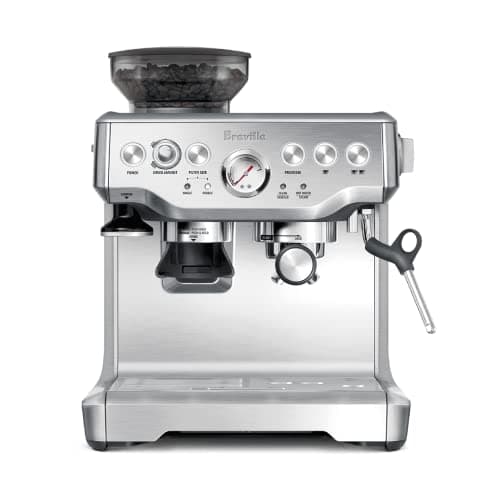
The Breville Barista Express is the machine most people picture when they picture “a home espresso machine.” It is the best-selling all-in-one for a reason: it folds the entire workflow — grind, dose, tamp, brew and steam — into a single stainless body that lives on one stretch of countertop. You put whole beans in the hopper, and it takes you all the way to a real, hand-textured milk drink without a second appliance. For a lot of first-time buyers, that is exactly the promise they are shopping for.
What you are actually buying is a well-integrated bundle of parts. There is a conical burr grinder built into the front of the machine that grinds on demand straight into the portafilter. There is a ThermoCoil heating system that warms up in a few minutes rather than instantly. There is a 54mm portafilter — wider than the cheap 51mm baskets, narrower than a commercial 58mm — and a manual steam wand you control yourself. And there is an analog pressure gauge on the front that reads your extraction as it pulls, so you can actually see when a shot is running too fast or choking. None of these pieces is best-in-class on its own; the point is that they work together, out of one box, on one counter.
The honest limits follow from that integration. ThermoCoil is slower to reach temperature and a touch less thermally stable than the ThermoJet system in the newer Barista Pro— a difference that matters more the pickier you get. The machine is large, because it has a grinder inside it. The built-in grinder is good, but a dedicated espresso grinderis better, and that gap is real if you chase light roasts. And the basket you use — pressurized dual-wall or single-wall — changes how the machine behaves more than most new owners expect. This review compiles Breville's published specs with aggregated owner reports so you know which of those trade-offs you are signing up for. See where it sits against the field in our best espresso machines under $1,000 roundup.
The built-in grinder: convenience vs a dedicated grinder
The single biggest reason people buy the Barista Express is the grinder inside it. It is a conical burr grinder — not a cheap blade unit — and it grinds on demand directly into the portafilter, so you go from whole beans to a dosed basket in seconds with nothing else on the counter. For most drinkers, especially those brewing medium and dark roasts, that grinder is perfectly good, and its convenience is the whole point of the machine. There is real value in never owning, cleaning or finding room for a second appliance.
The honest nuance is that a good dedicatedespresso grinder is better — more consistent, easier to dial across a narrower window, and generally tidier at single-dosing. The gap is small for forgiving roasts and grows the pickier your beans get: very fresh, light-roast single origins are where a built-in grinder starts to feel its limits and a standalone grinder pulls ahead. If you already own a grinder, or you know you will chase light roasts, the built-in grinder is redundant — and a grinderless machine plus one of the picks in our best grinders for espresso roundup is the setup that scales further. If you want one appliance that just works, the built-in grinder is a feature, not a compromise.
ThermoCoil vs ThermoJet (Express vs Pro)
The Barista Express uses Breville's ThermoCoil heating system, and the newer Barista Pro uses ThermoJet. The practical difference is two-fold. First, warm-up: ThermoCoil takes a few minutes to come up to temperature after you switch on, while ThermoJet is effectively ready in seconds — a real quality-of-life gap if you are impatient on a weekday morning. Second, thermal stability: ThermoJet holds brew temperature a little more tightly, which matters more the more demanding your beans and your palate become.
For most people the ThermoCoil warm-up is a minor habit — switch the machine on, let it heat while you weigh beans, and it is ready by the time you are. The stability difference is real but subtle, and the Express has made excellent espresso for years in spite of it. The question is simply whether instant heat-up and slightly tighter temperature are worth the step up in price to the Pro. We break that decision down field-by-field in our Barista Express vs Barista Pro comparison — read it before you choose, because it is the most common cross-shop for this machine.
Baskets: pressurized vs single-wall
This is the setting that quietly decides how good your shots are, and most new owners never think about it. The Barista Express ships with both pressurized (dual-wall) and single-wallbaskets. Pressurized baskets have a tiny restriction that artificially builds pressure, so they produce a thick-looking crema and forgive a bad grind or a sloppy tamp — ideal for your first week, or for pre-ground supermarket coffee. Single-wall baskets have no such crutch: they demand a good, fresh grind dialed to the machine, and reward it with genuinely better-tasting espresso.
The mistake is staying on the pressurized basket forever and concluding the machine is mediocre. The upgrade path is deliberate: start pressurized while you learn the workflow, then switch to single-wall once your grind and technique are dialed — and that is when the built-in grinder and a proper tamper start to matter. If your shots taste thin or sour on the single-wall basket, that is the grinder and dose talking, not a fault in the machine.
Who it's for / alternatives
The Barista Express is for the person who wants one machine that does everything and does not want a separate grinder taking up counter space. If that is you — and it is a lot of first-time buyers — it is close to the default recommendation, which is why it anchors our best espresso machines for beginners guide. It teaches you the whole craft, from grinding to milk texturing, on a single appliance you can grow into.
There are two honest alternatives. If you want instant heat-up and slightly better thermal stability in the same all-in-one form, look at the Barista Pro via our Express vs Pro comparison. If it is consistent dosing and tamping you want rather than speed, the Barista Express Impress adds an assisted puck-prep system to this exact machine — weighed up in our Express vs Impress comparison. If you already own a grinder, or you would rather put your money into a dedicated one, skip the built-in grinder entirely: a compact grinderless machine like the Breville Bambino paired with a proper grinder makes better espresso in less counter space for a similar total spend. Browse the whole category on the espresso machines hub if you are still narrowing down.
What we did not test
We have not run this machine on a bench for months, and we do not claim to have. This review compiles Breville's published specifications for the Barista Express, cross-checks the grinder, heating and portafilter details against Breville's own documentation, and weighs aggregated owner reports against our scoring rubric. The grinder type, ThermoCoil heating, 54mm portafilter, steam wand and pressure gauge come from Breville's materials, listed in Sources. Where hands-on time would tell you more than a spec sheet — exactly how the ThermoCoil holds temperature shot to shot, how the grinder retains over months, how forgiving the steam wand is for an absolute beginner — we say so rather than invent a measurement we did not take.