Skip to content
Portafilter Co

Machines · Espresso Machines

De'Longhi La Specialista Arte Evo vs Breville Barista Express

The two grind-to-portafilter all-in-ones people cross-shop most - both semi-automatic, both with a built-in grinder and a manual steam wand. Here is how the guided De'Longhi and the default Breville actually differ, and who should buy which.

By Stephen V.Updated How we pick
#ad

We earn a commission when you buy through our Amazon links, at no extra cost to you. It never changes a verdict, and we say so when the cheaper product is the better buy. How this works.

If you have narrowed home espresso down to two machines that grind their own beans, pack a real portafilter and steam milk with a proper wand, you are almost certainly cross-shopping these two: the De'Longhi La Specialista Arte Evo and the Breville Barista Express. They are the grind-to-portafilter all-in-ones most people compare, because they answer the same question — one countertop appliance that takes you from whole beans to a real, hand-textured milk drink — in two slightly different ways. Both are semi-automatic, both have a built-in conical burr grinder, both use a genuine portafilter rather than a pod or a capsule, and both make you texture milk by hand with a manual steam wand rather than pressing a button.

The difference is in philosophy. The Arte Evo leans on guidance: sensor grinding meters the dose for you as it grinds, and a Smart Tamping Station presses the puck at a repeatable pressure, so the two steps beginners fumble most — how much to grind and how hard to tamp — are handled with less guesswork. The Barista Express is the category default— the machine that started most home espresso setups — built around a wider 54mm portafilter, dose-control grinding you set yourself, a live pressure gauge on the front, and by far the deepest owner community and accessory ecosystem of any machine in the class. This page compares them on the things that actually change your morning: the grind-and-dose workflow, milk texturing, footprint, how forgiving each is for an outright beginner, and where each one leaves you room to grow. Read it alongside the full De'Longhi La Specialista Arte Evo review and the Breville Barista Express review for the deep dive on each.

On price, treat them as roughly the same money. They sit in a similar bracket, and street prices move enough that chasing the cheaper one on any given week is a losing game — buy on fit, not on a few dollars, because both are machines you keep for years. If you are torn between the two brands more broadly, our Breville vs De'Longhi comparison zooms out to the whole lineup; if you have not settled on a built-in grinder at all, the best espresso machines with a grinder roundup lays out the wider field. We did not lab-test either machine; our scores are judgments from documented research — published specs, decoded manuals and aggregated owner reports — and our methodology explains exactly how.

The short answer

Quick picks

#ProductBest forScorePrice
01
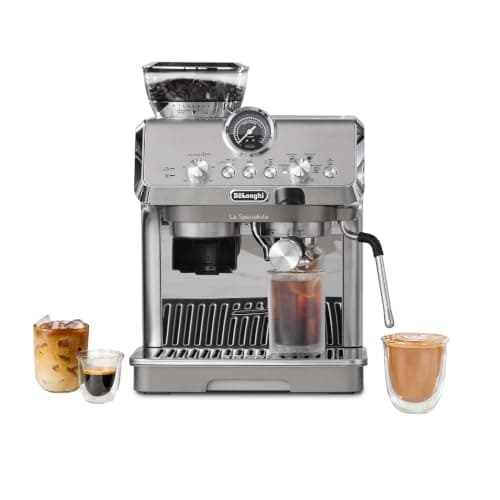
De'Longhi De'Longhi La Specialista Arte Evo (EC9255)
De'Longhi La Specialista Arte Evo (EC9255)

The one to buy if you want the machine to guide you through the parts beginners fumble. The Arte Evo folds the whole grind-dose-tamp-brew-steam sequence into one guided body and leans hard on making dosing and tamping repeatable: sensor grinding meters the dose as it grinds, and the Smart Tamping Station presses the puck at a consistent pressure, so your early shots come out more consistent with less technique. A built-in conical burr grinder feeds the 51mm portafilter, a 15-bar pump runs a real low-pressure pre-infusion, and the commercial-style manual steam wand heats fast and textures milk well. It also does what no Breville in this bracket does - a large 2 L tank and a dedicated cold-brew setting. The honest catch versus the Barista Express is the narrower 51mm group and only eight stepped grind settings, which cap how far you can grow an accessory habit or chase very light roasts.

Best guided grind-to-cup
7.5
$499.95Amazon
02
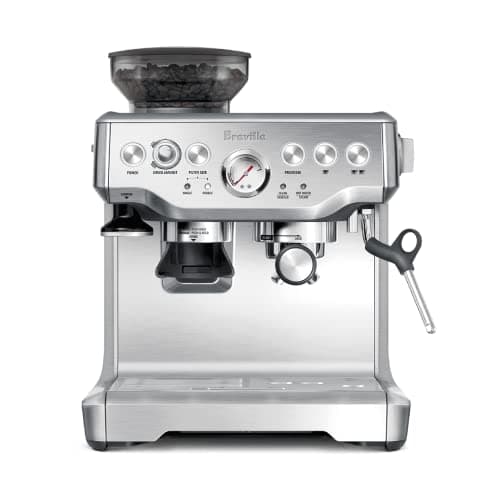
Breville Breville Barista Express (BES870XL)
Breville Barista Express (BES870XL)

The category default, and the safer pick for most first-time buyers. It folds the same grind-dose-tamp-brew-steam workflow into one proven stainless body, but built around a wider 54mm portafilter, dose-control grinding you set yourself, and a front pressure gauge that reads your extraction live so you can see and fix a bad shot as it pulls. Nothing else in the class has as deep an owner community, as much troubleshooting online, or as broad an accessory path - 54mm baskets, bottomless portafilters and tampers are everywhere. It asks a little more of you than the Arte Evo's guided dosing - you set the grind and learn the tamp by hand - and ThermoCoil warms up in a few minutes rather than instantly, but as the one machine that takes the most people from whole beans to a real milk drink, nothing here is this proven.

Best all-in-one for most
8.2
$679.94Amazon

#ad · Live prices from the Amazon Product API, as of Jul 30, 2026. Where we have no verified live price, we show none — a gap beats a number that has rotted.

In detail

The picks, in full

01
De'Longhi De'Longhi La Specialista Arte Evo (EC9255)

Best guided grind-to-cup

De'Longhi La Specialista Arte Evo (EC9255)

51mm portafilterBuilt-in conical burr grinderThermoblock, 1,550 W2 L tank + cold extraction
7.5/10

The one to buy if you want the machine to guide you through the parts beginners fumble. The Arte Evo folds the whole grind-dose-tamp-brew-steam sequence into one guided body and leans hard on making dosing and tamping repeatable: sensor grinding meters the dose as it grinds, and the Smart Tamping Station presses the puck at a consistent pressure, so your early shots come out more consistent with less technique. A built-in conical burr grinder feeds the 51mm portafilter, a 15-bar pump runs a real low-pressure pre-infusion, and the commercial-style manual steam wand heats fast and textures milk well. It also does what no Breville in this bracket does - a large 2 L tank and a dedicated cold-brew setting. The honest catch versus the Barista Express is the narrower 51mm group and only eight stepped grind settings, which cap how far you can grow an accessory habit or chase very light roasts.

Espresso quality
7
Steaming & milk texturing
7
Ease of use
8
Build & reliability
6
All-in-one convenience
9
Value
8

Pros

  • A genuinely complete setup out of the box — built-in conical burr grinder, tamping tools and a manual steam wand, nothing else to buy to start pulling shots
  • Large 2 L water tank means noticeably less refilling than most machines in this bracket
  • Cold Extraction Technology and a dedicated Cold Brew preset (plus Americano and hot water) that the Brevilles simply do not offer
  • Commercial-style manual steam wand heats quickly and teaches real milk texturing you control by hand, rather than an auto-frother
  • Active Temperature Control with three selectable infusion temperatures and a 15-bar pre-infusion, so the guided workflow still gives you levers to dial in

Cons

  • 51mm portafilter — far fewer bottomless portafilters, precision baskets and tampers than 54mm (Breville) or 58mm
  • Thermoblock heating, even with Active Temperature Control, is less thermally stable across back-to-back shots than a PID-managed thermocoil or boiler
  • Only eight stepped grind settings — a narrow range next to the dozens of steps, or stepless adjustment, on a dedicated espresso grinder, so fine dial-in is limited
  • Mostly plastic housing over metal accents, so it does not feel as solid as an all-metal machine at this price
  • Cold Extraction is a genuine novelty but not something most espresso drinkers use daily, and it is part of what you are paying for

Don't buy this if…

you want the widest upgrade path and the deepest owner community to lean on - the Barista Express's 54mm group and huge user base scale further than a 51mm machine with an eight-step grinder.

$499.95View on Amazon

Price as of Jul 30, 2026. Prices change — Amazon's at checkout is the one that counts.

#ad · we may earn a commission from this link to De'Longhi La Specialista Arte Evo (EC9255)

02
Breville Breville Barista Express (BES870XL)

Best all-in-one for most

Breville Barista Express (BES870XL)

Integrated conical burr grinderThermoCoil heating (few-minute warm-up)54mm portafilter, manual steam wandAnalog pressure gauge
8.2/10

The category default, and the safer pick for most first-time buyers. It folds the same grind-dose-tamp-brew-steam workflow into one proven stainless body, but built around a wider 54mm portafilter, dose-control grinding you set yourself, and a front pressure gauge that reads your extraction live so you can see and fix a bad shot as it pulls. Nothing else in the class has as deep an owner community, as much troubleshooting online, or as broad an accessory path - 54mm baskets, bottomless portafilters and tampers are everywhere. It asks a little more of you than the Arte Evo's guided dosing - you set the grind and learn the tamp by hand - and ThermoCoil warms up in a few minutes rather than instantly, but as the one machine that takes the most people from whole beans to a real milk drink, nothing here is this proven.

Espresso quality
8
Steaming & milk texturing
7
Ease of use
9
Build & reliability
8
All-in-one convenience
9
Value
8

Pros

  • Genuinely all-in-one — grinds, doses, tamps, brews and steams from one body
  • Built-in conical burr grinder means no separate grinder or counter space
  • Manual steam wand teaches real milk texturing you control by hand
  • Front pressure gauge gives live feedback so you can see and fix a bad shot
  • 54mm portafilter is a real step up from cheap 51mm pressurized-only setups
  • The most proven, best-supported all-in-one, with abundant owner knowledge online

Cons

  • ThermoCoil warms up in a few minutes rather than instantly
  • Slightly less thermally stable than the ThermoJet in the Barista Pro
  • Large footprint — it is a grinder and a machine in one body
  • Built-in grinder is good but a dedicated espresso grinder is better
  • Pressurized vs single-wall basket choice trips up new owners
  • Manual steam wand has a learning curve if you have never textured milk

Don't buy this if…

you want the machine to guide your dosing and tamping, cold brew on demand, or a bigger water tank - the La Specialista Arte Evo's guided workflow, 2 L tank and Cold Extraction setting fit that buyer better.

$679.94View on Amazon

Price as of Jul 30, 2026. Prices change — Amazon's at checkout is the one that counts.

#ad · we may earn a commission from this link to Breville Barista Express (BES870XL)

Grind and dose: guided metering vs dose control

The clearest split between these two is how they get ground coffee into the basket. The Arte Evo is built to take that decision off your hands. Its sensor grinding meters the dose as it grinds, and the Smart Tamping Stationis a small lever that presses the puck at a consistent pressure every time. Those are exactly the two steps a beginner fumbles most — how much to grind and how hard to tamp — and the Arte Evo turns them into a guided, repeatable routine. The trade is resolution: the grinder offers eight stepped settings, which is plenty to find a workable grind for a bag of medium roast but tight if you like to make small, deliberate adjustments or chase very light single origins.

The Barista Express keeps you more in the loop. Its dose-control grindinglets you set grind size and dose amount and grind straight into the portafilter, but you tamp by hand with the included tamper — a skill you build rather than a station that does it for you. In exchange you get a wider 54mm portafilter and a live pressure gauge on the front that reads the extraction as it pulls, so you can see a shot running too fast or choking and correct it. Neither approach is strictly better: the Arte Evo lowers the skill floor, the Barista Express gives you more hands-on feedback and a little more room to dial in. If a built-in grinder is the whole reason you are shopping, our best espresso machines with a grinder roundup shows where both land against the field.

Milk texturing and the steam wand

Both machines steam milk the real way, with a commercial-style manual wand you control by hand rather than an automatic frother that does it for you. That matters: hand-texturing is a skill, and once you have it you can pour genuine microfoam for a flat white or a cappuccino on either machine. The Arte Evo's wand is a particular strength — it heats quickly and textures milk with enough power to teach good technique, and it is one of the areas where owners tend to rate the machine highly. The Barista Express's wand is capable too, and it is the wand a huge number of home baristas have learned on, but like any manual wand it has a learning curve if you have never stretched milk before. On steaming the two are close: the Arte Evo has a slight edge in raw wand performance, while the Barista Express has the edge in the sheer volume of tutorials and owner advice available for learning it.

Footprint, tank and daily living

Both are large machines, because each has a grinder built into its body — that is the cost of the all-in-one convenience, and neither is a small-counter appliance. Where they diverge is the water tank and the extra tricks. The Arte Evo carries a large 2 L tank, which means noticeably less refilling day to day, and it adds De'Longhi's Cold Extraction Technologywith a dedicated Cold Brew preset alongside Espresso, Americano and Hot Water — cold coffee in minutes rather than an overnight steep, which no Breville in this bracket offers. The Barista Express is more single-minded: it is an espresso machine first and last, without the cold-brew or preset extras, but with a proven, no-surprises design and the analog pressure gauge as its signature feature. If cold coffee is part of your routine or you hate refilling a tank, the Arte Evo's extras are real, everyday wins. If you only care about the espresso and the milk, the Barista Express spends its budget on the fundamentals and the ecosystem rather than the feature list.

Ease for a beginner and the upgrade path

For an outright beginner, the Arte Evo asks less of you on day one: sensor grinding and the Smart Tamping Station mean two of the trickiest variables are handled, so your early shots are more consistent while you learn everything else. The Barista Express meets a beginner differently — it ships with forgiving pressurized baskets that produce a thick crema and tolerate a rough grind while you find your feet, then rewards you with better espresso when you switch to the single-wall baskets and dial in. Both are genuinely beginner-friendly; the Arte Evo lowers the skill floor with guidance, the Barista Express lowers it with forgiving baskets and an enormous body of owner knowledge to lean on.

The upgrade path is where the 51mm-versus-54mmgap becomes the deciding fact. The Arte Evo's 51mm group pulls a perfectly good shot, but the world of bottomless portafilters, precision competition baskets and aftermarket tampers is far narrower for 51mm than for the Barista Express's 54mm. If you suspect you will fall down the espresso rabbit hole — single-dosing, upgraded baskets, a bottomless portafilter to watch your extraction — the wider 54mm group and deeper accessory ecosystem give you more room to grow. If you will never own a second basket, that ceiling is invisible and the Arte Evo's guidance and extras may matter more. Either way, a better dedicated grinder is the single biggest upgrade for both machines down the line; our best coffee grinders for espresso roundup shows what that looks like. For the wider brand picture, the Breville vs De'Longhi comparison walks the two lineups side by side.

What we did not test

We have not run either machine on a bench for months, and we do not claim to have. This comparison compiles De'Longhi's and Breville's published specifications — the sensor grinding, Smart Tamping Station, 51mm portafilter, thermoblock, 2 L tank and Cold Extraction on the Arte Evo; the dose-control grinder, ThermoCoil, 54mm portafilter, manual steam wand and pressure gauge on the Barista Express — and weighs them against aggregated owner reports using our scoring rubric. Where hands-on time would tell you more than a spec sheet — exactly how tightly each holds temperature shot to shot, how the grinders retain over months, how forgiving each steam wand is for an absolute beginner — we say so rather than invent a measurement we did not take. See our methodology for how the scores are built.
How we picked

We did not lab-test this gear

Everyone in this category says they tested twenty machines. We have not pulled shots on every product here, and we say so. What we did instead: compiled the published specifications, cross-checked the manufacturer manuals, computed the running cost (wattage to energy, grams-per-shot to cost-per-cup), weighed aggregated owner reports, and scored each product against a published rubric. The scores are judgments from documented research — not measurements we took, because we do not have a test lab and we will not pretend we do. Where hands-on time would tell you more than a spec sheet, we flag it. Where a number came from someone else's work, we name them in Sources.

Questions

Frequently asked

La Specialista Arte Evo vs Barista Express - which should I buy?
Buy the De'Longhi La Specialista Arte Evo if you want the machine to guide your dosing and tamping, a large 2 L tank and cold brew on demand — it lowers the skill floor for a beginner and does more out of the box. Buy the Breville Barista Express if you want a wider 54mm group, more room to grow with accessories, a live pressure gauge and the deepest owner community in the class. They cost roughly the same, so choose on fit. The full La Specialista Arte Evo review and Barista Express review cover each in depth.
Which is easier for a total beginner?
Both are beginner-friendly, in different ways. The Arte Evo's sensor grinding and Smart Tamping Station handle two of the steps new owners fumble most, so your early shots are more consistent with less technique. The Barista Express ships with forgiving pressurized baskets to learn on and has an enormous library of tutorials and owner advice, so help is never far away. If you want the machine to do more of the thinking, lean Arte Evo; if you want the biggest support community, lean Barista Express.
What size portafilter does each use, and does it matter?
The Arte Evo uses a 51mm portafilter and the Barista Express a 54mm. The shot itself is fine on either. The difference is the upgrade path: 54mm has a much bigger world of bottomless portafilters, precision baskets and aftermarket tampers than 51mm, so the Barista Express scales further if you plan to build an accessory collection. If you will never own a second basket, the 51mm ceiling is invisible. Our best espresso machines with a grinder roundup lays out the wider field.
Which has the better built-in grinder?
Both are real conical burr grinders, not blade units, and both grind on demand into the portafilter. The Arte Evo meters the dose for you with sensor grinding but offers only eight stepped settings, which is tight for very light roasts. The Barista Express uses dose-control grinding you set yourself, with a wider adjustment range. For medium and dark roasts either is perfectly capable; for chasing light single origins, a dedicated standalone grinder beats both, and it is the biggest single upgrade for either machine — see our best grinders for espresso.
Can either machine make cold brew, and which has the bigger tank?
Only the De'Longhi La Specialista Arte Evo makes cold brew in this bracket — its Cold Extraction Technology has a dedicated Cold Brew preset that pulls cold coffee in minutes rather than steeping overnight, alongside Espresso, Americano and Hot Water. The Arte Evo also carries the larger 2 L water tank, so you refill less often. The Barista Express does neither; it is a focused espresso machine without the cold-brew or preset extras. Be honest about how often you would actually use cold brew before you let it decide the purchase.

Keep reading

Receipts

Sources

We do not run a testing lab, and we do not pretend to. Where a measured number came from someone else's work, we name them and link them. Where we could not verify something, we say so on the page rather than quietly leaving it out. Read our full method.