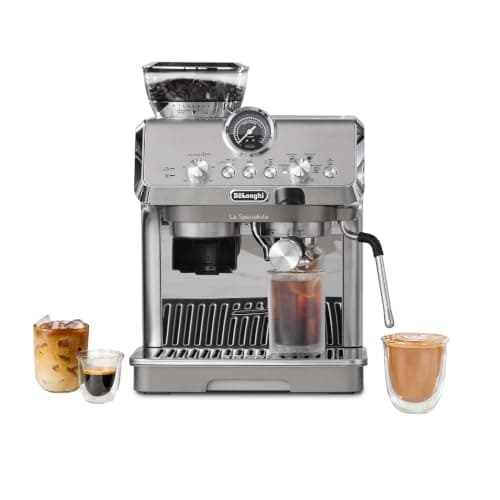
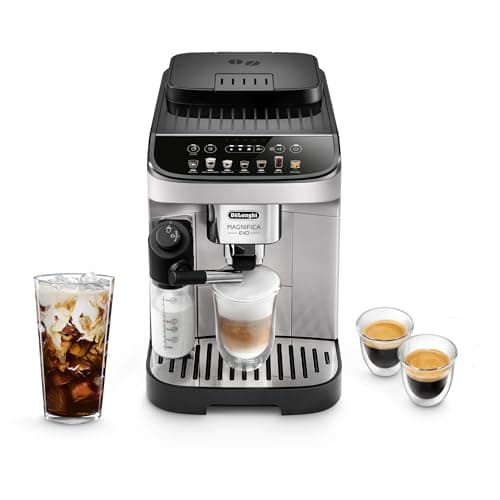
The De'Longhi Magnifica Evo and the La Specialista Arte Evo carry the same badge and roughly the same ambition — good espresso and good milk drinks at home, from whole beans, without a counter full of gadgets — and then they go about it in completely opposite ways. The Magnifica Evo is a super-automatic bean-to-cup: you tip beans into the hopper, press a button, and it grinds, doses, tamps, brews and (on the LatteCrema model here) froths the milk for you, start to finish, behind a sealed door you never open. The La Specialista Arte Evo is a manual portafilter machine that happens to have a grinder built in: it grinds and helps you dose and tamp, but then it hands you the portafilter, the buttons and a real steam wand, and you make the drink. One hides the process; the other lets you run it.
That is the whole decision, and it is not really about which machine is “better” — both are good at what they set out to do. It is about whether you want coffee to be a thing that happens or a thing you do. If your honest morning is a latte before the school run, made by whoever is up first and identical every single time, the super-automatic is built for exactly that. If part of the appeal is locking the portafilter in, watching the pour, steaming your own milk and nudging the grind when the beans change, the guided manual machine is the one that will keep you interested. We make the full one-touch case in our De'Longhi Magnifica Evo review and the hands-on case in our La Specialista Arte Evo review; this page is about choosing between the two.
A few things they share, so we can set them aside. Both are De'Longhi, both include a built-in conical burr grinder — so neither needs a separate grinder to start — and both land in a similar price neighborhood, close enough that cost is not the deciding factor and prices move too much for us to call one “the cheap one”. What actually separates them is control, milk, effort, maintenance, and who else in the house is going to use the thing. Those are the axes below. If you are not sure whether a bean-to-cup or a manual machine suits you at all, our semi-automatic vs super-automatic guide is the wider version of this same question.
Control: one button vs your own two hands
This is the axis everything else hangs off. The Magnifica Evo gives you almost no control on purpose — you set the grind across 13 steps and choose the strength and cup size, and the machine decides the rest behind a sealed brew group you cannot open. That is exactly why it is so consistent: there is no bad shot because there is no shot you are responsible for. The La Specialista Arte Evo hands you the opposite. You dose and tamp into a real 51mm portafilter with the tools it ships with, a 15-bar pump runs a low-pressure pre-infusion before it settles into extraction, and De'Longhi's Active Temperature Control lets you pick between three brew temperatures. You can pull a shot, taste it, and change something — grind, dose, temperature — to make the next one better. On a super-automatic, that feedback loop simply does not exist.
So the honest question is whether you want that loop. If tuning a shot sounds like a chore, it will be one, and the Magnifica removes it entirely. If it sounds like the fun part, the Arte Evo is the only one of the two that offers it — and it is why a guided manual machine can, in a practiced hand, out-cup a super-automatic that costs the same money. Both, incidentally, solve the “do I need a separate grinder” problem by building one in; if a grinder in the box is your main filter, our best espresso machines with a grinder roundup lines up the whole grind-and-brew field, automatic and manual alike.
Milk: an automatic carafe vs a wand you learn
Milk is where the two philosophies feel most different in the cup. The Magnifica Evo reviewed here is the LatteCrema model, which means a sealed carafe draws, heats and textures the milk and pours it into the cup on one touch — and De'Longhi states it handles oat, almond and soy as well as dairy. It is genuinely hands-off: no wand technique, no jug, no purge, and the carafe lifts off into the fridge between drinks. What it does not give you is latte-art microfoam or any way to dial the texture — it makes one good, consistent foam and that is that.
The La Specialista Arte Evo goes the other way with a commercial-style manual steam wand. You froth the milk yourself in a pitcher, which means a learning curve — the first few jugs will not be pretty — but also means you control the texture completely and can pour actual latte art once you have the hang of it. If steaming milk is a skill you want, it is the more rewarding tool; if it is a step you would rather skip forever, it is a chore the Magnifica deletes. Our how to steam milk guide is the starting point if you lean toward the wand.
Effort, maintenance and living with each
Day to day, the Magnifica Evo is the lower-effort machine by a wide margin. It rinses itself on power-up and power-down, packs the spent grounds into a dry puck that drops into a bin you empty every few days, and the LatteCrema carafe runs its own clean cycle. The one genuine limitation is that the brew group is sealed — you cannot pull it out to hand-rinse it the way you can on some machines — so you are trusting the automatic cycles and a periodic descale. The Arte Evo asks more of you: you knock a wet puck out after each shot, wipe and purge the steam wand every time, backflush the group, descale it, and generally keep a manual machine happy. None of it is hard, but it is hands-on, and it is daily.
There is a shared caveat worth stating for both machines: keep oily dark roasts and flavored beans out of either grinder. They gum up the burrs and the chute over time, and that is the single most common way these machines get damaged — medium roasts are the safe default for both. Note too the structural difference in the grinders themselves. The Magnifica's 13 grind steps give slightly finer strength adjustment for its automatic process, while the Arte Evo's 8 stepped settings are aimed at dialing espresso by hand — enough for a bag of medium roast, but tight if you chase very light single origins.
Household fit: who else is going to use it
This is the quiet deciding factor for a lot of buyers. A super-automatic is the right answer for a busy, multi-person household because anyonecan use it — there is nothing to learn, so a partner, a teenager or a guest gets the same latte you do without a lesson, and the machine turns out drink after drink on demand. If mornings are a queue of different orders, the Magnifica Evo just works. The La Specialista Arte Evo is a more personal machine. It rewards one or two people who enjoy making coffee and will build a little muscle memory; it is less friendly to the person who just wants caffeine and does not care how it happens. Be honest about your whole household, not just yourself — a manual machine that only one person can really use can quietly become a source of friction on a rushed weekday.
Which De'Longhi should you buy
- Buy the Magnifica Evo if you want effortless, repeatable milk drinks on one touch, more than one person will use the machine, and you would genuinely rather the espresso process stayed invisible. It is the everyday one-touch machine — the floor is high and the effort is near zero.
- Buy the La Specialista Arte Evo if making the coffee is part of the appeal: you want to pull and taste-tune your own shot, steam your own milk, maybe pour latte art, and you do not mind the daily hands-on upkeep. It is the guided all-in-one that will keep a curious drinker interested for years.
Because both include a grinder and sit at a similar price, you are not really choosing on money or on what is in the box — you are choosing a relationship with your coffee. Effortless and identical, or hands-on and improvable. If you are still torn between the two whole categories rather than these two machines, step back to our semi-automatic vs super-automatic explainer, and browse the grind-and-brew field in best espresso machines with a grinder before you commit. We did not lab-test either machine; our methodology explains how we judge.