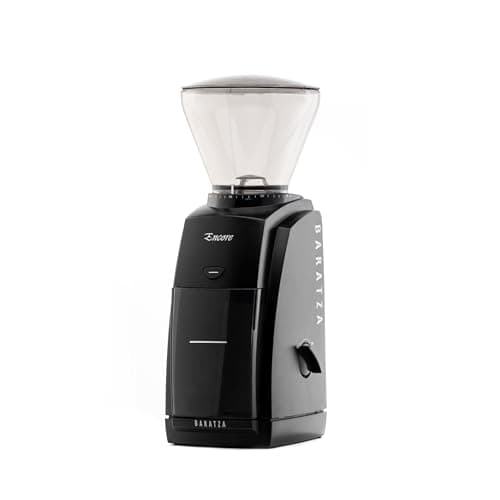
The Baratza Encore is the most recommended home coffee grinder of the last decade, and most of that reputation is earned. For French press, pour over, drip and cold brew it produces grounds uniform enough that the difference from a blade grinder is not subtle — it is the difference between coffee that tastes like coffee and coffee that tastes like sediment. It is built on a steel frame with a geared DC motor, every wear part is replaceable, and Baratza will sell you those parts and talk you through fitting them. There is a reason it has outlasted three generations of competitors.
And it is not an espresso grinder. That sentence is the whole reason this review exists, because the Encore gets recommended for espresso constantly — usually by people repeating a recommendation rather than pulling shots on one. Baratza's published grind range is 250 to 1200 micronsacross 40 stepped settings. Espresso wants the fine end of that and wants it adjustable in increments smaller than the Encore has. Brew Coffee Home, reviewing it hands-on, lists an espresso range of settings 4 to 9, notes it "may work with a pressurized portafilter", and then says directly that it is not fine enough for espresso and lacks the adjustability to dial espresso in. That matches what every honest owner eventually finds: you can get espresso-ish liquid out of it on a pressurized basket, and you cannot dial a real shot.
Baratza knows this, which is why the Encore ESP exists. The ESP is the same body and the same 40mm conical burrs with the 40 settings re-geared so that roughly the first twenty land in espresso territory instead of three of them. If you are here because you own an espresso machine, that is the grinder you want, and our Encore vs Encore ESP comparison lays out the difference setting by setting. If you are here because you own a French press, a V60 or a drip machine, read on — this is still the grinder to beat.
What you actually get
The specification is unglamorous and that is the point. 40mm conical stainless steel burrs, driven by a geared DC motor deliberately geared down so the burrs turn slowly, which keeps heat, noise and static lower than a high-speed grinder. Retailer spec sheets disagree on the exact figure, and we are not going to pretend otherwise: Whole Latte Love lists 450 RPM with an electronic controller adjustable from 405 to 495 RPM, while Brew Coffee Home and 1st-line both cite 550 RPM as the no-load burr speed. Either way it is slow by design, and the practical consequence is that it grinds unhurriedly and the grounds come out cool.
Forty stepped settings on a dial under the hopper, covering 250 to 1200 microns. A 227 g (8 oz) bean hopper and a 142 g (5 oz) grounds bin, both smoked plastic. Roughly 13.7 inches tall, 4.72 wide, 6.3 deep, about 7 pounds, on a steel frame inside a plastic housing. Two controls: an on/off switch and a front pulse button. A thermal cut-off switchthat trips if something hard gets into the burrs — which, if you have ever found a stone in a bag of beans, is a feature you only appreciate once. Baratza covers it with a one-year limited warranty serviced by Baratza directly.
Two things are missing and their absence is deliberate. There is no timer and no dose control— you run it until you have what you want, which in practice means you weigh beans in rather than weighing grounds out. And there is no grind-into-the-portafilter workflow; portafilter clearance is listed at 2.5 inches and a holder is sold separately, but the Encore is built around the bin. If you want dose-by-weight, Baratza's optional Esatto scale accessory does it to a stated ±0.2 g, and the Virtuoso+ is the in-family step up that includes a timer.
How it grinds, honestly
Grind uniformity is where the Encore earns its money, and the honest version of that praise has a boundary on both ends. Brew Coffee Home looked at grounds at settings 12, 15, 20, 28 and 36 and described the consistency as outstanding for the price — that band covers V60, Chemex, drip and French press, which is to say essentially everything the grinder is for. Above setting 35 the same reviewer found chunks and inconsistency, so the very coarsest end for cowboy coffee and some cold brew setups is weaker than the middle. Below the low single digits it cannot go fine enough for Turkish at all, which Baratza does not claim and which we mention because it is the other end of the same ceiling that rules out espresso.
In the middle of the range, where you will actually live, it is excellent and it is repeatable. A numbered stepped dial is an underrated virtue: setting 24 is setting 24 next month, which is what makes dialing in a recipe worth doing. Our French press grind size and moka pot grind size guides both use Encore numbers as a reference point for exactly that reason.
The real daily annoyances are small and worth knowing. It is slow— a direct trade for the low burr speed and the grind quality it buys. Static makes grounds cling to the bin and puffs a little mess when you pull it out, worse in a dry climate or a dry winter. And the grind quality drifts as the burrs load up with oils, so monthly cleaning is maintenance rather than housekeeping; our grinder cleaning guide covers the routine, and the burrs come out without tools, which is the part most grinders get wrong.
The thing nobody else offers
Baratza's repair program is the strongest non-performance argument in home coffee and it does not show up on a spec sheet. Burrs, motor, gearbox, hopper, bin — they are cataloged parts you can order, and owners routinely replace a DC motor or a burr set themselves rather than buying a new grinder. Over a decade that is the difference between one $150 purchase and three of them. It is also why a used Encore is a defensible buy in a way that a used grinder from a brand with no parts channel is not.
Against the obvious alternatives: a good hand grinder at similar money will out-grind it on uniformity and cost you two minutes of cranking per brew, which is a real trade and not a strictly worse one. Going cheaper means the sub-$100 bracket, where you give up either burr size or build. Going up in-family means the Virtuoso+ for a timer and a slightly better burr. And if filter coffee is genuinely all you care about, a flat-burr brew grinder produces more separation and clarity — our best grinders for drip and pour over page ranks that field, and Encore vs Fellow Ode is that comparison in one page.
Where every brew method lands on the dial
These are the setting ranges Brew Coffee Home published from hands-on brewing, not numbers we derived. Treat them as a starting point rather than a recipe — bean density and roast level move the right answer by a setting or two either way.
| Brew method | Encore setting range |
|---|
| Turkish | 1-3 (not fine enough — the reviewer's verdict) |
| Espresso | 4-9 (pressurized basket only; not dialable) |
| Moka pot | 4-12 |
| AeroPress | 8-12 |
| Siphon | 12-29 |
| V60 | 13-18 |
| Pour over (general) | 13-20 |
| Chemex and drip | 18-23 |
| French press | 24-34 |
| Percolator | 24-34 |
| Cold brew | 30-40 |
Look at the shape of that table and the grinder explains itself. The usable, uniform band runs from about 8 to 34, and nine brew methods live inside it. Espresso sits at the very edge with four or five settings available, and Turkish sits past the edge entirely. A grinder that covers nine methods well and one method badly is not a bad grinder; it is a filter grinder, and the mistake is only in how it gets recommended.
Why it cannot do espresso, mechanically
It is worth understanding the reason rather than taking it on faith, because the same logic applies to every grinder you will consider next.
Espresso needs grounds around 200 to 300 microns, and more importantly it needs the ability to move in increments of roughly 10 to 20 microns, because a shot that runs in 20 seconds and a shot that runs in 32 seconds can be one small adjustment apart. Spread 40 steps across a 250-to-1200-micron range and each step is worth something like 24 microns on average — at the coarse end that is irrelevantly fine, and at the espresso end it is a coarse jump that lands you on either side of the window you were aiming for.
That is the whole Encore ESP change. Same burrs, same body, same 40 steps — re-geared so that about half of them fall inside espresso range, which makes each step small enough to actually dial with. It is a gearing decision rather than a grinding-quality one, which is why the ESP is not dramatically more expensive and why the plain Encore cannot be upgraded into it. Our espresso grind size guide covers the window you are aiming for, and do you need a grinder for espresso covers the question underneath it.
Living with it: the three maintenance facts
Clean it monthly, and expect drift if you do not.Coffee oils build up on the burrs and in the chute, and the symptom is not an obvious clog — it is that your usual setting starts producing a coarser, weaker brew. One of the sources we read notes exactly that: grind quality tends to deteriorate over time toward coarser grinds. The ring burr lifts out without tools, and a stiff brush is the whole procedure.
Brush the burrs, never wash them. Steel burrs plus water equals rust, and rusted burrs are a parts order rather than a cleaning problem.
Static is a climate variable, not a defect.Grounds clinging to the bin and a small puff of dust when you pull it out is normal Encore behavior and it is noticeably worse in dry winter air. A drop or two of water on the beans before grinding — the Ross Droplet Technique — is the free fix, and tapping the bin before you lift it out handles most of the rest.
Who should buy something else
Espresso owners: the Encore ESP, without qualification. Our best espresso grinders page covers what comes after it.
Filter purists: a flat-burr brew grinder separates particle sizes more cleanly, which shows up as clarity and sweetness in a light-roast pour over. Encore vs Fellow Ode is that decision in one page.
Budget buyers: the under $100 bracket exists and is honest about what you give up, and a hand grinder at Encore money out-grinds it if you will turn a crank.
Anyone who wants a timer: the Virtuoso+ is the same family with a 40-second timer dial and a slightly more aggressive burr.
What we did not test
We did not bench this grinder. We have no lab and we say so on our methodologypage. Every specification above is Baratza's published figure as listed by retailers, and every observation about grind consistency, setting ranges and espresso capability is attributed to the named hands-on reviewers in Sources. We have not measured particle distribution, retention, noise in decibels, or burr life, and where retailer spec sheets contradict each other — 450 versus 550 RPM, 120 versus 240 watts — we have printed both figures rather than choosing the one that reads better.