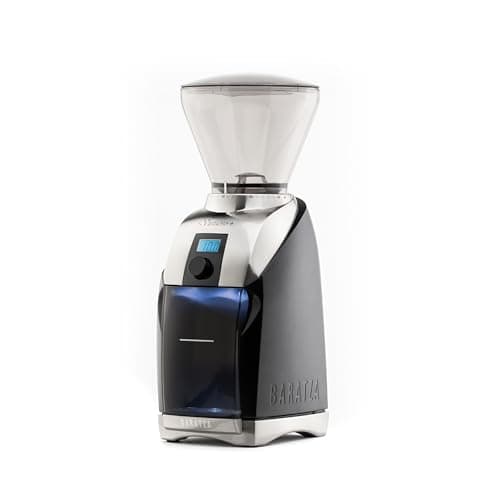
The Baratza Virtuoso+ is one of the best electric grinders you can buy for drip and pour over, and it is important to say that plainly before the caveat arrives, because on this espresso-focused site the honest headline is a split verdict. For filter brewing it is superb: Baratza's precision M2 conical burr grinds a clean, uniform medium grind, the gear-reduced motor turns the burr at a cool 550 RPM, and 40 stepped settings spread across the filter range give you real, fine-grained control over a pour over or a carafe. Add a digital timer you can set to a tenth of a second and you get a grinder that turns “about that much coffee” into a dose you repeat every single morning. If filter is what you brew, it earns its place near the top of our best grinders for drip and pour over roundup.
The honest limit is espresso, and it is baked into the same design that makes it so good at filter. Espresso lives in a hair-thin slice near the fine end of the grind range, and it needs adjustment in very small, closely spaced steps to land a shot between choking and gushing. The Virtuoso+'s steppeddial is tuned for the medium filter range, and its steps get relatively coarse at the fine end — there simply are not many settings down where espresso lives, and each click moves the grind more than a shot wants. You can coax espresso out of it in a pinch, but you will frequently find yourself between two settings, one a touch too fast and the next a touch too slow, with no way to land in between. That is the difference between a grinder that can pull espresso and one that only manages it, and it is exactly why Baratza sells a separate, espresso-tuned model. Our best grinders for espresso roundup ranks the tools that actually clear that bar.
So the buying advice is a fork. If you brew drip and pour over and want a grinder you will keep for years — Baratza's parts-and-repair support is the best in the category — the Virtuoso+ is an excellent, repeatable choice and this review is a recommendation. If espresso is your main brew, this is the wrong grinder, and the right one from the same company is the Baratza Encore ESP, which re-tunes the burr geometry for the fine end and concentrates its steps where espresso lives, or a dedicated espresso grinder. Below we cover exactly where the Virtuoso+ shines, where its stepped dial runs out of room, and who each path is for.
Where the Virtuoso+ shines: filter and drip
Set aside espresso for a moment and the Virtuoso+ is close to a category benchmark. Filter brewing pours water through the coffee bed slowly under gravity, so the grind's job is to present particles that all give up roughly the same flavor in the same three or four minutes. The Virtuoso+'s precision M2 conical burr does exactly that: it produces an even medium grind with few fines, which is the single thing that separates a clean, sweet cup from the flat, harsh one most people accept as normal. The gear-reduced motor holds the burr at a cool 550 RPM, which keeps heat and noise down, and the 40 stepped settings are spread across the filter range so that one click is a real but small change — enough resolution to move a pour over from under- to properly extracted without hopping past the sweet spot. For drip and pour over, this is a grinder that does the important job extremely well, and it sits near the top of our best grinders for drip and pour over list for that reason.
Espresso: the honest limitation
Here is the part that matters most on an espresso site. The Virtuoso+ is only marginally suited to espresso, and the reason is adjustment resolution, not burr quality. Espresso occupies a sliver of the grind range so narrow that a fraction too fine chokes the shot and a fraction too coarse lets it gush — so the number that decides espresso capability is how small a step the adjustment makes near the fine end. The Virtuoso+'s dial is steppedand tuned for the filter range, and its steps run relatively coarse at the fine end: there are few settings where espresso actually lives, and each click moves the grind more than a shot wants. The practical result is that you dial down toward espresso and find yourself stuck between two clicks — one that runs a touch too fast, the next a touch too slow — with no way to land in between. It will pull a shot in a pinch, especially with forgiving medium-roast beans and a pressurized basket, but it fights you, and it will never be the effortless, repeatable espresso tool that a finely stepped or stepless grinder is. If you want to understand exactly what “fine enough” means and why it decides the shot, read how to dial in espresso before you spend.
Virtuoso+ vs Encore ESP: what to buy for espresso
The good news is that the fix comes from the same company. Baratza sells the Encore ESPprecisely because the standard Encore and Virtuoso platforms run too coarse at the fine end for espresso: the ESP re-tunes the burr geometry for the fine range and concentrates roughly 40 closely spaced steps where espresso actually lives, so you can dial a shot without running out of adjustment. If espresso is your main brew, that is the Baratza to buy, not the Virtuoso+ — and it typically costs less. We cover it in full in our Baratza Encore ESP review. The Virtuoso+ is the step-up sibling of the standard filter Encore, and what its premium buys you is the precision M2 burr and the tenth-of-a-second digital timer — both filter upgrades, not espresso ones. Spending up to a Virtuoso+ does not unlock espresso; it refines filter. If you want a genuinely espresso-first grinder at any price, our best grinders for espresso roundup is the page to read.
Who the Virtuoso+ is for
Buy the Virtuoso+ if you brew drip or pour over every day, you want repeatable dosing without reaching for a scale each time, and you value a grinder you can keep for years — Baratza's parts-and-repair support is the best in the category, so this is a grinder you fix rather than replace. It is a superb filter workhorse for a household that lives on a carafe or a careful pour over, and the digital timer is a genuine daily convenience. Do not buy it if espresso is your main brew, or even a serious part of your week: the stepped dial runs coarse where espresso lives, and you will be happier with the Encore ESP or a dedicated espresso grinder. And if you are torn between a filter electric like this and pairing a machine with a separate espresso grinder, our best espresso machines for beginners roundup shows what the machine half of an espresso setup looks like.
What we did not test
We have not run this grinder for months on a bench, and we do not claim to have. This review compiles Baratza's published specifications for the Virtuoso+ — the precision M2 conical burr, the 40 stepped settings, the digital timer adjustable to a tenth of a second, the gear-reduced 550 RPM grinding — cross-checks them against our own drip-grinder research, and weighs aggregated owner reports against our scoring rubric. We do not own a particle analyzer, and any site that implies it measured micron distributions on a kitchen table is not being straight with you. The specification claims come from Baratza's own materials, listed in Sources. Where hands-on time would tell you more than a spec sheet — exactly how the stepped dial behaves at the very edge of the espresso range, how much the grinder retains between doses, or how the timer drifts as beans age — we say so rather than invent a figure. Prices are never quoted from memory; the live price renders from our pipeline with the date it was checked.
How we picked
We did not lab-test this gear
Everyone in this category says they tested twenty machines. We have not pulled shots on every product here, and we say so. What we did instead: compiled the published specifications, cross-checked the manufacturer manuals, computed the running cost (wattage to energy, grams-per-shot to cost-per-cup), weighed aggregated owner reports, and scored each product against a published rubric. The scores are judgments from documented research — not measurements we took, because we do not have a test lab and we will not pretend we do. Where hands-on time would tell you more than a spec sheet, we flag it. Where a number came from someone else's work, we name them in Sources.