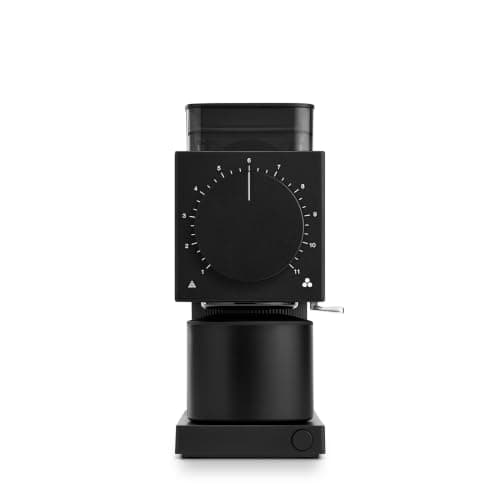
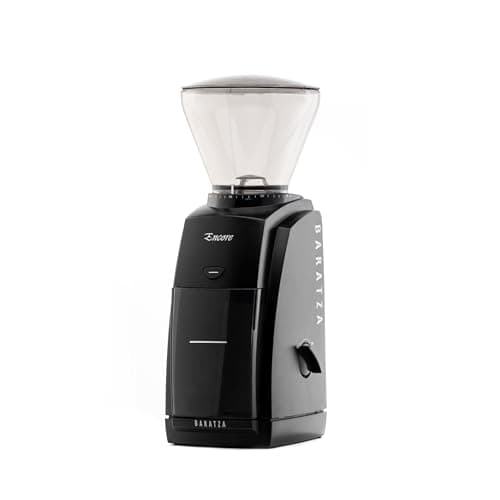
The Baratza Encore and the Fellow Ode Gen 2 are two of the most recommended grinders in home coffee, and they answer the same question — how do I grind good filter coffee at home — from opposite ends of the price range. Both are burr grinders built for brewed coffee: drip, pour over and immersion. Neither is really an espresso grinder, and that is the first thing to be clear about before you spend a cent. If espresso is your goal, both of these are the wrong page, and we will point you somewhere better below.
The Encoreis the affordable 40mm conical workhorse that has taught a generation of people to brew filter. It is cheap, it is hopper-fed, it is endlessly repairable, and it does the one job it was built for — an even medium grind for drip and pour over — well enough that people keep them running for a decade. The Ode Gen 2 is a design-led single-dose brew grinder with 64mm flat burrs, very low retention and a near-silent motor, and it makes the cleanest, most uniform filter grind of the two by a clear margin. It also costs several times as much as the Encore, and Fellow states plainly that it is not intended for espresso.
So this is not a “which is better” fight so much as a “what are you optimizing for” one. Buy the Encore for value, simplicity and a grinder you can fix forever. Buy the Ode for grind quality, low-retention single dosing, quiet and looks. We did not lab-test either grinder; how we reach our scores is set out in our methodology. If espresso even occasionally matters to you, stop here and read the Baratza Encore ESP review instead — that is the espresso-tuned version of this platform, and it is the grinder you actually want.
Where each grinder wins
Line the two up and the split is clean. The Ode Gen 2 wins on the things that show up in the cup and on the counter: it grinds more uniformly, it retains far less coffee between doses, and it is much quieter. The Encore wins on the things that show up in your bank account and over the years you own it: it costs a fraction as much, it is simpler to live with as a fill-and-go hopper, and it is built to be repaired instead of replaced. That is why our overall scores land where they do — the Ode is the better grinder, the Encore is the better value, and which of those matters more is a question only your budget and your standards can answer.
Grind quality and the cup
Both grinders make a genuinely good filter grind — this is not a case of one being good and the other bad. But the Ode's 64mm flat burrs produce a narrower particle distribution than the Encore's 40mm conical set, which in filter brewing shows up as clarity: individual flavors read a little more distinctly, and there are fewer fines to mute the cup. On a carefully brewed pour over, tasted side by side, the difference is real. On a travel mug of drip you are drinking on the way out the door, it is much harder to notice, and the Encore is more than good enough. If you want to understand where filter grinds sit and why uniformity matters, our grind size guide walks through the whole range method by method.
Retention, workflow and noise
This is where the Ode earns most of its premium. It is a single-dose grinder: you weigh in exactly the beans you are about to brew, grind them, and almost nothing stays behind. The Encore is a hoppergrinder that holds beans on top and keeps a little ground coffee in its chamber and chute between grinds, along with some static cling that scatters grounds. For a household brewing the same beans in bulk every morning, the Encore's hopper is actually the easier life — fill it, press the button, walk away. For someone who switches roasts often, chases the freshest possible cup, or just hates cleaning up static, the Ode's low-retention single dosing is worth a lot. It is also far quieter, which is a genuine feature at six in the morning. If low retention is the thing you care about most, it is worth seeing the wider field in our best single dose grinders roundup, where the Ode sits among purpose-built rivals.
Repairability and cost over time
The Encore's quiet superpower is that Baratza built it to be opened. Burrs, motors, gearboxes and switches are all available as spare parts, repair guides are everywhere, and plenty of Encores have been running for ten years or more because their owners replaced a cheap part instead of the whole machine. That is a real part of its value that a spec sheet never shows. The Ode is a more sealed, more design-forward object; it is well built and carries a solid warranty, but it is not a grinder you casually take apart on the kitchen table. If “buy it once, keep it forever, fix it yourself” is your philosophy, the Encore speaks to it more directly.
Neither of these is an espresso grinder
It bears repeating because it is the most common way people buy the wrong grinder. The Ode is designed for brewed coffee only— Fellow says so — and does not grind fine enough to pull espresso at all. The standard Encore can technically reach a fairly fine grind, but its steps get coarse and unruly at the fine end, which is exactly why Baratza sells a separate, espresso-tuned Encore ESP. If there is any chance espresso is in your future, do not buy either of these two and grind coarser for filter — buy a grinder built for the fine end. For filter first, though, both are squarely in their element, and our best grinders for drip and pour over roundup ranks them against the rest of the filter field.
Which one should you buy
- Buy the Baratza Encore if you want the most trustworthy filter grind for the least money, you brew drip or pour over and like a simple fill-and-go hopper, and you value a grinder you can repair and keep for a decade. It is the sensible default, and it is not a compromise so much as a different set of priorities.
- Buy the Fellow Ode Gen 2 ifyou brew pour over and drip deliberately, you want the cleanest cup, the lowest retention and a near-silent grind, and the price does not put you off. It is the better grinder in the cup, and a lovely thing to use every morning — as long as you never need espresso from it.
Plenty of people would be happy with either. If your honest answer is “I mostly make filter, I care about the cup, and I have the budget,” the Ode is worth it. If it is “I want great filter coffee without overthinking or overspending,” the Encore has been the right answer for years and still is.