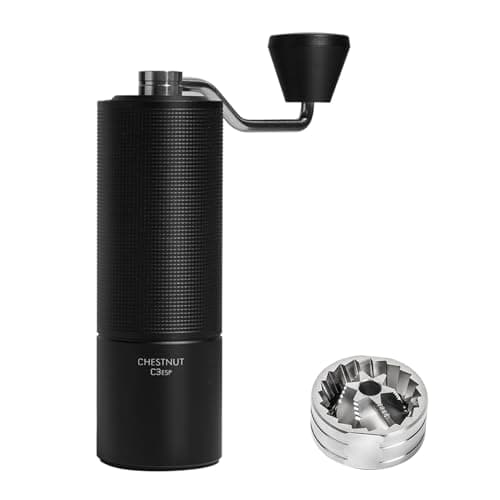
The TIMEMORE Chestnut C3 ESP answers one question better than any other grinder we know: how little can you spend and still make real espresso by hand? The standard Chestnut C3 is a much-loved budget hand grinder, but it was tuned for filter, and its adjustment steps sat too coarse to reliably land in the hair-thin espresso window. The ESP version keeps the same all-metal body and 38mm burrs but re-gears the dial to move in fine, tightly spaced clicks — about 0.023mm each — which is what turns a good filter grinder into a genuine, espresso-capable one. It is, as far as we can find, the cheapest grinder that crosses that line without cutting a corner that matters.
What you are really buying is adjustment resolution, because that — not burr size or brand — is the single thing that decides whether a hand grinder can pull a shot. Espresso extracts across a tiny slice near the fine end of the grind range, where a fraction too fine chokes the shot and a fraction too coarse lets it gush. The C3 ESP's external stepped dial is fine enough to nudge a shot by a hair and stay repeatable, and it does the same trick in reverse for pour-over and French press. Paired with that is a build that has no business being this cheap: an all-metal aluminum body over a dual-bearing axle that keeps the burrs aligned, so the grind stays even and the whole thing survives a backpack.
The honest limits are the ones a small manual grinder always has. It is a hand grinder, so every shot costs you about a minute of cranking, and a fine espresso dose is the hardest, most effortful grind there is. The 38mm burrs are excellent but smaller than the 48mm sets on premium grinders, so they clear a dose more slowly, and the roughly 20-25g single-dose throat means one shot or one cup at a time. And while the stepped dial reaches espresso, the very finest light-roast shots — the ones that want the smallest possible steps — push it to its edge. None of that undoes the headline: for this money, nothing else grinds espresso this well. See where it sits among the field in our best hand grinders roundup, and read it head to head with the premium do-everything pick in our 1Zpresso K-Ultra vs Timemore C3 comparison.
C3 ESP vs the standard Chestnut C3
This is the question that sends most people to this page, and the answer is simple: buy the ESP if you want espresso. The two grinders share the same all-metal body and the same 38mm burr set — the difference is the gearing on the adjustment dial. The standard C3 is tuned for filter, so its steps are spaced too coarsely to reliably hit the fine espresso window; the C3 ESP re-gears the dial into much finer clicks, roughly 0.023mm each, so the espresso range actually has usable settings in it. If you will only ever brew pour-over, drip and French press, the standard C3 is superb and saves you a little money. If espresso is on the menu at all, the ESP is the one to buy — the finer dial is the whole point of the model.
How fine is fine enough for espresso?
Espresso lives in a slice of the grind range so narrow that a stepped grinder's job is to make its clicks small enough to land inside it. The C3 ESP's roughly 0.023mm steps clear that bar: they are fine and closely spaced enough that you can move a shot from gushing to choking in a handful of clicks and settle on a good one in between. The honest nuance is at the extreme fine end. On a forgiving setup, or with medium-roast beans, you will rarely wish for more. On a very demanding non-pressurized basket with fresh, hard, light-roast beans — the beans that want the very smallest possible steps — you can occasionally find yourself between two clicks, one a touch too fast and the next a touch too slow. That is the real ceiling of a value grinder, and it is why enthusiasts chasing the finest light-roast shots eventually move up. It is not a reason for most buyers to spend more before they need to. Our espresso grind size guidewalks through what “fine enough” actually means in the cup.
The trade you are making: burrs, capacity and your arm
The C3 ESP is a small, single-dose tool by nature, and that shapes everything about living with it. The 38mm stainless burrs are well cut and grind evenly, but they are smaller than the 48mm sets on premium grinders, so they take more turns to clear a dose — and a fine espresso grind is the most effortful setting there is. Expect roughly a minute of cranking per shot. The throat holds about 20-25g, which is one espresso dose or one cup's worth of filter at a time, so this is not the grinder for filling a French press for four people or pulling back-to-back shots for a crowd. For a one-or-two-drink household it is a pleasant part of the routine and the small size is a genuine asset; for a busy morning kitchen it becomes real labor, which is the moment an electric or a bigger-burr grinder earns its keep. If you want to see how the C3 ESP compares against the premium all-rounder on exactly these points, our 1Zpresso K-Ultra vs Timemore C3 comparison lays the trade out click by click.
Who it is for
The C3 ESP is the right grinder for someone who wants to make real espresso by hand for the least defensible money — a first espresso grinder, a travel or office grinder, or the quiet, no-outlet partner for a manual or portable espresso maker. It is single-dose by design, so it fits the same buyer who reads our best grinders under $200roundup: value first, no features you will not use, every dollar in the burrs and the dial. It is not the grinder for a household grinding for four before work, and it is not the grinder for chasing the very finest light-roast shots — those buyers should size up.
What we did not test
We have not run this grinder for months on a bench, and we do not claim to have. This review compiles TIMEMORE's published specifications, cross-checks the C3 ESP's burr geometry and step size, and weighs aggregated owner reports against our scoring rubric. The burr size, step spacing and espresso-range claims come from TIMEMORE's own materials, listed in Sources — we do not own a particle analyzer, and any site that implies it measured micron distributions on a kitchen table is not being straight with you. Where hands-on time would tell you more than a spec sheet — exactly how much it retains, how the very finest light-roast shots behave at the edge of its range — we say so rather than invent a figure.
How we picked
We did not lab-test this gear
Everyone in this category says they tested twenty machines. We have not pulled shots on every product here, and we say so. What we did instead: compiled the published specifications, cross-checked the manufacturer manuals, computed the running cost (wattage to energy, grams-per-shot to cost-per-cup), weighed aggregated owner reports, and scored each product against a published rubric. The scores are judgments from documented research — not measurements we took, because we do not have a test lab and we will not pretend we do. Where hands-on time would tell you more than a spec sheet, we flag it. Where a number came from someone else's work, we name them in Sources.