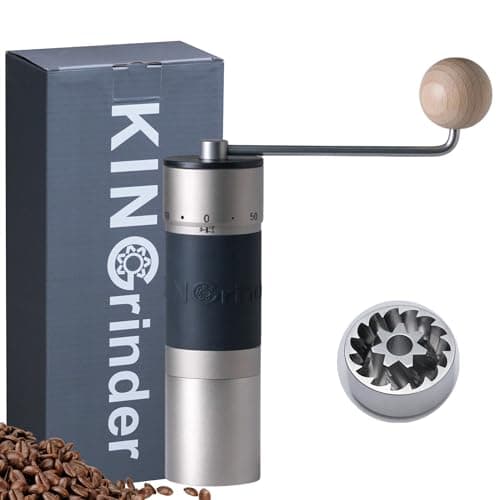
The KINGrinder K6 exists to answer a single, pointed question: how little can you spend and still dial espresso by hand with real precision? Its whole design points at the fine end of the grind range. It pairs a large 48mm heptagonal burr set with an external numbered dial that moves in roughly 16-micron clicks — finer, smaller steps than most hand grinders offer at any price — and it wraps that in an aluminum body at a genuinely budget cost. The result is the most espresso adjustment per dollar we can find in a manual grinder, and the reason it keeps turning up as the value pick whenever the conversation is about pulling shots on a budget. See where it ranks against the rest of the category in our best hand grinders roundup.
What you are really buying is adjustment resolution, because that — not burr diameter or the brand on the body — is the single thing that decides whether a hand grinder can make espresso. Espresso extracts across a hair-thin slice near the fine end of the grind range, where a fraction too fine chokes the shot and a fraction too coarse lets it gush. The K6's 16-micron steps land inside that window and let you nudge a shot by a genuinely small increment, and because the dial is external and numbered, every setting reads straight off the outside of the grinder: espresso lives at a number, French press lives at another, and you return to either exactly. That combination of fine steps and a readable dial is normally the preserve of grinders costing several times as much, which is why the K6 punches so far above its price and slots naturally into our best coffee grinders under $200 shortlist.
The honest catches are the ones a budget grinder always carries, and none of them touches the grind. There is no carry case in the box, so it travels less neatly than the 1Zpresso hand grinders; KINGrinder is a younger, less-established name than 1Zpresso, Timemore or Comandante, with a shorter track record and a thinner parts-and-service network; and the fit and finish are solid rather than jewel-like. It is also a single-dose, hand-cranked tool, so a fine espresso dose is about a minute of real work and one drink at a time. If you want the same espresso-capable idea in the smallest, cheapest possible package, the Timemore C3 ESP is the obvious cross-shop — we lay the two out side by side in our Timemore C3 ESP review. But if the priority is the finest, most readable espresso adjustment your money can buy by hand, the K6 is the one to beat.
Why the external numbered dial matters
On a lot of hand grinders, adjustment happens on an internal ring you turn by counting clicks from a zero point you set yourself. It works, but it turns switching brew methods into arithmetic, and it is easy to lose your place. The K6 moves the whole business to an external numbered dialon the outside of the grinder. Each brew method sits at a number you can see and dial straight to — roughly 16 microns per click across around 240 numbered settings — so “espresso is here, French press is there” becomes a real, written-down instruction rather than a memory game. That is not a cosmetic nicety. The entire point of dialing in espresso is repeatability: you change one variable at a time, taste the result, and move a hair in the right direction, which only works if you can return to your last setting exactly. A numbered external dial makes that loop effortless, and our guide to dialing in espresso walks through why that repeatability is what separates a good shot from a lucky one.
16 microns: is it fine enough for espresso?
Espresso lives in a slice of the grind range so narrow that a stepped grinder's whole job is to make its clicks small enough to land inside it. The K6's roughly 16-micron steps clear that bar comfortably — they are finer than the 1Zpresso K-Ultra's ~20-micron clicks and the Timemore C3 ESP's ~23-micron clicks — so you can move a shot from gushing to choking in a handful of clicks and settle on a good one in between. In practice that means the K6 has more usable settings inside the espresso window than most budget grinders, and even the very finest light-roast shots, which want the smallest possible steps, have room to breathe. It still opens up wide enough for pour-over and French press when you want a different brew — the fine gearing does not lock out the coarse range, you just dial the number up. If you want to see how those steps stack up against electrics and other manuals for pulling shots, our best grinders for espresso roundup ranks the field.
The trade for the price: build, brand and no case
The K6 spends its money where it changes the cup — the burrs and the dial — and saves it everywhere else, which is exactly how a grinder gets this much adjustment for this little. The body is aluminum over a dual ball-bearing shaft, which is the important part: two bearings keep the burrs aligned so the grind stays even, and that is the floor a serious hand grinder has to clear. What you give up is polish and pedigree. There is no travel case in the box, so it packs less neatly than the 1Zpresso grinders that include one; the fit and finish are solid rather than jeweled; and KINGrinder is a newer name than 1Zpresso, Timemore or Comandante, with a shorter track record and a thinner parts-and-service network to lean on if something wears out years down the line. If that pedigree and an included case matter to you, the do-everything all-rounder to weigh it against is the 1Zpresso K-Ultra, which offers both at a clear step up in price. The K6's pitch is simple: the same grind quality, less of the finish.
Who the K6 is for
Buy the K6 if espresso is your main brew, you want the finest, most readable adjustment your money can buy by hand, and you would rather put every dollar into burrs and a dial than into a brand name or a case. It is an ideal first espresso grinder, a quiet no-outlet partner for a manual or portable espresso maker, and a genuinely good travel grinder even without the case. The honest cost is your arm and your patience: it is a single-dose, hand-cranked tool, so a fine espresso dose is about a minute of real work and one drink at a time, which is a pleasant ritual for one or two cups and real labor for a household grinding four before breakfast. That is the moment an electric earns its keep — our hand versus electric guide lays out the trade in full, and if you are still deciding whether a dedicated grinder is worth it at all, do you need a grinder for espresso makes the case.
What we did not test
We have not run this grinder for months on a bench, and we do not claim to have. This review compiles KINGrinder's published specifications for the K6 — the external numbered dial, the roughly 16-micron-per-click adjustment, the 48mm heptagonal burr set, the ~25-30g single-dose capacity — cross-checks them against the K6 entry in our own hand-grinder research, and weighs aggregated owner reports against our scoring rubric. We do not own a particle analyzer, and any site that implies it measured micron distributions on a kitchen table is not being straight with you. The specification claims come from KINGrinder's own materials, listed in Sources. Where hands-on time would tell you more than a spec sheet — exactly how many turns a specific dose takes for your grip, or how the burrs hold their edge after a year of daily use — we say so rather than invent a figure.