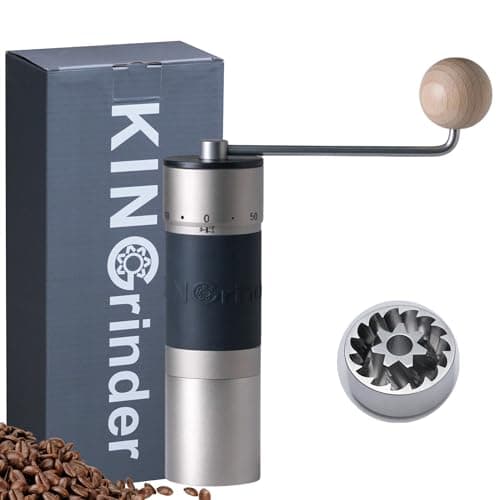
Skip to content
Portafilter Co

Grinders · Coffee Grinders

KINGrinder K6 vs 1Zpresso K-Ultra: is double the price worth it?

The budget hand grinder that out-punches its price against the one most people call the best hand grinder, period. What the extra money actually buys, who should spend it, and the cheaper 1Zpresso that splits the difference.

By Stephen V.Updated How we pick
#ad

We earn a commission when you buy through our Amazon links, at no extra cost to you. It never changes a verdict, and we say so when the cheaper product is the better buy. How this works.

Buy the KINGrinder K6. For the overwhelming majority of people asking this question, it grinds espresso well enough that the difference in the cup between it and the 1Zpresso K-Ultrais smaller than the difference between two bags of beans — and the K-Ultra costs well over double. Spend the difference on coffee. The K-Ultra is the right buy in one specific case: you grind several doses a day by hand, you brew light roasts, and you care about how the grinder feels as much as what it produces. In that case it is genuinely the nicest hand grinder most people will ever own.

Both grinders clear the bar that actually matters. A hand grinder is only an espresso grinder if it adjusts in steps small enough to land inside the narrow espresso window and then holds that setting — and both of these do, with external dials you can read rather than internal collars you have to count blind. Both run 48mm burr sets, which is large for a hand grinder and the reason either one clears an 18g dose without a fight. Neither is a compromise. This is a question about diminishing returns, not about quality.

Where they separate is in the grinding experience and the precision of the adjustment. The K-Ultra's heptagonal burr geometry and tighter bearing setup make the crank noticeably smoother and faster through a dose, and its external numbered dial moves in roughly 20-micron clicks with 100 clicks per rotation — fine enough that you can make a change you can taste without overshooting. The K6 adjusts externally and numerically too, in similar-sized steps, but the mechanism is less refined: slightly more play, slightly more effort, slightly more variance between nominally identical settings. The K-Ultra also ships with a carry case, which sounds like a trinket until you travel with a hand grinder.

There is a third answer that a lot of readers should take, which is why it is on this page: the 1Zpresso X-Ultra. It is the same company's smaller grinder — 40mm burrs, 12.5-micron clicks, a foldable handle — at a price much closer to the K6 than to the K-Ultra. If you want 1Zpresso's dial and feel without paying flagship money, that is the grinder, and it is the one we would recommend to someone who is already over the K6 budget but not sure about going all the way.

The short answer

Quick picks

#ProductBest forScorePrice
01
KINGrinder KINGrinder K6
KINGrinder K6

The value answer and the right buy for most people. An external numbered dial, stainless burrs large enough to clear an espresso dose, and a price that makes the whole category make sense. It grinds espresso properly and repeatably; what it does not do is feel refined doing it. If this is your first espresso-capable hand grinder, there is no better place to put the money.

Best value — buy this one
8.0
$109.00Amazon
02
1Zpresso 1Zpresso K-Ultra Manual Coffee Grinder
1Zpresso K-Ultra Manual Coffee Grinder

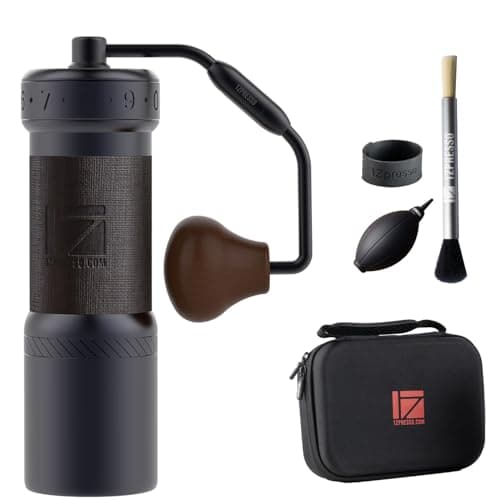
The best hand grinder most people will ever own, and priced accordingly. 48mm heptagonal burrs, an external numbered dial with roughly 20-micron clicks and 100 clicks per rotation, a carry case, and a crank that feels like machined equipment rather than a tool. Worth it if you hand-grind daily, brew light roasts, or simply want the nice thing — not worth it if you are choosing between this and a better machine.

Best grinder, if the budget allows
8.6
$259.00Amazon
03
1Zpresso 1Zpresso X-Ultra Manual Coffee Grinder
1Zpresso X-Ultra Manual Coffee Grinder

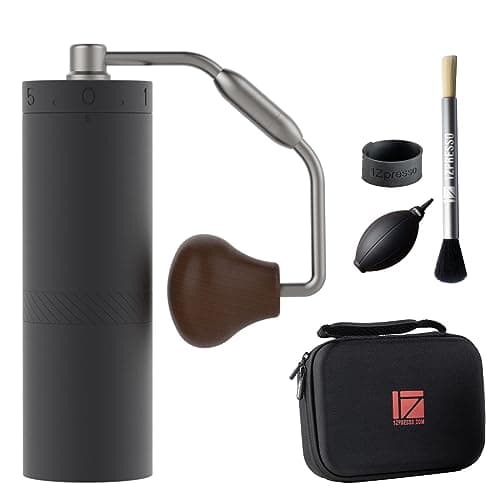
The middle answer, and the one to take if the K6 feels too crude and the K-Ultra too expensive. 40mm heptagonal burrs with the finest adjustment of the three on paper — 12.5 microns per click — in a lighter body with a folding handle. You give up some burr diameter, which costs you a little speed per dose, and you keep 1Zpresso's dial and feel.

Best middle ground
8.4
$159.00Amazon

#ad · Live prices from the Amazon Product API, as of October 5, 2026. Where we have no verified live price, we show none — a gap beats a number that has rotted.

In detail

The picks, in full

01
KINGrinder KINGrinder K6

Best value — buy this one

KINGrinder K6

External numbered dialStainless burrsManual / handEspresso-capable
8.0/10

The value answer and the right buy for most people. An external numbered dial, stainless burrs large enough to clear an espresso dose, and a price that makes the whole category make sense. It grinds espresso properly and repeatably; what it does not do is feel refined doing it. If this is your first espresso-capable hand grinder, there is no better place to put the money.

Espresso grind quality
8
Adjustment precision
8
Grinding feel / effort
6
Build
8
Value
10

Pros

  • Costs a fraction of the K-Ultra for most of the result in the cup
  • External numbered dial — settings are readable, not counted blind
  • Burrs big enough to clear an 18g dose without a struggle
  • Leaves budget for a better machine, a scale, or simply better beans

Cons

  • Crank feel is agricultural next to a 1Zpresso
  • More play in the mechanism, so repeatability is good rather than excellent
  • No carry case, and the handle does not fold

Don't buy this if…

…you grind several doses a day by hand. The extra effort per dose compounds, and that is exactly where the K-Ultra earns its price.

The reason the K6 keeps winning value arguments is that hand grinders remove the most expensive component — the motor — and spend the money on burrs. At this price you are getting a burr set and an adjustment mechanism that an electric grinder could not include for three times as much. The honest limit is the mechanism around the burrs rather than the burrs themselves: it works, it holds a setting, and it does not feel precise while it does so.

If you have not already settled the cheaper end of this question, our K6 vs Timemore C3 ESP comparison is the one below this on the ladder, and the K6 review covers the grinder on its own terms.

$109.00View on Amazon

Price as of October 5, 2026. Prices change — Amazon's at checkout is the one that counts.

#ad · we may earn a commission from this link to KINGrinder K6

02
1Zpresso 1Zpresso K-Ultra Manual Coffee Grinder

Best grinder, if the budget allows

1Zpresso K-Ultra Manual Coffee Grinder

48mm heptagonal stainless burrsExternal numbered dial ~20µm/click100 clicks/rotationCarry case included
8.6/10

The best hand grinder most people will ever own, and priced accordingly. 48mm heptagonal burrs, an external numbered dial with roughly 20-micron clicks and 100 clicks per rotation, a carry case, and a crank that feels like machined equipment rather than a tool. Worth it if you hand-grind daily, brew light roasts, or simply want the nice thing — not worth it if you are choosing between this and a better machine.

Espresso grind quality
9
Adjustment precision
9
Grinding feel / effort
9
Build
9
Value
7

Pros

  • Smoothest, fastest grinding of the three — less effort per dose
  • Dial precision you can actually use: small changes land where you expect
  • Excellent with light roasts, where even particle distribution shows most
  • Carry case and build quality that make it a travel grinder as well as a home one

Cons

  • Well over double the K6 for a difference most palates will find subtle
  • Heavier than the X-Ultra and bulkier in a bag without the case
  • The money might do more good elsewhere in a first setup

Don't buy this if…

…your machine or your basket is the current limit. Fix the weakest link first; a better grinder cannot rescue a pressurized basket.

Where the K-Ultra earns its money is per-dose effort and dial confidence. Grinding 18g at espresso fineness is physical work; the K-Ultra's geometry turns it into noticeably less of it, which matters enormously if you do it twice a morning and not at all if you do it twice a week. The dial is the other half: 100 clicks per rotation at around 20 microns each means a one-click change produces a difference you can taste rather than a jump you have to correct.

Our K-Ultra review covers it alone; 1Zpresso vs Comandante settles the premium-against-premium question, and K-Ultra vs Timemore C3 is the same budget-vs-premium question against the cheaper Timemore.

$259.00View on Amazon

Price as of October 5, 2026. Prices change — Amazon's at checkout is the one that counts.

#ad · we may earn a commission from this link to 1Zpresso K-Ultra Manual Coffee Grinder

03
1Zpresso 1Zpresso X-Ultra Manual Coffee Grinder

Best middle ground

1Zpresso X-Ultra Manual Coffee Grinder

40mm heptagonal stainless burrsExternal dial, 12.5µm/click60 clicks/rotationFoldable handle, ~30g
8.4/10

The middle answer, and the one to take if the K6 feels too crude and the K-Ultra too expensive. 40mm heptagonal burrs with the finest adjustment of the three on paper — 12.5 microns per click — in a lighter body with a folding handle. You give up some burr diameter, which costs you a little speed per dose, and you keep 1Zpresso's dial and feel.

Espresso grind quality
8
Adjustment precision
9
Grinding feel / effort
8
Build
9
Value
8

Pros

  • 1Zpresso adjustment and feel at a price much nearer the K6
  • Finest nominal step size of the three — 12.5 microns per click
  • Folding handle and lighter body make it the best travel grinder here
  • Smaller burrs still clear an 18g espresso dose comfortably

Cons

  • 40mm burrs take a few more turns per dose than 48mm
  • Less headroom if you also grind coarse for a full French press
  • Costs meaningfully more than the K6 for a modest gain in the cup

Don't buy this if…

…you grind large coarse doses for filter as often as you pull espresso. The bigger burrs of the K6 or K-Ultra suit that better.

A note on micron figures, because they are the most misread spec in hand grinders: a smaller number per click is not automatically better. It means finer control and more clicks to travel the same distance. The X-Ultra's 12.5 microns over 60 clicks per rotation and the K-Ultra's 20 microns over 100 clicks per rotation are different ways of achieving control that is more than sufficient for espresso; burr diameter and mechanism rigidity decide more of the result than the step size does.

Our X-Ultra review goes deeper, and X-Ultra vs K-Ultra is the within-family comparison if the K6 is already out of the running.

$159.00View on Amazon

Price as of October 5, 2026. Prices change — Amazon's at checkout is the one that counts.

#ad · we may earn a commission from this link to 1Zpresso X-Ultra Manual Coffee Grinder

The specs, side by side

Every figure below is the manufacturer's published specification for the exact listing linked above. We have not measured particle distributions; we do not have a lab, and our methodology page says so plainly.

KINGrinder K61Zpresso K-Ultra1Zpresso X-Ultra
BurrsStainless conical, 48mm class48mm heptagonal stainless40mm heptagonal stainless
AdjustmentExternal numbered dialExternal numbered, ~20µm/clickExternal, 12.5µm/click
Clicks per rotationNumbered scale10060
Travels with youNo case, fixed handleCarry case includedFolding handle, lightest
Effort per 18g doseHighest of the threeLowest of the threeMiddle
Who it is forMost people, most budgetsDaily hand-grinders, light roastsPeople over the K6 budget, under the K-Ultra

What the extra money actually buys

Three things, in order of how much they will matter to you. First, effort: the K-Ultra moves through a dose with less resistance, and if you grind two or three doses a day that is the single biggest quality-of-life difference on this page. Second, dial confidence: more clicks over the espresso range means a change you intend is a change you get, which shortens dialling in a new bag from several shots to one or two. Third, and last, the cup: there is a real difference in particle uniformity between a premium 48mm heptagonal burr set and a budget one, and it shows most with light roasts and in the clarity of a filter brew. It is the smallest of the three differences, and the one most reviews oversell.

When the K6 is the better buy even if you can afford the K-Ultra

If anything else in your setup is the limit, buy the K6 and fix the limit. A pressurized dual-wall basket caps what any grinder can do — see pressurized vs unpressurized baskets. A machine that cannot hold brew temperature does the same. And if you do not yet own a scale, that is the cheapest upgrade in espresso and it beats a grinder upgrade outright. Spend in the order of what is actually constraining the shot; our complete espresso setup under $500 page lays out that order explicitly.

Which one to buy

Buy the K6 if this is your first espresso-capable grinder, if you pull one or two shots a day, or if the money has anywhere better to go. Buy the K-Ultra if you hand-grind daily, if you brew light roasts and chase clarity, or if you want a grinder that will still feel excellent in ten years. Buy the X-Ultraif you want 1Zpresso's precision and feel in the lightest, most travel-friendly package and 48mm burrs are not worth the premium to you. All three are ranked against the wider field in best hand grinders.

What we did not test

We have not run sieve analyses or laser diffraction on these burr sets, and we are not going to claim grind distributions we did not measure. The specifications here are the manufacturers'; the judgments are ours, formed from published engineering detail, decoded manuals and a large volume of consistent owner reporting about effort, play and repeatability. Where hands-on time would tell you more than any of that — and with hand grinders, feel is exactly that kind of thing — we say so rather than inventing a test.

How we picked

We did not lab-test this gear

Everyone in this category says they tested twenty machines. We have not pulled shots on every product here, and we say so. What we did instead: compiled the published specifications, cross-checked the manufacturer manuals, computed the running cost (wattage to energy, grams-per-shot to cost-per-cup), weighed aggregated owner reports, and scored each product against a published rubric. The scores are judgments from documented research — not measurements we took, because we do not have a test lab and we will not pretend we do. Where hands-on time would tell you more than a spec sheet, we flag it. Where a number came from someone else's work, we name them in Sources.
Questions

Frequently asked

Is the 1Zpresso K-Ultra worth double the KINGrinder K6?
For most people, no. The K6 grinds espresso properly and holds a setting; the K-Ultra grinds more smoothly, adjusts more confidently and feels far better doing it. If you hand-grind daily or brew light roasts, that is worth the money. If you pull a shot or two a day on medium roasts, it is not.
Which has better adjustment, the K6 or the K-Ultra?
The K-Ultra. Both have external numbered dials, which is the important part, but the K-Ultra's 100 clicks per rotation at about 20 microns each have less play, so a single click reliably produces the change you intended. The K6's steps are similar in size but less repeatable in practice.
Can both grinders do espresso properly?
Yes. Both adjust finely enough to sit inside the espresso window and both hold that setting between doses, which is the whole requirement. Neither is a pressurized-basket-only compromise. See best hand grinders for how they rank against the rest of the field.
Should I buy the X-Ultra instead of either?
If you are over the K6 budget but balking at the K-Ultra, yes — it is the most sensible compromise on this page. You give up 8mm of burr diameter, which costs a few extra turns per dose, and keep 1Zpresso's dial precision, build and the folding handle.
How long does an 18g espresso dose take by hand?
Roughly 40-60 seconds on a budget grinder like the K6 and noticeably less on the K-Ultra, depending on the bean and how fine you are grinding. Espresso fineness is the hardest work a hand grinder does; filter grinds are much quicker on all three.
Is a hand grinder good enough for espresso at all, or should I buy an electric?
A good hand grinder out-grinds electrics costing two to three times as much, because the money goes into burrs rather than a motor. The trade is time and effort per dose. Our hand vs electric guide walks through exactly when the trade stops being worth it.

Keep reading

Same gear, other pages

We cover this gear elsewhere too

Receipts

Sources

We do not run a testing lab, and we do not pretend to. Where a measured number came from someone else's work, we name them and link them. Where we could not verify something, we say so on the page rather than quietly leaving it out. Read our full method.