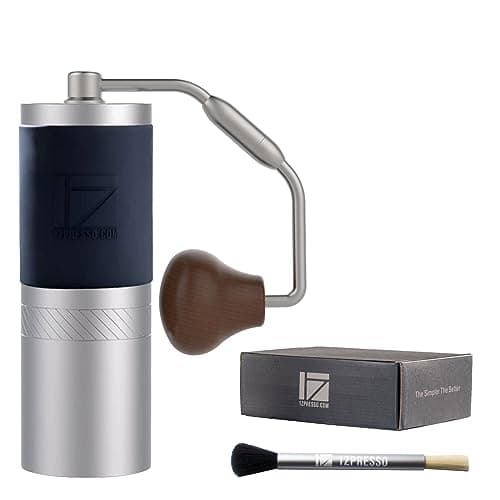
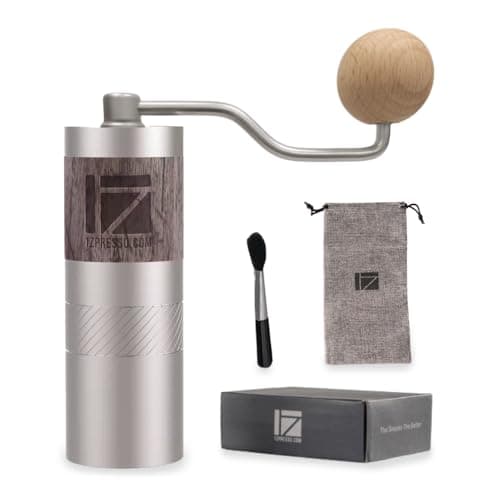
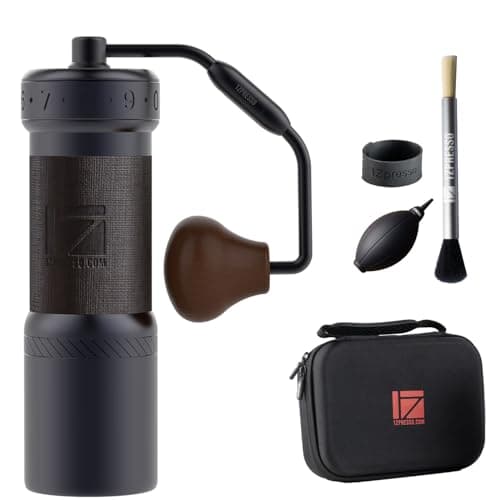
The best 1Zpresso grinder for most people is the K-Ultra — 48mm stainless conical burrs with an external numbered adjustment dial, which is the feature that makes a hand grinder genuinely livable: you read the setting instead of counting clicks blind. If you want the same burrs for less money and do not mind an internal ring, the 1Zpresso J is the value pick and is excellent for espresso. The budget pick is the Q2, which is smaller than a soda can and the right answer for travel, an office drawer or a campsite.
1Zpresso is worth understanding as a range rather than a set of models, because the lineup is unusually logical. Every grinder is a hand grinder — there is no electric in the catalog — and each one is a combination of two choices: the burr set, which determines how fast it grinds and how uniform the output is, and where the adjustment lives, which determines how easily you can repeat a setting. Those two choices account for almost the entire price spread. Nothing in the range is a bad grinder; the question is which combination suits what you brew.
External dial or internal ring is the feature that changes your mornings. Most hand grinders hide the adjustment underneath the burr, inside the body, where you set it by counting clicks from fully closed — and lose the setting the first time you wash it or knock it. An external numbered dial sits on the outside where you can see the number, so "setting 2.4 for this bag" is something you write down and return to exactly. That sounds like convenience and is actually what makes repeatable espresso possible on a hand grinder, because espresso lives in a window a few tens of microns wide and you cannot converge on it if you cannot find your way back.
Burr size buys speed, not just quality. A 48mm burr set shears more coffee per revolution than a 40mm one, so a dose takes fewer turns and less effort — and because each particle passes through the gap fewer times, the output tends to be slightly more uniform. On a hand grinder the effort difference matters more than the uniformity difference, especially at espresso fineness, which is by far the hardest grind to turn. This is the main thing you buy by spending more on a manual grinder.
Why a hand grinder at all. Because a manual grinder spends almost its entire price on the burr set and the shaft that holds it steady — there is no motor, no gearbox, no timer and no hopper to pay for first. The practical consequence is that a $100 hand grinder out-grinds a $100 electric and keeps out-grinding electrics well past $150. It also has effectively zero retention, because there is nowhere for grounds to hide, so a grind change lands on the very next dose. The cost is labor. Hand vs electric grinders has the full trade, and best hand grinders ranks 1Zpresso against the other manual brands.
A note on the X-Ultra. 1Zpresso also makes the X-Ultra, a 40mm heptagonal burr grinder with an external dial at roughly 12.5 microns per click — the finest resolution in the range. It is a genuinely good grinder and we have a full X-Ultra review, but its listing currently shows no buyable offer in our price layer, so it is not given a buy row on this page. If that changes it belongs in the ranking; X-Ultra vs K-Ultra is the comparison to read if you find one.
Choose by the dial, then by the burr size. If you run more than one coffee or switch between espresso and filter, buy the external dial — the K-Ultra. If you brew one way, the internal ring on the J gives you the same 48mm burrs for less. If the grinder has to travel, the Q2 is the only one in the range that genuinely packs small, and you accept more turns per dose for it.
How 1Zpresso compares with the other manual brands. Timemore competes at the cheap end, where the Chestnut C3 ESP is the espresso-geared rival to the Q2 and the J. KINGrinder competes hard on specs per dollar, with the K6 offering 48mm burrs and finer steps than the J for less money. Comandante sits above the whole category on build and resale. All three comparisons are on the site: K-Ultra vs Timemore C3, KINGrinder K6 vs K-Ultra and 1Zpresso vs Comandante.
What grind setting to start from. 1Zpresso publishes a grind-setting reference per model and per brew method, and it is the fastest way to a usable starting point — then adjust by taste. For espresso, start at the fine end of their espresso range and work coarser until the shot time lands where you want it. Our how to dial in espresso guide is the routine, and there is a grind-size page per brew method: AeroPress, French press and moka pot.
The honest ceiling of a hand grinder. Effort, not quality. Grind quality at this price is better than any electric you can buy for the same money. But a fine espresso dose is close to a minute of hard cranking, and if your household makes three or four milk drinks before work, the grinder quietly stops getting used and a bag of pre-ground appears on the counter. Be truthful about volume before you buy — best electric espresso grinders under $500 is the honest alternative at that volume.
Keep the burrs clean. All three grinders here come apart far enough to brush out, and a build-up of coffee oils on a burr set changes the grind before it obviously looks dirty. How to clean a coffee grinder is the routine; on a hand grinder it takes about five minutes.
How we picked
We did not lab-test this gear
Everyone in this category says they tested twenty machines. We have not pulled shots on every product here, and we say so. What we did instead: compiled the published specifications, cross-checked the manufacturer manuals, computed the running cost (wattage to energy, grams-per-shot to cost-per-cup), weighed aggregated owner reports, and scored each product against a published rubric. The scores are judgments from documented research — not measurements we took, because we do not have a test lab and we will not pretend we do. Where hands-on time would tell you more than a spec sheet, we flag it. Where a number came from someone else's work, we name them in Sources.