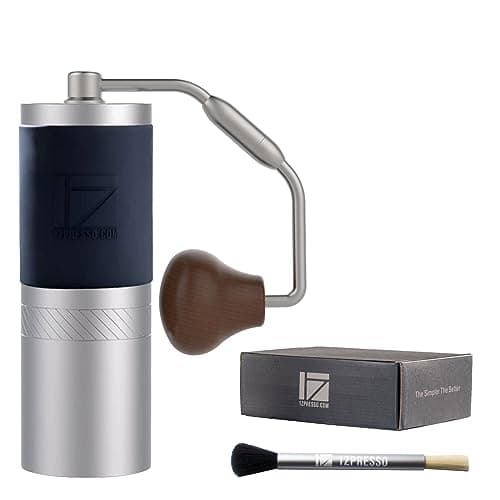
There is a straightforward way to think about the 1Zpresso J, and it saves a lot of reading: it is a K-Ultra that spent its adjustment budget on nothing. Both grinders turn 48mm stainless conical burrs. Both are built from 304 stainless steel and aluminum alloy. Both come from a company whose grinders have, for several years now, been the default recommendation at their respective prices. The difference is that the K-Ultra puts its grind adjustment on an external numbered dial you can turn with the grinder assembled and full of beans, and the J puts it on a ring inside the burr chamber that you reach by taking the grinder apart.
That one decision is worth real money — the J consistently sells well below the K-Ultra — and it costs nothing at all if you brew filter coffee. A pour-over setting is a setting you find once and leave alone for a bag of beans. It costs a great deal if you pull espresso, where finding the right grind is an iterative loop of grind, brew, taste, adjust, repeat, and where “adjust” on a J means emptying the chamber and separating the body. That is the whole review. The rest is detail, and the detail is good.
We should say plainly what this is: a desk review built from 1Zpresso's published specifications and the hands-on accounts of reviewers we name in Sources. We have no lab, we have not measured this grinder's particle distribution, and our methodology page says so in those words. Where the published figures and retailer listings disagree, we print both.
What you actually get
48mm conical burrsin stainless steel. That number is the single most important specification on the page, because burr diameter is most of what decides how fast a hand grinder gets through a dose and how cleanly it cuts rather than crushes. Most grinders at the J's price run 38mm or 40mm burrs; 48mm is what you normally pay premium money for, and it is the same diameter 1Zpresso fits to the K-Ultra and the J-Ultra above it.
An internal adjustment ring, 30 clicks per rotation, roughly 25 microns per click.1Zpresso's own product page confirms the 30-click rotation and does not publish a micron figure; the 25-micron-per-click number comes from 1Zpresso's published grind-setting reference and from The Coffee Folk's comparison of the range, which also puts the J's total usable travel at around 120 settings. Twenty-five microns is a fine step by filter standards and a coarse one by espresso standards, which is the mechanical version of the same point the lead makes.
30 to 35 grams of capacity, which is the J's quiet superpower and the reason it beats more expensive grinders for some people. A 35-gram chamber is a full Chemex, a generous V60, or most of a French press in a single grind. Grinders built around espresso tend to cap out around 20 to 25 grams, so a batch brewer on one of those grinds twice.
705 grams on the scale, measuring 17 × 18.5 × 5.7 cm with the handle attached, in a body of 304 stainless steel, aluminum alloy and wood. It is a heavy object for a hand grinder and it feels like one. 1Zpresso lists a foldable handle and tool-free disassembly for cleaning, rates the grinder to 200 kg of coffee over its life, and covers it with a one-year limited warranty. The box contains the grinder and a cleaning brush; the carrying case and the cylinder case that 1Zpresso sells for it are paid add-ons, not inclusions, which is a small thing that catches people out when they compare the J against a K-Ultra that ships with its case.
How it grinds
Well, and quickly, and that is not a surprise given the burrs. The reviewers we read consistently place the J in the tier of hand grinders that produce filter grounds uniform enough to compete with electric grinders costing two or three times as much, and the mechanism behind that is not mysterious: a larger conical burr set presents more cutting edge per rotation, so each bean spends less time being pushed around before it exits at the size you asked for. Fewer boulders, fewer fines, less of the muddiness that makes cheap-grinder coffee taste simultaneously thin and bitter.
The practical consequence of 48mm burrs that people notice first is speed. A hand grinder is a hand grinder and you are still turning a crank, but the J gets through a 20-gram filter dose considerably faster than a 38mm grinder will, and the gap widens as the dose grows. Grinding 35 grams for a Chemex on a small-burr grinder is a genuine chore. On the J it is a short one.
The Coffee Folk calls the J the best 1Zpresso for manual brewing, and notes that its range does technically cover everything “from espresso to French press” while the 25-micron steps leave only a narrow window for dialing a shot in. That is a fair and careful way to put it, and it matches the shape of every other account we found. The J can reach espresso fineness. Reaching a grind size is not the same as being able to navigate around it.
The internal ring, and why it decides everything
An external dial and an internal ring do exactly the same job. They differ in how much ceremony stands between you and a change of mind.
On the J, changing grind size means unscrewing the catch cup, parting the grinder, turning a numbered ring that sits against the burr, and reassembling. Thirty seconds, maybe, once you have the motion — and it is thirty seconds you are doing with a burr chamber that may still have grounds in it. Once a month for a new bag of filter coffee, this is irrelevant. Four times in ten minutes while you chase a 27-second shot, it is the reason people sell grinders.
The ring is numbered, which matters more than it sounds: it means a setting is recordable and repeatable. Write down “J, 48” for your V60 and you can return to it exactly, next month or next year. That is the thing a stepless grinder with no markings cannot give you, and it is why we are comfortable calling the J a precise grinder with an inconvenient interface rather than an imprecise one.
So the buying rule is unusually clean. If you brew pour over, drip, French press, AeroPress or cold brew — and especially if you brew them in batch sizes — the J gives you flagship burrs and flagship capacity at a mid-range price, and the compromise lands somewhere you will never stand. If espresso is in the picture now or plausibly within a year, buy the K-Ultra instead and treat the difference as the price of an interface you will use every single morning. Our 1Zpresso J vs K-Ultra comparison works through that decision side by side.
Where it sits against the field
Against its own family: the X-Ultrais the cheaper external-dial option with smaller burrs, the K-Ultra is the external-dial version of the J's burr set, and the J-Ultra sits above both with a finer-stepped axle. If what you want is the external dial, 1Zpresso will sell you one at three price points.
Against the obvious rivals: the Comandante C40 is the heirloom answer and costs considerably more for a smaller burr and a nicer object. The KINGrinder K6 undercuts the J with an external dial and espresso-friendly stepping, which makes it the direct counter-argument if the dial is what you care about. And at the bottom of the market the Timemore C3 ESP does espresso stepping on 38mm burrs for a fraction of the money, slower and less uniformly.
Against electrics: this is the comparison people skip, and it is the one that makes the J look best. At the J's price an electric grinder buys you a motor, a housing and a 40mm burr. The J buys you a 48mm burr and nothing else. If you brew one or two cups of filter coffee a day and do not mind a minute of cranking, the cup is better on the hand grinder. Our hand versus electric grinder guide takes that trade apart properly.
Internal versus external adjustment, in practice
This is the only specification on a hand grinder that changes your morning, so it is worth being concrete about what each one feels like.
| Task | External dial (K-Ultra, X-Ultra, K6) | Internal ring (1Zpresso J) |
|---|
| Change grind for a new bag of filter coffee | Turn the dial, note the number | Empty, part the grinder, turn the ring, reassemble |
| Dial in an espresso shot (3-6 changes) | Seconds per change, grinder stays together | A disassembly per change |
| Switch between espresso and pour over daily | Practical | Not realistically practical |
| Return to a known setting months later | Numbered, exact | Numbered, exact |
| Hand the grinder to a houseguest | Fine | Expect to be called |
Read down the right-hand column and the pattern is clear: every row the internal ring loses is a row about changing the setting often. None of them is about grind quality, because the ring does not affect grind quality. A single-method filter brewer touches one row in that table once a month. An espresso drinker touches two of them every day.
Where the clicks land, by brew method
These are starting points derived from 1Zpresso's published grind-setting reference and the roughly 25-micron-per-click step size, not settings we measured in a cup. Bean density and roast level move the right answer by a few clicks either way, and you should expect to adjust by taste.
| Brew method | Rough position on the J's range |
|---|
| Espresso | The fine end — reachable, but only a few clicks of usable window |
| Moka pot | Just coarser than the espresso window |
| AeroPress | Fine to medium, depending on your steep time |
| V60 and pour over | Medium — the grinder's sweet spot |
| Chemex and drip | Medium to medium-coarse |
| French press | Coarse |
| Cold brew | The coarse end |
We have given positions rather than click numbers deliberately. Published click recommendations for 1Zpresso grinders vary between sources and between burr batches, and a number we did not verify in a cup would be a number pretending to be a measurement. Find your V60 setting by taste, write it on a label, and work outward from it — our espresso grind size guide and French press grind size guide explain which direction to move and why.
The capacity argument nobody makes
Hand-grinder reviews are written almost entirely by and for espresso drinkers, which is why capacity barely gets mentioned. It deserves better, because 30 to 35 grams is a genuinely differentiating number.
A single V60 is 15 to 22 grams of coffee. A Chemex for two is 40 to 50. A full 8-cup French press is around 55. Grinders designed around espresso cap out near 20 to 25 grams because a double shot is 18, so a batch brewer on one of those is grinding twice, with a chamber swap in the middle, every morning. The J's chamber handles a V60, an AeroPress, a moka pot and a small press in one pass.
That is the case for buying a J over a K-Ultra even if you can afford the K-Ultra: more capacity, same burrs, less money, as long as you are honest that espresso is not coming. Our best hand grinders roundup ranks the whole field with that trade in mind.
Living with it
Cleaning is tool-free, which is the point of a conical hand grinder. 1Zpresso states tool-free disassembly, and the practical routine is a brush through the burrs and chute when grind quality starts drifting coarser at a setting that used to work. Brush, never wash — steel burrs and water make rust, and rusted burrs are a parts order rather than a cleaning job. Our grinder cleaning guide has the full procedure.
The internal ring is a reason to be disciplined about notes.Because changing the setting is a chore, the J rewards writing settings down more than an external-dial grinder does. A strip of tape on the body with your two or three regular numbers on it removes most of the grinder's daily friction.
705 grams is a travel decision. The handle folds, which helps, but this is not a grinder that disappears into hand luggage the way a 38mm grinder does. If packing weight is the brief, the 1Zpresso Q2is the same company's answer to that question.
What we did not test
We did not bench this grinder. The 48mm burr diameter, 30-click rotation, 30-35 g capacity, 705 g weight, 17 × 18.5 × 5.7 cm dimensions, material list, foldable handle, tool-free disassembly, 200 kg rating and one-year warranty are all 1Zpresso's published figures. The roughly 25-micron step size and the ~120-setting total travel come from 1Zpresso's grind-setting reference and The Coffee Folk's published comparison. We have not measured particle distribution, retention, grind times in seconds, or burr life, and we have not pulled espresso on this grinder. Where a retailer listing contradicts 1Zpresso's own page — box contents are the usual culprit — we have gone with the manufacturer and said so.