Skip to content
Portafilter Co

Grinders · Coffee Grinders

Comandante C40 MK4 Nitro Blade review: reference-grade filter grinding by hand

The C40 is the hand grinder other hand grinders get measured against. Here is why its filter grind is worth the premium, why the stock stepping is coarse for espresso, and how the optional Red Clix axle changes that.

By Stephen V.Updated How we pick
#ad

We earn a commission when you buy through our Amazon links, at no extra cost to you. It never changes a verdict, and we say so when the cheaper product is the better buy. How this works.

The Comandante C40 MK4 Nitro Blade is the hand grinder that other hand grinders get compared to. It is a premium, German-made manual grinder built around a conical burr set Comandante calls the Nitro Blade— a high-alloyed, high-nitrogen martensitic stainless steel with a fine micro-crystal structure — and for years it has been the default answer when someone asks what the best filter grind you can get by hand actually is. If you brew pour-over, drip or French press and you care about clarity in the cup, this is the grinder the rest of the field is measured against.

What you are paying for is grind quality and the build that delivers it. The Nitro Blade burrs produce a strikingly even filter grind with very few fines, which is what gives a pour-over its clean, articulate flavour, and the whole grinder is engineered to a standard that feels closer to a tool than a gadget: a BPA-free Eastman Tritan frame, an oak knob, tight tolerances, and two 40g bean jars in the box. It is compact, it is quiet in the way only a hand grinder is, and it is the kind of object people keep for a decade. Against the wider field of manual options in our best hand grinders roundup, the C40 is the one that sets the ceiling for brewed coffee.

Here is the honest part, and it is the thing most buyers need to hear before they spend the money. The C40 is a filter grinder first. It cangrind for espresso — plenty of people pull good shots with one — but the stock adjustment steps are relatively coarse for espresso, where the difference between a sour, gushing shot and a balanced one can live between two clicks. Comandante's own answer to this is the optional Red Clix RX35 axle, which roughly halves the step size and gives you an extra setting between each standard click, making the fine espresso window far easier to land. If espresso is your main brew, factor that accessory in, and read our best grinders for espressoto see whether a purpose-built espresso grinder serves you better. And because the C40 sits at the top of the price ladder, the value question against cheaper hand grinders is real — we take it head-on in our 1Zpresso K-Ultra vs Comandante comparison.

01
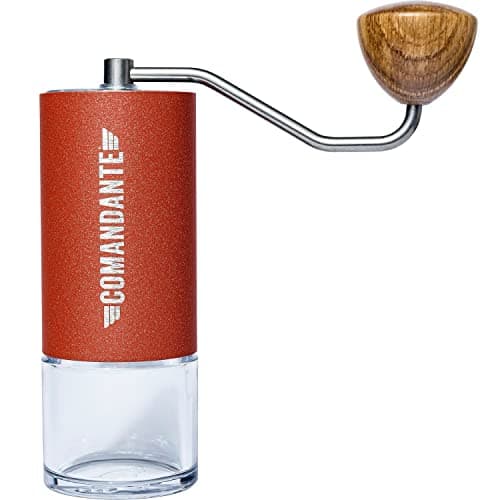
Comandante Comandante C40 MK4 Nitro Blade Hand Grinder

Best hand grinder for filter coffee

Comandante C40 MK4 Nitro Blade Hand Grinder

Conical Nitro Blade high-nitrogen steel burrsStepped click adjustment (~30 microns per click)Two 40g bean jars, Eastman Tritan (BPA-free) frameOptional Red Clix RX35 axle for finer espresso steps
8.2/10

The reference hand grinder for filter coffee, and it earns the reputation. The Nitro Blade high-nitrogen steel conical burrs produce an exceptionally even filter grind with few fines, which is exactly what pour-over, drip and French press reward, and the German build — Eastman Tritan frame, oak knob, tight tolerances, two 40g bean jars — is built to outlive most machines on your counter. Be clear-eyed on two things before you buy. First, espresso: the C40 can do it, but the stock stepping is coarse for the fine espresso window, and the honest fix is the optional Red Clix RX35 axle that roughly halves the step size. Second, price: this is premium money, and cheaper 1Zpresso and Timemore grinders deliver 90 percent of the result for much less. Buy the C40 for a reference-grade filter grind and a grinder for life; do not buy it as an espresso-first tool at stock, and do not buy it if the value math against the challengers matters more to you than the last few percent of grind quality.

Filter grind quality
10
Grind consistency
9
Build & materials
9
Espresso capability
7
Ergonomics & portability
8
Value
6

Pros

  • Reference-grade filter grind — the Nitro Blade burrs are exceptionally even with very few fines, which is what pour-over and drip clarity depend on
  • Superb German build: BPA-free Eastman Tritan frame, oak knob, tight tolerances and a grinder that holds its setting for years
  • Compact, quiet and travel-friendly — a genuinely portable grinder that outperforms most electrics for brewed coffee
  • Two 40g bean jars in the box (glass and polymer) make single-dosing and dosing straight into a brewer easy
  • Capable across the whole brew range, from coarse French press down to espresso, especially once fitted with the Red Clix axle

Cons

  • Stock adjustment steps are relatively coarse for espresso — the fine window can fall between two clicks without the optional Red Clix axle
  • Premium price: cheaper 1Zpresso and Timemore hand grinders deliver most of the result for meaningfully less money
  • Getting the best espresso experience means buying the Red Clix RX35 axle on top — an extra spend the marketing does not lead with
  • Manual grinding takes effort and time, especially at fine espresso settings and for larger doses
  • 40g jar capacity means batch brewing for several cups is a multi-fill, multi-crank exercise
  • Comandante does not publish an exact burr diameter, so you are buying on reputation and results rather than a headline spec

Don't buy this if…

espresso is your main brew and you want it dialled in easily at the price you paid — a stock C40 asks you to work within coarse steps, and a dedicated espresso grinder or a cheaper hand grinder with tighter espresso stepping will get you there with less fuss. Skip it too if the value math against a 1Zpresso or Timemore matters more to you than the last few percent of filter grind quality.

In daily use the C40 does one thing better than almost anything else you can buy at any price: it grinds a filter coffee that tastes clean and defined. The Nitro Blade burrs cut rather than crush, and the result is a narrow particle distribution with few of the fines that muddy a cup and clog a paper filter. On a pour-overthe difference shows up as separation and clarity — you taste more of what a good bean is doing — and on a French press the coarse grind stays coarse instead of shedding silt into the bottom of your mug. For brewed coffee this is as good as hand grinding gets.

The espresso story is more nuanced, and it is where honest advice matters. The C40 will grind fine enough for espresso, and the burrs are more than capable of the job — but the stock drivetrain moves in relatively large steps, roughly 30 microns per click, and espresso lives in a window so tight that one click can be the whole difference. That is what people mean when they say the stock C40 is "coarse for espresso." The fix is Comandante's own Red Clix RX35 axle, which roughly halves the step to around 15 microns and adds a setting between each standard click, so you can actually creep up on the shot instead of jumping past it. If you brew both, the C40 with a Red Clix is a genuinely versatile one-grinder setup; if you brew espresso only, weigh it against the field in our best grinders for espresso before you commit.

$299.00View on Amazon

Price as of Jul 30, 2026. Prices change — Amazon's at checkout is the one that counts.

#ad · we may earn a commission from this link to Comandante C40 MK4 Nitro Blade Hand Grinder

Why the Nitro Blade burrs matter for filter

The heart of the C40 is its burr set. Comandante makes the Nitro Blade from a high-alloyed, high-nitrogen martensitic stainless steel — a hard, corrosion-resistant material with a fine micro-crystal structure that lets the cutting edges stay sharp and precise. In plain terms, sharper, better-defined edges shear beans more cleanly and produce fewer fines, and fewer fines is the single biggest lever on filter-coffee clarity. That is why the C40 has the reputation it does for pour-over and drip: it is not marketing, it is the burr geometry doing exactly what a filter brewer wants. If you want to understand how grind size steers the cup, our grind size guide explains the mechanism, and it applies just as much to brewed coffee as to espresso.

The stock stepping is coarse for espresso — and the Red Clix fixes it

This is the caveat to internalise before you buy the C40 as an espresso grinder. Espresso is brewed under pressure through a very fine, tightly packed puck, and the grind window that produces a balanced shot is narrow — a fraction of a turn is the difference between sour and gushing on one side and bitter and choked on the other. The stock C40 adjusts in steps of roughly 30 microns per click, which is beautifully judged for filter but leaves espresso feeling like you are picking between two settings that are both slightly wrong. Comandante's answer is the Red Clix RX35 axle, which roughly halves the step size to about 15 microns and gives you an extra click between each of the stock ones. It is the accessory serious C40 espresso users fit, and it turns a "capable but fiddly" espresso grinder into a properly dial-able one. Budget for it if espresso is your main brew — the C40 without it is a filter grinder that can also do espresso, not an espresso grinder.

The value question against 1Zpresso and Timemore

The C40 is premium money, and the honest reason to think hard before buying is that the challenger field has become very good. A 1Zpresso K-Ultraor a Timemore Chestnut gets you most of the way to the C40's grind quality for meaningfully less, and some of those grinders arrive with finer, espresso-friendly stepping built in rather than sold separately. What the C40 gives you over them is the last few percent of filter clarity, a build and a feel that are a clear step above, and a name with real resale value. Whether that premium is worth it is a genuine judgment call, not a foregone conclusion, and we lay the two philosophies side by side in our 1Zpresso K-Ultra vs Comandante comparison. If your priority is espresso value specifically, the challengers often win; if your priority is a reference filter grind and a grinder for life, the C40 is the one people rarely regret.

Build, capacity and living with it

Part of what the money buys is longevity. The C40 uses a BPA-free Eastman Tritan frame, an oak knob, and tolerances tight enough that the grinder feels solid and axis-true in the hand — there is very little of the wobble or flex that betrays a cheaper unit. It ships with two 40g bean jars, one glass and one polymer, which makes single-dosing straightforward: weigh into a jar, grind, brew. The 40g ceiling is the practical limit to know about — it is ample for one or two cups, but batch-brewing for a table means grinding in stages, and grinding by hand at fine settings takes real effort and a little time. If the daily crank is not for you, an electric is the honest alternative, and our electric espresso grinders cover that route.

Who should buy it

  • Buy the C40 iffilter coffee — pour-over, drip, French press — is your main brew and you want the best grind you can get by hand, in a grinder built to last a decade. This is exactly what it is for.
  • Buy it with the Red Clix RX35 if you also pull espresso and want one grinder for both; the axle gives you the finer stepping the espresso window needs.
  • Consider a cheaper hand grinder instead if value is your priority — a 1Zpresso K-Ultra or a Timemore gets you most of the way for much less, sometimes with better stock espresso stepping.
  • Skip it ifespresso is your only brew and you want it dialled in easily at the price — a dedicated electric espresso grinder will be less effort day to day.

What we did not test

We have not run this grinder for months on a bench, and we will not pretend we have. This review compiles Comandante's published materials for the C40 MK4 Nitro Blade — the high-nitrogen martensitic steel burrs, the Eastman Tritan frame, the 40g bean jars and the German manufacture — cross-checks them against the Red Clix RX35 drivetrain listing for the step sizes, and weighs aggregated owner reports against our scoring rubric. Note that Comandante does not publish an exact burr diameter and retailer figures disagree, so we deliberately do not print one. Where hands-on time would tell you more than a spec sheet — exactly how the burrs hold their edge over years, how much effort a fine espresso dose takes for you, how the stock steps feel on your particular beans — we say so plainly rather than invent a figure. Our scores are judgments from documented research, not lab measurements; we do not have a lab.

How we picked

We did not lab-test this gear

Everyone in this category says they tested twenty machines. We have not pulled shots on every product here, and we say so. What we did instead: compiled the published specifications, cross-checked the manufacturer manuals, computed the running cost (wattage to energy, grams-per-shot to cost-per-cup), weighed aggregated owner reports, and scored each product against a published rubric. The scores are judgments from documented research — not measurements we took, because we do not have a test lab and we will not pretend we do. Where hands-on time would tell you more than a spec sheet, we flag it. Where a number came from someone else's work, we name them in Sources.

Questions

Frequently asked

Is the Comandante C40 good for espresso?
It can pull good espresso, but with a caveat: the stock adjustment steps are relatively coarse for the fine espresso window, so dialling in can feel like choosing between two settings that are both slightly off. Comandante's Red Clix RX35 axle roughly halves the step size and is the accessory serious C40 espresso users fit. If espresso is your main brew, budget for the Red Clix or compare a purpose-built option in our best grinders for espresso.
What is the Comandante Red Clix and do I need it?
The Red Clix RX35 is an optional replacement drivetrain axle for the C40. It roughly halves the grind step — from about 30 microns per click to around 15 — and adds a setting between each standard click, which makes landing the narrow espresso window far easier. You do not need it for filter coffee, where the stock stepping is already excellent, but it is close to essential if you want to dial in espresso comfortably on a C40.
Is the Comandante C40 worth the price over a 1Zpresso or Timemore?
It depends on what you value. The C40 gives you the last few percent of filter grind quality, a noticeably better build, and strong resale value. A 1Zpresso K-Ultra or Timemore Chestnut delivers most of the result for meaningfully less, and some arrive with finer espresso stepping built in. If a reference filter grind and a grinder for life matter most, the C40 is worth it; if value is the priority, the challengers often win. We compare them directly in our 1Zpresso vs Comandante piece.
What are the Comandante Nitro Blade burrs made of?
The Nitro Blade burrs are made from a high-alloyed, high-nitrogen martensitic stainless steel with a fine micro-crystal structure. The point of the material is hard, precise, corrosion-resistant cutting edges that stay sharp, which shears beans cleanly and produces very few fines — the main reason the C40 is prized for filter-coffee clarity.
How much coffee can the Comandante C40 grind at once?
The C40 ships with two bean jars, each holding around 40 grams of roasted coffee — plenty for one or two cups. If you brew larger batches you will grind in stages, and because it is a hand grinder, fine espresso doses in particular take real effort and a little time. If daily hand-cranking is not for you, an electric grinder is the honest alternative.

Keep reading

Receipts

Sources

We do not run a testing lab, and we do not pretend to. Where a measured number came from someone else's work, we name them and link them. Where we could not verify something, we say so on the page rather than quietly leaving it out. Read our full method.