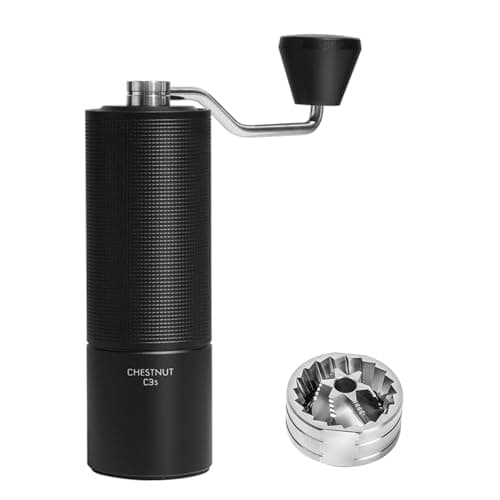
Timemore sells four grinders that are, physically, close to the same grinder. The Chestnut C3, C3S, C3 ESP and C3S Pro share a Ø38mm S2C660 conical burr in SUS420 steel, the same 25-gram chamber, the same rough dimensions and the same roughly 530-gram weight. What separates them is which dial Timemore fitted and whether the handle folds. Get that right and you have one of the best-value grinders in home coffee. Get it wrong and you have a grinder that will fight you every morning for years.
The C3S is the filter one. Its internal dial is what Timemore calls the classic dial: 0.0833mm — about 83 microns — per click, 12 clicks per rotation, with roughly 36 clicks of usable travel according to the hands-on reviewers and the user manual. Eighty-three microns is a sensible, well-judged step for pour over, drip, AeroPress and French press, where the difference between two adjacent settings is something you can actually taste and nothing you will ever need to split. It is roughly four times too coarse a step for espresso, where you are hunting a window perhaps 20 microns wide.
If espresso is what you are here for, stop reading and go to the Timemore C3 ESP instead: same burr, same body, a dial re-geared to 0.0233mm per click across 30 clicks. It is the Baratza Encore / Encore ESP relationship one price tier down, and like that pair it is a gearing decision rather than a grinding-quality one, which means you cannot upgrade into it later. Our Encore vs Encore ESP comparison explains the same mechanism in the electric world if the logic is new to you.
A note on how we work: this is a desk review built from Timemore's published specifications and the hands-on accounts of the reviewers we name in Sources. We have no lab, we have not measured this grinder, and our methodology page says so plainly. Where sources disagree, we print the disagreement rather than the tidier number.
What you actually get
A Ø38mm S2C660 conical burr in SUS420 stainless steel.S2C stands for spike-to-cut, and the geometry is scaled down from Timemore's considerably more expensive Chestnut X. That lineage is the C3 family's best feature and the reason these grinders punch above their price: the burr is not a generic budget cone, it is a smaller version of a good one. 38mm is a normal diameter at this price — the 1Zpresso Jat 48mm is what paying more buys — and it grinds a filter dose in roughly 30 to 45 seconds of cranking.
An internal stepped dial at 0.0833mm per click, 12 clicks per rotation. That is Timemore's own published figure from its C3-series page, and it is worth stating clearly because a number of retailer listings describe this grinder as stepless, which it is not. Twelve clicks per rotation times 0.0833mm is almost exactly 1mm of burr travel per full turn, which is a useful sanity check on the figure. The Basic Barista's hands-on review and the C3 user manual both put the usable range at around 36 click steps in total.
An all-metal body, which is the C3S's actual reason to exist.This is the specific difference between the C3S and the plain C3: Eight Ounce Coffee's guide to the family states that the C3 uses plastic elements in its internal body and handle cap while the C3S is full metal. At this price that is not a cosmetic upgrade — plastic internals are where budget hand grinders develop play in the axle, and play in the axle is what turns a uniform grind into a mediocre one after a year.
Around 530 grams, measuring roughly 147 × 52 × 159mm, holding up to 25 grams of beans.Sources disagree slightly on capacity — Timemore's C-series comparison table says 25 g maximum and Eight Ounce's guide says 20 g — and the honest reading is that 20 g is comfortable and 25 g is the brim. The handle is the standard fixed crank; the folding handle is the C3S Pro, which is otherwise the same grinder.
How it grinds
For filter coffee, very well for the money, and the mechanism is the burr geometry rather than anything clever. Reviewers consistently place the C3 family at or near the top of the sub-$100 hand-grinder bracket for grind uniformity, and that is the only bracket where a budget grinder's grind quality is genuinely in question — above it, everything grinds well and you are buying speed, capacity and interface.
The practical experience is a 30 to 45 second crank for a pour-over dose, grounds that look and brew uniform, and a grinder small enough to live in a drawer or a rucksack. For a V60, a Chemex for one, an AeroPress or a small French press, it does the job that matters and it does not pretend to do more.
Two honest limits. The 25-gram chamber means a full 8-cup French press — around 55 grams of coffee — is two grinds and a chamber swap; if you brew in batches, capacity is the specification to shop on and the J's 30-35 g chamber is the upgrade that actually changes your morning. And 38mm burrs on a hand crank mean this is not a fast grinder in absolute terms; it is fast enough for one or two cups and tiring for four.
Why 83 microns a click rules out espresso
It is worth understanding the arithmetic rather than taking the verdict on faith, because the same logic decides every grinder you will consider next.
Espresso lives around 200 to 300 microns, and the part that matters is not reaching that number — the C3S can — but moving around inside it. A shot that gushes in 18 seconds and a shot that chokes at 45 can be one small adjustment apart, which means you need steps on the order of 10 to 25 microns to land where you are aiming. The C3S moves 83 microns per click. From a shot running too fast, one click finer can easily take you straight past the window and out the other side, and there is no setting in between because the dial is stepped.
That is the entire reason the C3 ESP exists, and the fix is purely gearing: the ESP dial moves 0.0233mm — about 23 microns — per click across 30 clicks a rotation, on the identical burr. Four times the resolution, same grind quality, same body, roughly the same money. Our espresso grind size guide covers the window you are aiming for, and do you need a grinder for espresso covers the question underneath it.
The one caveat worth stating: on a pressurized portafilter, the kind that ships with most entry machines, the basket manufactures its own back-pressure and grind precision matters much less. If that is your setup, the C3S will produce espresso-like coffee. Our pressurized vs unpressurized baskets guide explains why, and why most people eventually want the other kind.
Where it sits against the field
Against its own family: the plain C3 is slightly cheaper with plastic internals, the C3 ESP is the espresso gearing, and the C3S Pro is this grinder with a folding handle for travel. The C3S is the one to buy if you brew filter and want the metal body.
Against the step up: 1Zpresso's Q2 is the direct rival at similar money with a smaller burr and a lighter body, and the KINGrinder K6 costs more and adds an external numbered dial and espresso-capable stepping, which is the single biggest interface upgrade available in this category. Spending up to the 1Zpresso J buys 48mm burrs and a 30-35 g chamber.
Against electrics:at the C3S's price an electric grinder is a blade grinder or close to it, and a blade grinder is not a grinder — it is a chopper, and the cup difference is enormous. Our burr vs blade guide covers that, and the OXO Brew conical burr grinder is roughly where electric burr grinders start being worth owning. The honest summary is that below about $120 a hand grinder gives you a better cup and an electric gives you a button.
The four Chestnut C3 grinders, and which one you want
This table is the whole buying decision, and it is built from Timemore's own C-series specifications plus Eight Ounce Coffee's guide to the family. Note how little changes across the rows: the burr, capacity and dimensions are shared, which is why these grinders are so easy to confuse and why confusing them is so costly.
| Model | Body | Dial | Handle | Buy it for |
|---|
| Chestnut C3 | Plastic internals and handle cap | Classic, 0.0833mm / 12 clicks | Fixed | The lowest price that still grinds properly |
| Chestnut C3S | Full metal | Classic, 0.0833mm / 12 clicks | Fixed | Filter brewing — pour over, drip, press, AeroPress |
| Chestnut C3 ESP | Full metal | Espresso, 0.0233mm / 30 clicks | Fixed | Espresso, and anyone who might buy a machine |
| Chestnut C3S Pro | Full metal | Classic, 0.0833mm / 12 clicks | Foldable | Filter brewing that travels in hand luggage |
All four share the Ø38mm S2C660 burr, the up-to-25-gram chamber and roughly 530 grams of weight. Two decisions, then: metal or not, and filter dial or espresso dial. The second one is the expensive mistake, because you cannot retrofit a dial.
Where the clicks land, by brew method
These positions come from Timemore's own published C-series grind guidance, which gives click ranges for the classic dial. They are starting points, not recipes — bean density and roast level move the right answer by a click or two either way, and you should expect to adjust by taste.
| Brew method | Classic dial, approximate clicks |
|---|
| Espresso / moka pot | 7-8 (moka yes; espresso only on a pressurized basket) |
| AeroPress | 10-14, depending on your steep time |
| V60 and pour over | 13-16 |
| Chemex and drip | 15-18 |
| French press | 17-20 |
| Cold brew | 20+ |
Look at the spread and the grinder explains itself: pour over, drip and press occupy a comfortable eight-click band in the middle of the range, each click a meaningful and tastable move. Espresso occupies one or two clicks at the bottom. A grinder with eight good clicks for the thing you do and two for the thing you do not is a well-designed grinder sold to the wrong person about half the time. Our AeroPress grind size, French press grind size and moka pot grind size guides cover which direction to move and why.
The stepless confusion, and how to not buy the wrong grinder
This deserves its own section because it is a genuine trap. Several retailer listings for the C3S — Newegg's among them — describe its adjustment as stepless. Timemore's own C3-series page says the opposite: an internal grind adjustment dial, classic version 0.0833mm per click, 12 clicks per rotation. Brew Coffee Home's hands-on review of the family independently confirms the C3S uses the same 12-click dial as the original C3. The arithmetic agrees too — twelve clicks at 0.0833mm is 1mm of travel per rotation, which is a designed number, not a coincidence.
We flag it because “stepless” is exactly the word an espresso buyer searches for. A stepless grinder can land anywhere, including inside a 20-micron espresso window. A 12-click stepped dial cannot. If a listing tells you this grinder is stepless and you are buying it to pull shots, that listing is about to cost you money.
The second trap is the model name itself. C3, C3S, C3 ESP, C3S Pro differ by one or two characters and sit on the same product pages at the same retailers, often with shared photography. Read the dial specification, not the name, and check the box label on arrival.
Living with it
Clean it when the grind drifts, not on a calendar.The tell on any hand grinder is that a setting which used to work starts producing coarser, weaker coffee as oils accumulate on the burr. A brush through the burr and chute is the whole job. Brush, never wash — steel burrs and water make rust. Our grinder cleaning guide has the routine.
Write your settings down.Because the dial is internal, changing it is a small chore, and the grinder rewards knowing your two numbers — one for pour over, one for press — rather than exploring. A strip of tape on the body removes most of the daily friction.
Treat 20 grams as your working capacity.Timemore's table says 25 g maximum; a brim-full chamber on a hand grinder is a slower, grittier crank. If you regularly brew more than a single V60, capacity rather than grind quality is the reason to spend more.
What we did not test
We did not bench this grinder. The Ø38mm S2C660 burr, SUS420 steel, 0.0833mm-per-click and 12-clicks-per-rotation figures, the 25 g capacity, the roughly 530 g weight and the 147 × 52 × 159mm dimensions are Timemore's published specifications. The full-metal-versus-plastic distinction between C3S and C3 is Eight Ounce Coffee's, the 12-click confirmation and the C3-family breakdown are Brew Coffee Home's, and the roughly 36-click total travel comes from The Basic Barista's review and the C3 user manual. We have not measured particle distribution, retention, grind time in seconds or burr life, and we have not pulled espresso on this grinder. Where a retailer listing contradicts Timemore — the “stepless” claim, the 20 g versus 25 g capacity — we have printed both and said which we trust.