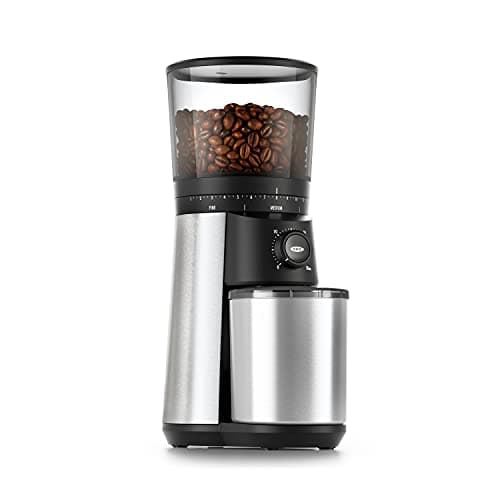
Somewhere around a hundred dollars, electric coffee grinders stop being chopping machines and start being grinders. The OXO Brew conical burr grinder sits almost exactly on that line, and it is the reason the line exists: it has real conical metal burrs, a hopper, a timer that remembers what you did last time, and the single most underrated feature in a kitchen appliance, which is that you press one button while half awake and walk away.
It is also a grinder about which two specific expectations are routinely wrong, and both come from the product listing. The first is the setting count: OXO's own Amazon title advertises 43 grind settings, and every hands-on reviewer who has counted the physical detents reports 15, with the larger numbers arrived at by counting the unmarked positions between them. The second is espresso, which the listing does not promise but which buyers at this price reliably hope for. It cannot, and the reason is more interesting than “not fine enough” — which we get to below.
Within its actual job — drip, pour over, French press, cold brew — it is a genuinely good grinder and a quietly smart piece of industrial design. Complete Home Barista, reviewing it hands-on, rates its pour-over uniformity as slightly more consistent than the Baratza Encore while noting the difference is subtle for filter coffee. That is high praise at the price, and the Encore is the grinder this one is always measured against.
How we work: this is a desk review assembled from OXO's published listing figures and the hands-on accounts of the named reviewers in Sources. We have no lab, we have not measured this grinder, and our methodology page says so. The published specifications for this product disagree with each other more than usual, and we have printed the disagreements rather than picking the tidiest numbers.
What you actually get
Conical metal burrs.The diameter is genuinely disputed: Complete Home Barista lists a 50mm conical set, while another published review gives 40mm, and OXO's retail listing says only “stainless steel burrs” without a number. We are not going to resolve that for you, and you should treat any review that states one figure confidently without sourcing it with suspicion. What is not in dispute is that they are burrs rather than a blade, which is the difference that actually changes the cup — our burr vs blade guide covers why.
Fifteen stepped settings, advertised as 43. The physical dial has 15 detents. OXO arrives at the larger number by counting the positions you can leave the dial between detents, which do technically change the grind and which you cannot reliably return to. Treat it as a 15-setting grinder with some slop, because that is how it behaves, and 15 well-spaced settings across the filter range is a perfectly reasonable thing to own.
A roughly 12 oz (340 g) bean hopper, per OXO's listing, which is a week of coffee for most households and more than the Encore's 8 oz.
A one-touch timer that remembers.This is the feature that justifies the grinder's existence over a hand grinder, and reviewers single it out: set the duration once for your usual dose, and every subsequent morning is a single button press that repeats it. It is not a scale and it does not weigh anything — a change of bean density changes the dose — but for the person who brews the same coffee the same way every day, it is the difference between a two-minute ritual and a four-second one.
A 110 W motor in a plastic housing,per Complete Home Barista, which also flags the obvious consequence: the plastic body and modest motor are what limit this grinder's lifespan against premium machines, and it reports that some units suffer motor burnout or bearing wear before the 6-to-9-year life you would hope for. Warranty figures conflict — Complete Home Barista says one year, another published review says two — so check OXO's current terms at the point of purchase rather than trusting either.
How it grinds
For filter coffee, well. Complete Home Barista found adequate uniformity with few fines and few large chunks across pour-over settings, called French press grind quality good, and placed it marginally ahead of the Encore for pour over while stressing that the gap is subtle. It also notes — and this is true of every grinder — that consistency improves with fresh beans and lighter roasts, because oily dark-roast beans smear rather than fracture.
Speed is about 25 to 35 seconds for a single pour-over dose, which is unremarkable and fine. You are not standing over it; the timer is.
Noise is where published accounts diverge most. Complete Home Barista measured roughly 78 to 82 dB. Coffeeness reports a range of about 85 to 100 dB depending on setting, and Coffee Review measured 92 to 97 dB— though that article covers OXO's more expensive integrated-scale model, so it may not describe this grinder at all. The honest summary is that every reviewer who mentions noise mentions it as a complaint, and that it is louder than a geared-down grinder like the Encore. If a quiet kitchen is the priority, our quiet grinder page covers the class built for it. We have not measured this grinder in decibels.
Why it cannot do espresso, and why that is the interesting part
The usual reason a filter grinder fails at espresso is that it will not go fine enough. The OXO's failure is different and more instructive: Complete Home Barista reports that it does grind fine enough technically, but that its adjustment steps are coarse enough to produce noticeable jumps in particle size, and that at espresso settings it generates excess fines which cause channeling.
Those are two distinct problems. Coarse steps mean you cannot land in the window — the same arithmetic that rules out most filter grinders, where a shot gushing at 18 seconds and choking at 45 are one adjustment apart. Excess fines mean that even if you landed in the window, the puck would not behave: a bed with too many sub-50-micron particles compacts unevenly, water finds the path of least resistance, and you get a sour, thin shot with a spray pattern rather than a stream. Our channeling guide covers the mechanism and espresso grind size covers the window.
This matters practically because it means no accessory fixes it. A better basket, a WDT tool, a puck screen — these mitigate channeling caused by distribution, not channeling caused by a particle distribution with the wrong shape. The fix is a grinder whose burrs and gearing were chosen for espresso. The cheapest honest version of that is the Baratza Encore ESP, and our best espresso grinders page covers the field above it.
Where it sits against the field
Against the Baratza Encore,which is the comparison that decides most purchases: the OXO is usually a little cheaper, holds more beans, has a repeat timer the Encore lacks, and grinds pour over marginally more uniformly according to the one reviewer who put them side by side. The Encore answers with a geared-down motor that runs quieter and cooler, 40 settings instead of 15, and — the real argument — Baratza's parts and repair program, which means an Encore is realistically a ten-year grinder you can re-burr and re-motor yourself. If you want the better daily interface, take the OXO; if you want the grinder you will still own in 2036, take the Encore. Neither does espresso.
Against a hand grinder at the same money: a Timemore C3S will match or beat it on grind uniformity and costs less, because the money goes into a burr instead of a motor, a housing and a timer. The trade is 30 to 45 seconds of cranking per dose and a 25-gram capacity. If you brew one cup and care most about the cup, the hand grinder wins. If you brew a full carafe, or you brew for a household, or you simply will not crank a handle before coffee, the OXO wins and it is not close. Our hand versus electric guide takes that trade apart.
Against spending more: the next real step for filter coffee is a flat-burr brew grinder, which separates particle sizes more cleanly and shows up as clarity in a light roast. The Fellow Ode Gen 2 is that grinder, at several times the price, and our best grinders for drip and pour over page ranks the whole field. Going cheaper means the sub-$100 bracket, which is mostly hand grinders for exactly the reason above.
The 43-settings question, settled
This is the most common source of confusion about this grinder, so it is worth one clear table. The number on the box and the number you can actually use are different, and knowing which is which changes nothing about whether to buy it — but it changes what you expect when the dial arrives.
| Figure | Where it comes from | What it means |
|---|
| 15 settings | Hands-on reviewers counting physical detents | The settings you can feel, record and return to exactly |
| 38 settings | One published review's count | Detents plus some of the positions between them |
| 43 settings | OXO's own retail listing | Detents plus every intermediate position |
All three numbers describe the same dial. The useful one is 15, because a setting you cannot reliably return to is not a setting you can dial a recipe in on. Fifteen steps spread across the filter range is roughly 1.5 to 2 settings per brew method, which is adequate — and noticeably less adjustment than the Encore's 40, which is the main specification where the Baratza is plainly ahead.
What the published specs actually say, and where they conflict
This product has unusually inconsistent published figures. Rather than present a clean spec table we do not believe, here is the honest version.
| Specification | Published figures | Our reading |
|---|
| Burr diameter | 50mm (Complete Home Barista) vs 40mm (another review); OXO gives no number | Unresolved — treat any confident single figure as unsourced |
| Grind settings | 15 detents / 38 / 43 (OXO's listing) | 15 usable, repeatable settings |
| Hopper | ~12 oz (340 g), per OXO's listing | Consistent across sources |
| Motor | 110 W (Complete Home Barista) | Single-sourced but uncontested |
| Noise | 78-82 dB / 85-100 dB / 92-97 dB | Loud; the 92-97 figure may describe OXO's scale model, not this one |
| Warranty | 1 year vs 2 years | Confirm with OXO at purchase |
| Housing | Plastic (uncontested) | The main longevity limit |
We print this rather than hide it because a tidy spec table assembled from contradictory sources is a fabrication with good manners. Where you see a review give you one number for the burr diameter of this grinder, ask where it came from.
Coarse steps versus excess fines: two different espresso failures
Most filter grinders fail at espresso for one reason. This one fails for two, and the distinction is worth carrying to your next grinder purchase.
Coarse stepsare a navigation problem. Espresso wants grounds around 200 to 300 microns and wants moves of roughly 10 to 25 microns, because the gap between a gushing shot and a choked one is small. A dial with 15 detents across the whole filter range cannot offer moves that small at the fine end — you step over the window rather than into it. This is the same arithmetic that rules out the plain Encore, the Timemore C3S and most grinders sold for drip.
Excess fines are a different and worse problem, because they persist even when you land on the right average grind size. Complete Home Barista specifically reports this grinder producing an excess of fines at espresso settings, and the consequence is mechanical: a puck containing too many very small particles compacts unevenly under pressure, water carves a preferential path through it, and the extraction becomes a spray rather than a stream. The cup reads sour and thin regardless of your recipe.
The practical takeaway is that the second problem cannot be bought around. Our puck prep guide and WDT tools address distribution channeling, which is a real and fixable thing. They do not address a particle distribution whose shape is wrong, and no accessory does. Grind geometry is bought, not corrected.
Living with it
The timer is a duration, not a dose. Set it once for your usual coffee and it will repeat faithfully, but switch from a dense light roast to an oily dark one and the grams that come out will change. If dose accuracy matters to you, weigh the output on a scale for a week and note the seconds for each bean you buy regularly.
Clean it when the grind drifts, not on a schedule. The tell on any burr grinder is that a setting which used to work starts brewing weaker and coarser as oils accumulate. Brush the burrs and chute; never wash steel burrs, because they rust. Our grinder cleaning guide has the routine.
Expect it to be loud, and grind it the night before if that is a problem. Pre-grinding costs you some aroma and is a perfectly reasonable trade in a house with sleeping people in it. Our bean storage guide covers minimizing the cost.
Buy it knowing the housing is plastic.That is the honest price of the price. If the thing you want is a grinder you will keep for a decade and repair rather than replace, the Encore's parts catalog is the argument and it is a strong one.
What we did not test
We did not bench this grinder. The 12 oz hopper, stainless burrs, one-touch operation and the 43-setting figure are OXO's own listing. The 50mm conical burr set, 15 physical settings, 110 W motor, plastic housing, one-year warranty, 78-82 dB measurement, 25-35 second dose time, the pour-over and French press consistency assessments, the comparison against the Encore, the espresso verdict (fine enough but coarse steps plus excess fines causing channeling) and the motor-burnout and bearing-wear reports are all Complete Home Barista's. The conflicting 40mm burr figure, the 38-setting count, the two-year warranty claim and the 85-100 dB and 92-97 dB noise ranges come from the other published reviews named in Sources. We have not measured particle distribution, retention, decibels or burr life, we have not pulled espresso on this grinder, and where sources conflict we have printed every figure rather than choosing one.