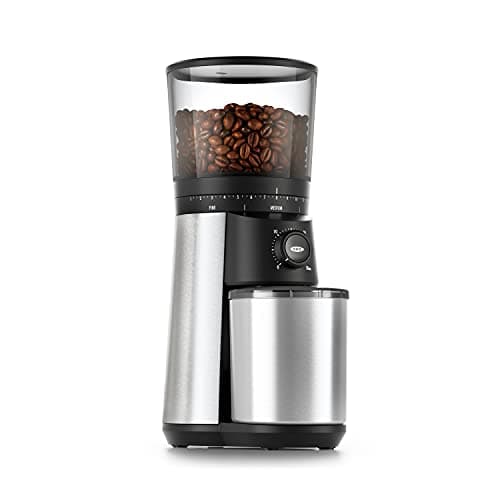
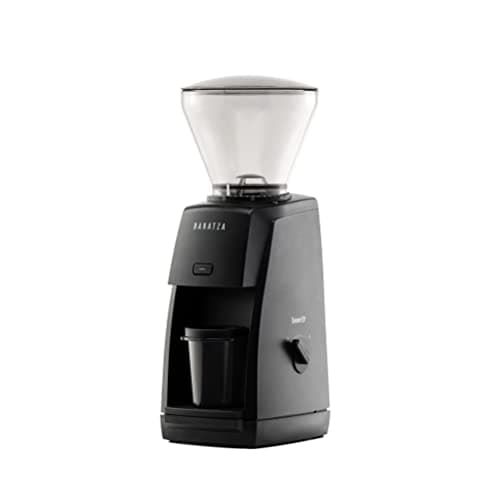
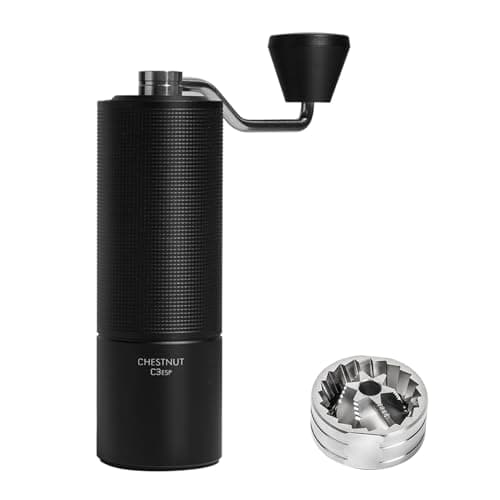
Buy a burr grinder. A blade grinder is a spinning knife in a cup: it chops beans into whatever sizes happen to result, which is dust and boulders in the same scoop. A burr grinder mills beans between two abrasive surfaces set a fixed distance apart, so nothing leaves until it is small enough to fit through the gap — and the gap is a number you choose. That single difference is the biggest improvement available in home coffee, and the cheapest burr grinder worth owning costs less than a month of takeaway coffee.
If you want the shortest useful version: a blade grinder makes coffee that tastes bitter and sour at the same time, and no brewing adjustment can fix it. Here is why that happens, because understanding it also tells you what to look for when you buy.
What a blade grinder actually does
A blade grinder has a propeller spinning at high speed in a chamber. Beans are struck, shattered, and bounce around being struck again. Whether a given fragment gets hit again is luck — it depends on where it happens to be. So the output is a wide distribution of particle sizes: a lot of fine dust from the pieces that got hit repeatedly, and chunks from the pieces that sat in a corner.
Why that specifically ruins coffee.Extraction is a function of surface area and time. Dust has enormous surface area for its mass, so it gives up its soluble compounds almost immediately and then keeps giving up the bitter, astringent ones — it over-extracts. A boulder has very little surface area relative to its mass, so water barely penetrates it and it contributes mostly sour, under-developed acidity. Both happen in the same brew, in the same cup. That is why the result is not simply "weak" or "strong" — it is harsh and thin together, and it is the flavour signature of a blade grinder.
You cannot brew your way out of it. Brew longer to rescue the boulders and the dust gets more bitter; brew shorter to spare the dust and the boulders contribute nothing. There is no setting that is correct for both, which is the whole problem in one sentence.
There is no grind setting, either. A blade grinder has no adjustment mechanism at all — you control it by how long you hold the button, which changes the average while keeping the spread just as wide. Grinding longer for espresso gives you more dust, not finer coffee.
And it heats the coffee. High-speed blades generate real heat in a small chamber, which drives off aromatic compounds before the coffee ever meets water. Minor compared with the particle problem, but it is not nothing.
What a burr grinder does instead
Two abrasive surfaces — either nested cones or facing rings — turn against each other with a set gap between them. Beans are drawn in at the wide end, crushed and sheared progressively, and can only exit when they are small enough to pass the gap. Nothing leaves early and nothing leaves oversized. The output is a far narrower particle distribution centred on a size you selected.
Which means grind size becomes a dial. That is the practical consequence that matters most. Coarse for French press, medium for drip, medium-fine for a moka pot, fine for espresso — all the same grinder, moved deliberately, repeatably. Every brewing guide on this site assumes you can do that, because every brew method has a grind window and hitting it is most of the work.
Burr grinders still produce some fines. Worth saying, because people expect perfection. Coffee is brittle and shears unevenly at the cell level, so even an excellent grinder produces a small population of very fine particles. The difference is scale: a good burr grinder produces a tight distribution with a small fines tail, and a blade grinder produces no distribution worth the name. Expensive grinders are mostly buying a slightly tighter distribution — which is why the jump from blade to cheap burr is enormous and the jump from cheap burr to expensive burr is subtle.
Conical vs flat burrs
Once you are buying burrs, this is the next question, and it matters much less than the first one.
Conical burrs are a cone inside a matching ring. Gravity helps feed them, so they can run slower, which means less heat and less noise. They are the norm at every price from $50 to $600, and every pick below is conical. Nothing about a conical burr caps what you can achieve in espresso or filter.
Flat burrs are two facing rings. They tend to produce a narrower particle distribution, which in espresso shows up as more clarity and a slightly more forgiving dial-in window, and in filter as a cleaner cup. They usually need a faster motor, retain more grounds in the chamber, and cost more. They start to make sense well above the entry level — our best flat burr grinders page covers that tier.
The honest summary: conical versus flat is a preference between two good options. Burr versus blade is a difference in kind. Do not let a flat-burr debate delay buying any burr grinder.
Espresso grinder vs coffee grinder — the distinction that costs people money
This is the follow-up question people ask after they buy their first burr grinder and discover it cannot pull espresso, and it is worth understanding before you spend.
A grinder being "for espresso" is not about burr quality. It is about adjustment resolution at the fine end. Espresso lives in a window a few tens of microns wide: too fine and the machine chokes, one step coarser and the shot gushes. A general-purpose grinder spreads its 40 settings across everything from cold brew to the fine end of filter, which leaves perhaps three usable steps in the espresso zone — so you hop straight over the setting you need.
An espresso-capable grinder either packs many closely spaced steps into that zone or is fully stepless. That is the entire difference, and it is why the Baratza Encore is superb for filter and genuinely frustrating for espresso while the Encore ESP — same burrs, same motor — is fine for both. The gearing is not something you can retro-fit, so decide before you buy. Our Baratza Encore vs Encore ESP comparison is that exact lesson, and best grinders for espresso covers the field where resolution is the headline spec.
The practical rule: if espresso is even a maybe, buy an espresso-geared grinder now. The premium is small. Buying a filter grinder and replacing it in a year is the expensive route, and it is the most common grinder regret we see.
Which brew methods punish a blade grinder most
All of them, but not equally — which matters if you are deciding how urgent this is.
Espresso: catastrophically.Nine bars of water through a compressed puck finds every inconsistency and channels through it. A blade grinder cannot make espresso. Not "makes mediocre espresso" — cannot, because you also have no way to adjust the grind.
Moka pot: badly. Dust packs the basket and blocks flow, raising pressure until the brew scorches or the valve vents. See moka pot grind size.
Pour over: clearly. Fines migrate down and clog the filter bed, so flow stalls and the brew over-extracts while the boulders sit there untouched.
French press: noticeably. Dust passes straight through the metal mesh and lands in your cup as silt that keeps extracting while you drink.
Cold brew: least of all. A twelve-hour steep in cold water is forgiving enough that a blade grinder is survivable. If cold brew is genuinely all you make, this is the one place you can shrug — how to make cold brew has the method.
Burr vs blade, side by side
| Blade grinder | Burr grinder |
|---|
| Mechanism | Spinning knife shatters beans at random | Two abrasive surfaces mill to a set gap |
| Particle size | Wide spread — dust and boulders together | Narrow spread centred on your setting |
| Grind adjustment | None — only how long you hold the button | A dial, repeatable and recordable |
| In the cup | Bitter and sour at once, from the same brew | Clean and balanced, adjustable by taste |
| Espresso | Not possible | Possible if the grinder is espresso-geared |
| Heat | Real heat from high-speed blades | Minimal, especially on conical burrs |
| Price floor | About $20 | About $60 for a genuinely good one |
Is a cheap burr grinder better than an expensive blade grinder?
Yes, and it is not close. This is the comparison worth being blunt about, because a $100 blade grinder with a chrome body and a timer exists and will outsell every grinder on this page. It is still a knife in a cup. Price does not change the mechanism, and the mechanism is the problem.
The corollary is the useful part: the money you spend going from blade to burr buys a dramatic improvement, and money spent above that buys diminishing returns. A $70 hand grinder clears the bar that matters. A $400 grinder is better, but the gap between $70 and $400 is far smaller than the gap between $20 and $70.
Why hand grinders out-perform electrics at the same price
It is arithmetic, not mysticism. A hand grinder has no motor, no gearbox, no timer and no hopper assembly, so nearly the whole budget goes into the burr set and the shaft that holds it concentric. An electric at the same money has to pay for all of that hardware first, and the burrs get what is left.
The shaft matters more than people expect: under grinding load an unsupported shaft lets the burr deflect, the gap opens unevenly, and the particle distribution widens. You cannot see it; you taste it as a cup that is harsh and thin at once — the same failure mode as a blade grinder, in miniature. Double-bearing shafts and all-metal bodies are why the Timemore and 1Zpresso grinders punch above their price. Hand vs electric grinders covers the full trade, and best hand grinders ranks the manual field.
What to check before you buy any burr grinder
Does it reach the grind size your brew method needs? Espresso needs fine resolution at the fine end; moka needs resolution through the middle; French press and cold brew need a genuinely coarse setting that many espresso-geared grinders cannot reach. Match the grinder to what you actually brew — espresso grind size, AeroPress grind size and French press grind size each describe their window.
Can you record and return to a setting? An external numbered dial is worth real money because it turns dialling in from guesswork into a note on your phone.
Is the body metal, and is the shaft supported? This is where cheap grinders fail, and it is usually visible in the specification.
Are parts sold? Burrs wear. A grinder whose burrs you can replace is a ten-year purchase; one whose burrs you cannot is disposable.
Will you actually use it? A hand grinder you resent is worse than an electric you use. Be honest about how many drinks you make before work.
Keeping burrs working
Coffee oil builds up on burrs and in the chute, and stale grounds in the path are yesterday's coffee in today's cup — a slow, invisible decline people blame on their beans. How to clean a coffee grinder is the routine, and it is quicker than you think. Burrs themselves wear slowly; most home grinders go years before a replacement set is worth fitting, and by then you will know whether you want to upgrade instead.