Start at medium-fine — a little finer than drip, clearly coarser than espresso, roughly the texture of table salt — with a steep of about one minute and thirty seconds. That is the setting we would hand a new AeroPress owner, and it works. But the more useful answer is that the AeroPress has no single correct grind size, because grind and steep time trade directly against each other in this brewer, and three quite different combinations all make excellent coffee.
That is why every AeroPress recipe you read disagrees with the last one. The inventor's original instructions call for a fine grind and a steep of about ten seconds. World AeroPress Championship recipes have been won with everything from espresso-fine to French-press-coarse. None of them is wrong, and they are not describing different coffee — they are describing different points on the same trade.
Why the AeroPress is different
It is an immersion brewer, not a percolation brewer. This is the whole mechanism. In a pour over or a drip machine, water flows through a bed of coffee and the grind size controls how fast it flows — so grind size sets the brew time, and you do not get to choose them independently. In an AeroPress the coffee sits in water for as long as you decide, and then you press. Flow is not the variable; time is, and you control it with a clock.
So grind size controls extraction rate, not brew duration. Finer coffee has more surface area, so it gives up its soluble compounds faster. That means a fine grind needs a short steep and a coarse grind needs a long one — and if you hold the product of the two roughly constant, you land in the same place. Fine and fast, or coarse and slow. Both arrive.
The paper filter catches the fines either way. The reason you can go genuinely fine in an AeroPress without the gritty, muddy result a French press would give you is the paper filter. It traps the tiny particles that would otherwise end up in the cup. This is also why the AeroPress produces a cup with the body of an immersion brew and the clarity of a filter coffee — a combination no other brewer manages as cheaply.
Pressure is the smallest variable, despite the name.Pressing is not brewing; by the time you press, nearly all the extraction has already happened during the steep. The press is a filtration step with a bit of extra extraction attached. This is why "press harder" is almost never the fix for anything, and why an AeroPress is not an espresso maker — see how to make espresso without a machine for what it can and cannot do.
Three starting points that all work
Pick one and stay with it for a week rather than changing something every morning. Doses assume a single drink of roughly 200-250 ml.
1. Fine and fast — the original recipe.Grind noticeably finer than drip, close to the fine end of what your grinder does comfortably. Steep for 10 to 30 seconds, then press slowly over 20 to 30 seconds. The cup is strong, sweet and quite concentrated — traditionally diluted with hot water afterwards, which is where the AeroPress's "Americano style" reputation comes from. This is the fastest route to coffee and the most forgiving of a cheap grinder, because a very short steep gives fines less time to over-extract.
2. Medium-fine and standard — the default we recommend. Table-salt texture, roughly 15 to 17 g of coffee, water just off the boil, steep 1:30, stir once at the start, press over 20 to 30 seconds. This produces the most balanced cup for most coffees and is the setting to judge everything else against. If you only ever use one recipe, use this one.
3. Coarse and long — the clarity recipe. Grind as coarse as you would for a French press, use cooler water (around 80 to 85 C), and steep for two to four minutes. This is the approach behind many competition recipes and it produces a remarkably clean, tea-like, aromatic cup that highlights acidity in a light roast. It is also the most forgiving of a grinder that produces a lot of fines, because the coarse majority extracts slowly and the fines are caught by the paper.
Fixing a brew that is wrong
Bitter, harsh, drying or ashy. Over-extracted. Go coarser, or shorten the steep, or use cooler water — change one of the three. Bitter is the most common AeroPress fault and it is nearly always a fine grind left to sit too long.
Sour, thin, salty or hollow. Under-extracted. Go finer, or steep longer, or use hotter water. If the coffee tastes simultaneously sour and weak, that is under-extraction rather than a weak brew, and adding more coffee will not fix it.
Very hard to press, or the plunger stalls. Too fine for the dose. This is the one genuine hard limit on grind size in an AeroPress: go fine enough and the puck chokes the paper filter. Go a step coarser, use slightly less coffee, or stir before pressing to break up the bed.
Weak and watery but not sour. That is a ratio problem, not a grind problem — use more coffee. See coffee-to-water ratio for the arithmetic.
Muddy or gritty in the cup. Check the paper filter seated properly and was rinsed, and that you are not using a metal filter with a fine grind. Metal filters pass fines by design, which is fine with a coarse grind and unpleasant with a fine one.
What grinder you need for this
Less than for any other method on this site, and that is a genuine conclusion rather than reassurance. Two things make the AeroPress forgiving: the paper filter catches fines, and you control steep time independently, so you can compensate for a grinder that produces a wide particle spread by shortening or lengthening the steep. A $60 hand grinder is completely adequate. A blade grinder is still not, because it produces dust and boulders in the same scoop and no steep time is correct for both at once — burr vs blade grinders explains why.
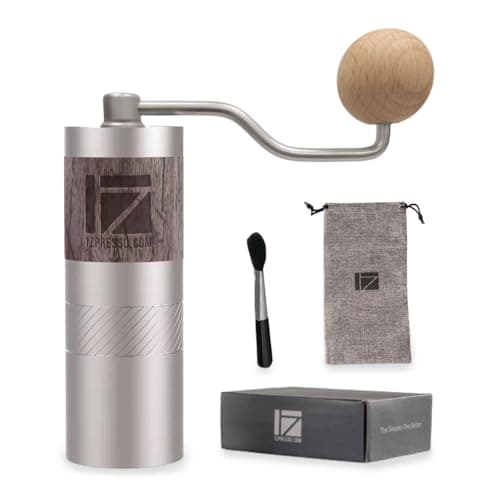
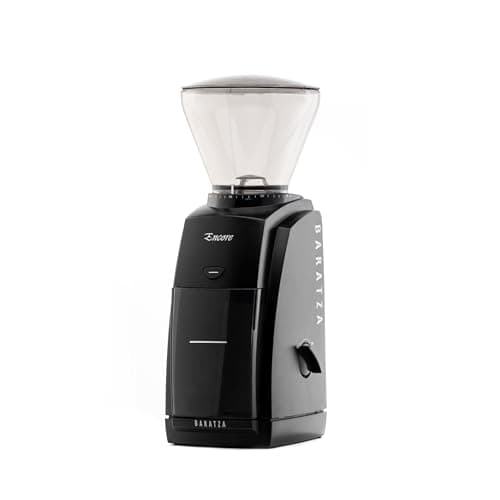
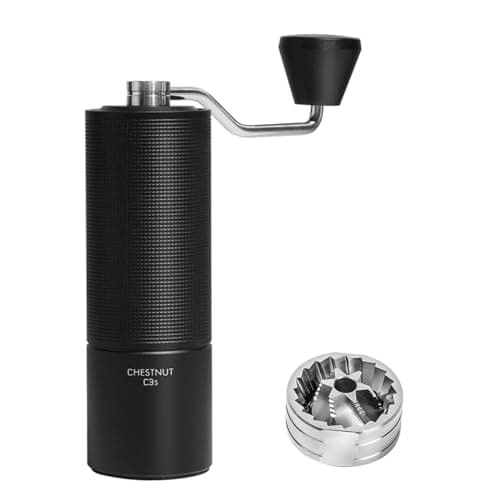
What you do want is adjustment range. If you intend to try all three recipes above, your grinder needs to reach from French-press coarse down to clearly finer than drip, with usable settings throughout. The three picks below all do, and the first is the one we reach for.
The three recipes, side by side
All three make genuinely good coffee. The right one for you depends on how much time you have, what your grinder does well, and whether you prefer a concentrated cup or a tea-like one.
| Recipe | Grind | Water temp | Steep | Cup | Best for |
|---|
| Fine and fast (original) | Finer than drip | Just off boil | 10-30 seconds | Strong, sweet, concentrated — dilute to taste | Speed, and darker roasts |
| Medium-fine (our default) | Table salt | Just off boil | 1:30 | Balanced, full-bodied, clean | Most coffees, most mornings |
| Coarse and long | French press coarse | 80-85 C | 2-4 minutes | Clean, tea-like, aromatic, acid-forward | Light roasts, and grinders with lots of fines |
How AeroPress grind compares to other methods
Coarsest to finest: cold brew, French press, AeroPress on the coarse recipe, drip and pour over, AeroPress on the standard recipe, moka pot, AeroPress on the fine recipe, espresso finest by a wide margin. The AeroPress appears three times in that list, which is the whole point of this page — it is the only brewer on the site that genuinely spans the range.
If you are coming from another method, the useful comparisons are French press grind size (coarser, and far less forgiving of fines because there is no paper), moka pot grind size (a narrow medium-fine window set by pressure, not by choice) and espresso grind size (a different world, where grind is the only lever).
Inverted brewing and whether it changes the grind
The inverted method — assembling the AeroPress upside down so nothing drips through during the steep — is popular and it does change one thing: it removes the slow drip that happens in the standard orientation, so your steep time is the whole steep time rather than approximately it. That makes long steeps more precise and is why competition recipes often use it.
It does not change the correct grind size. If you switch to inverted and keep everything else the same, expect a slightly stronger cup because none of the water left early — so either accept that or shorten the steep by fifteen seconds or so. Grind is not the dial to touch.
The other variables, in order of how much they matter
Dose and ratio first. Roughly 15 to 17 g per 250 ml is a strong, normal cup. If your coffee is weak, this is almost always the fix, not the grind.
Water temperature second. Hotter extracts faster. If you are at a fine grind and a long steep and getting bitterness, dropping to 85 C does more than any grind change.
Grind third, which is where this page comes in — and it is the dial to use when the cup is close but not right.
Press speed last, and barely at all. Twenty to thirty seconds, steady, stop when you hear the hiss. Pressing harder or faster does not meaningfully change extraction, and forcing a stalled press is how seals get damaged. Our best AeroPress roundup covers the hardware differences across the range, and AeroPress vs French press explains why the paper filter changes the grind rules so completely.