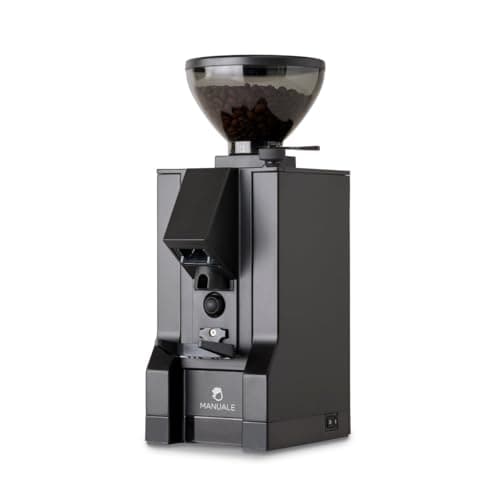
The Eureka Mignon Notte answers a very specific wish: you want cafe-grade espresso grinding at home, you want to nudge the grind by the smallest possible amount to chase the perfect shot, and you would rather your grinder did not sound like a power tool at six in the morning. The Notte pairs 50mm flat steel burrs with a stepless adjustment collar and wraps them in a compact, heavy Italian body, then runs the whole thing more quietly than almost anything else near its price. It is hopper-fed and grind-on-demand, so you flip it on and it grinds straight into the portafilter — no weighing every dose, no fuss. If your ideal morning is press-and-go espresso with real resolution and the least noise, this is the grinder built for it.
The heart of the Notte is the stepless collar. Instead of clicking between fixed settings, the adjustment moves continuously, so you can creep the burrs closer by a hair to slow a gushing shot or open them a whisker to rescue one that chokes. That fine resolution is exactly what the narrow espresso window rewards, because espresso lives in a tiny band of the grind range and the difference between a balanced shot and a sour or bitter one is often a fraction of a turn. Behind the collar sit 50mm flat steel burrs, which turn out a clean, uniform espresso grind with the kind of even particle size that lets pressurized water meet the same resistance across the whole puck. It is a genuine step up from the conical grinders most people start on, and it is why the Notte earns a place among our best electric espresso grinders under $500.
The quiet is not a gimmick, either — it is one of the real reasons to choose the Notte over a louder rival. A grinder you can run without waking the house is a grinder you will actually use every morning, and Eureka has tuned this one to be notably calm for an electric. Add the compact footprint and the planted, premium feel of the Italian build, and the Notte is a pleasure to live with day to day. If you are cross-shopping it against Eureka's own step-up model with the touchscreen and the larger 55mm burrs, our Eureka Mignon Specialita review lays out where the extra money goes and whether it is worth it for you.
The honest catch is the one every hopper-fed grinder shares, and it is worth stating before you buy: the Notte holds a little coffee inside between doses, so it is not the tool for someone who wants near-zero waste or who swaps a fresh single-origin in and out every day. The stepless dial also has no numbered scale, so once you land a setting you like, you track it yourself — a small habit, not a dealbreaker, but worth knowing. And a grinder is only half a setup: pair the Notte with a capable machine and fresh beans and the resolution shows up in the cup, which is the whole argument our best grinders for espresso guide makes across a wider field of picks.
Who the Mignon Notte is really for
The Notte suits a common and very specific buyer: someone who pulls espresso most mornings, wants a grinder that dials in with real precision, and cares that it runs quietly in a shared kitchen or an early-rising house. If that is you, this is close to ideal. The stepless collar gives you the fine control espresso rewards, the flat burrs give you clean, uniform grounds, and the low noise means you will actually reach for it at 6am without a second thought. Where the Notte is notthe right pick is at the edges. If you want the near-zero waste and bean-swapping freedom of single-dosing — weighing in exactly what you brew and leaving almost nothing behind — a purpose-built single-doser fits you better, and our best single-dose grinders roundup ranks the strongest of them. And if the lowest spend is the priority, a good conical starter will pull a genuinely fine shot for less; you are paying the Notte premium for the flat burrs, the stepless resolution and the quiet, not for the basic ability to make espresso.
How the stepless collar changes your dial-in
This is the feature the whole grinder turns on, so it is worth being precise. A steplessadjustment collar moves continuously rather than clicking between fixed positions. On a stepped grinder you sometimes want a setting that lives between two clicks and cannot have it; on the Notte you simply rotate the collar a fraction and land exactly where the shot wants to be. In practice that means when a shot runs too fast and tastes thin, you creep the burrs a hair finer and pull again; when it chokes and drips bitter, you open them a whisker. Because espresso occupies such a narrow slice of the grind range, that hair-fine control is the single thing that most separates a grinder you can dial a shot in on from one you fight. The trade is that stepless dials rarely carry a numbered scale, so you remember or mark your settings yourself — a minor habit once you find the window you like for a given bean.
Flat burrs, quiet operation and the hopper workflow
The Notte's 50mm flat steel burrs are the other half of the story. Flat burrs tend to throw a more uniform, clean grind than the conical sets on most entry grinders, which reads in the cup as a little more clarity and definition — the reason larger flat burrs turn up in cafes. Fifty millimeters is on the compact end of the flat-burr world, but burr size is not a scoreboard: alignment, adjustment resolution and build matter at least as much, and Eureka has those dialed. If you want to understand what flat geometry does and does not buy you over a conical, our best flat burr grinders roundup walks through the whole trade honestly. The Notte is also hopper-fed and grind-on-demand: you keep beans in the hopper, flip it on, and it grinds straight into the portafilter. That is faster and lower-effort than weighing each dose, and it suits a household that brews the same coffee every day — the price is that beans sit exposed in the hopper and a little coffee stays inside the grinder between doses, which you purge. The quiet is the daily-living bonus: Eureka tuned this one to run notably softly for an electric, so it is the grinder you can use without waking anyone.
What we did not test
We have not run the Notte on a bench for months, and we will not pretend otherwise. This review compiles Eureka's published specifications, cross-checks the way flat burrs and stepless collars work mechanically, and weighs aggregated owner reports against our scoring rubric. The specs — the 50mm flat steel burrs, the stepless adjustment, the electric grind-on-demand operation and the compact Italian build — come from Eureka's own materials, listed in Sources. Our scores are editorial judgments from that documented research, not measured numbers: there is no particle-size laser rig or decibel meter behind them. Where hands-on time would genuinely tell you more than a spec sheet — exactly how much coffee the hopper retains between two different beans, or how the noise compares side by side with a louder rival on your own counter — we say so rather than invent a figure. The claim we are most confident in is the simplest: a stepless collar and 50mm flat burrs give you finer, cleaner espresso adjustment than the stepped conical grinders most people start on, and every published spec and owner account we found supports that.
How we picked
We did not lab-test this gear
Everyone in this category says they tested twenty machines. We have not pulled shots on every product here, and we say so. What we did instead: compiled the published specifications, cross-checked the manufacturer manuals, computed the running cost (wattage to energy, grams-per-shot to cost-per-cup), weighed aggregated owner reports, and scored each product against a published rubric. The scores are judgments from documented research — not measurements we took, because we do not have a test lab and we will not pretend we do. Where hands-on time would tell you more than a spec sheet, we flag it. Where a number came from someone else's work, we name them in Sources.