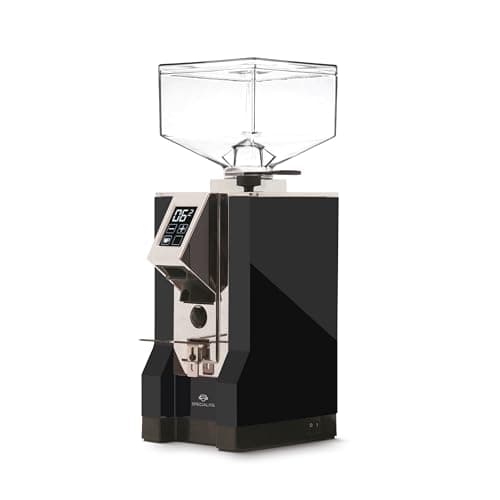
The Eureka Mignon Specialita is the grinder people buy when an entry electric is no longer enough. It is a traditional, hopper-fed, on-demand Italian espresso grinder built around 55mm flat burrs and a stepless micrometric adjustment — the classic template Eureka has refined for decades — and it has become the default step up for home baristas who have outgrown a stepped starter grinder and want finer control, quieter operation, and a genuinely repeatable dose. If the entry electric is where most people begin, the Specialita is where a lot of them go next.
Two things define this grinder in daily use, and both are the reason it is so widely recommended. The first is noise, or the lack of it: Eureka's Silent Technology makes the Specialita one of the quietest grinders you can put on a counter, which sounds like a small thing until you are pulling the first shot of the day in a sleeping house. The second is the adjustment. The Specialita uses Eureka's patented stepless micrometric regulation, so instead of jumping between fixed clicks you sweep continuously through the grind range and settle on the exact point the espresso wants. For a brew method that lives in a tiny window between too fast and too slow, that infinite fine adjustment is the whole game. A touchscreen display on the front stores two programmable timed doses plus a continuous mode, so once you have dialed a shot in you can repeat it with a tap.
Here is the honest framing, because it is the thing buyers most often get wrong. The Specialita is a hopper-fed grinder. A large number of owners single-dose it — they pull the hopper off, drop a weighed dose of beans straight onto the burrs, run it, and purge the little that is left — and it works beautifully that way. But it is not a purpose-built single-dose grinder, and you should buy it knowing that. Retention is modest but real, and single dosing here is an owner-adopted workaround rather than a designed feature. If a low-retention, weigh-in-weigh-out workflow is your actual priority, read our best single-dose grinders first, because a grinder built for that from the ground up will serve you better. If, on the other hand, you want a quiet, precise, traditional espresso grinder and are relaxed about single dosing being a workaround, the Specialita is one of the easiest recommendations in the category. See where it lands against the field in our best grinders for espresso.
Stepless micrometric adjustment: why it matters for espresso
The single biggest reason to move up to a grinder like the Specialita is the jump from stepped to stepless adjustment. A stepped grinder gives you fixed positions, and on a demanding espresso setup you can occasionally find the perfect setting sits between two clicks — one shot runs a touch fast, the next a touch slow. Eureka's patented stepless micrometric system removes those walls: you rotate the adjustment collar and the burrs move continuously, so you can land on the exact grind point the beans want on the day. Espresso is uniquely sensitive to this because it is brewed under pressure in a narrow window, where a fraction of a turn is the difference between a sour, gushing shot and a balanced one. If you are still learning how grind size drives extraction, our espresso grind size guide explains what you are actually chasing when you dial in.
Genuinely quiet: Silent Technology in practice
Grinder noise is one of those specs that reads as trivial on paper and matters enormously in a real kitchen. The Specialita is part of Eureka's silent range, and it is genuinely one of the quietest on-demand grinders available — a real advantage if you make coffee early, in an apartment, or near sleeping family. It will never be silent; it is a burr grinder crushing beans. But next to a typical entry electric it is noticeably calmer and lower-pitched, and that alone is a reason people upgrade. Paired with the ACE anti-clump and anti-static system, which reduces the static mess and clumping that plague many grinders, the whole experience on the counter feels a tier more refined than a starter machine.
Hopper-fed, but many owners single-dose it
This is the nuance to get right. The Specialita ships as a hopper-fed grinder: you fill the hopper, and it grinds on demand into your portafilter. A very large share of owners, though, prefer to single-dose — they remove the hopper, weigh a single shot's worth of beans, drop them straight onto the burrs, and grind, usually with a small purge to clear the chute. It works, and the grind quality is excellent either way. What it is not is a grinder engineeredfor single dosing. There is no bellows and no dedicated single-dose bin, and retention — while modest — is higher than a purpose-built single-doser designed to give back almost exactly what you put in. Buy the Specialita for its grind quality, quiet, and stepless precision; if the workflow you care most about is low-retention single dosing, weigh it honestly against the dedicated options in our best single-dose grinders.
Who it is for, and the premium question
The Specialita is the right grinder for someone who has done their time on a stepped starter grinder, or who is skipping that step entirely, and wants a quiet, precise, well-built espresso grinder they will keep for a long time. It pairs naturally with a capable single-boiler or prosumer espresso machine, where the machine can actually show off what a good grinder does. The honest caveat is price: this is a premium spend and a real step up from an entry electric, so if your budget or ambitions are still entry-level, a re-geared starter grinder or a strong value pick from our best grinders under $200will get you brewing for less. The Specialita earns its cost in quiet, precision and longevity, not in raw versatility — it will grind for filter and pour over, but espresso is unmistakably its purpose.
What we did not test
We have not run this grinder for months on a bench, and we are not going to pretend we have. This review compiles Eureka's published specifications — the 55mm flat burrs, the stepless micrometric regulation, the Silent Technology and the touchscreen timer — cross-checks them against the manufacturer materials listed in Sources, and weighs aggregated owner reports against our scoring rubric. Where hands-on time would tell you more than a spec sheet — exactly how many grams the burr chamber retains, how the single-dose purge behaves day to day, how the touchscreen holds up over years — we say so plainly rather than invent a number. Our scores are judgments from documented research, not lab measurements; we do not have a lab.