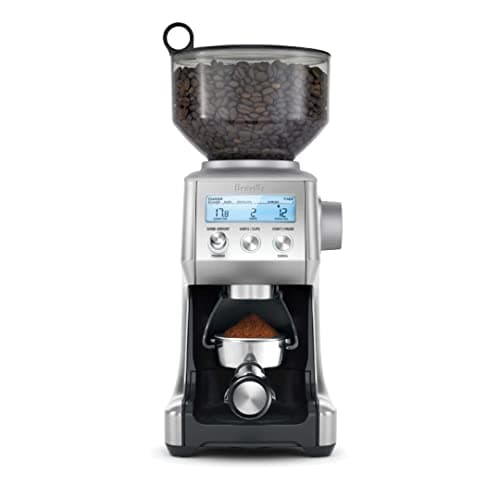
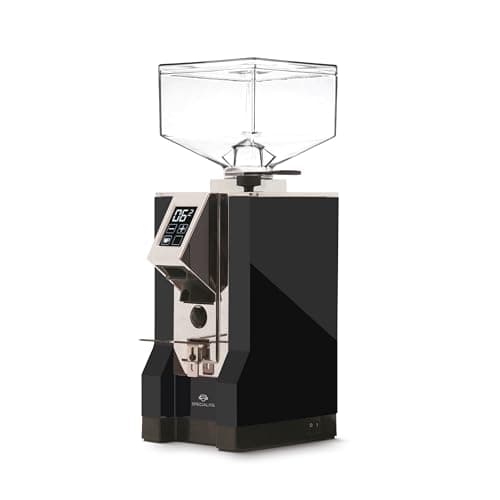
The Eureka Mignon Specialita and the Breville Smart Grinder Pro are the two grinders a lot of home baristas cross-shop when they are ready to move past a basic mill, and they answer two different questions. The Specialita is a specialist: a quiet, premium, Italian espresso grinder with 55mm flat burrs and a stepless micrometric dial, built to land the narrow espresso window precisely and hold it. The Smart Grinder Pro is an all-rounder: conical burrs and 60 stepped settings that run from a fine espresso grind all the way out to a coarse French press one, with a dose-and-timer display that makes it genuinely easy to live with. They are not really rivals so much as answers to different priorities — and once you know which priority is yours, the choice is clear.
The gap between them is the gap between depth and breadth. The Specialita does one job — espresso — and does it beautifully: the steplessdial sweeps continuously so you can creep the grind finer by a hair rather than hopping between clicks, the 55mm flat burrs turn out a clean, separated grind prized for clarity, and Eureka's Silent Technology makes it one of the quietest grinders you can put on a counter. The Smart Grinder Pro trades some of that espresso precision for range: its 60 stepped settings span the whole brewing spectrum, so one grinder covers a shot, a pour-over, an AeroPress and a French press without owning two machines. If you want the deeper single-grinder read, our Eureka Mignon Specialita review and Breville Smart Grinder Pro review are the companions to this comparison.
So the decision is refreshingly narrow. Do you brew espresso above all, and want the finest dial-in and the quietest operation you can get — even at a premium and even though the Eureka is a hopper grinder many owners single-dose rather than a dedicated single-doser? Or do you brew more than one way, want a single friendly grinder to do all of it, and would rather spend less and keep the flexibility? Answer that honestly and the winner is obvious. This page walks through the burrs and adjustment, the noise and build, the workflow, and the things that genuinely separate them, then names who each grinder is for. See where both land against the field in our best grinders for espresso.
Two philosophies: espresso specialist vs do-everything all-rounder
The cleanest way to understand these two is that they were designed to answer different questions. The Specialita is a purpose-built espresso grinder that happens to be able to grind coarser; the Smart Grinder Pro is a do-everything grinder that happens to be able to grind fine. That framing decides almost everything downstream. If you make espresso and little else, and you want the grinder to be genuinely good at that one job — fine, precise, repeatable, quiet — the Eureka is built for you and rewards you every morning. If your week runs across espresso, pour-over, drip, AeroPress and French press, or two people brew differently under one roof, the Breville's range means you dial from a shot to a carafe and back on a single machine instead of buying two. Neither is better in the abstract; they are better at different things. Buy the Breville as a dedicated espresso tool and you are paying for range you do not need; buy the Eureka expecting a flexible all-rounder and you bought a specialist. Match the grinder to how you actually brew and both look like smart purchases.
Stepless flat burrs vs 60 stepped conical settings
For espresso specifically, this is the difference that matters most. The Specialita uses Eureka's patented stepless micrometricadjustment: rotate the collar and the burrs move continuously, so you can land on the exact grind point the espresso wants on the day — the fraction-of-a-turn control that separates a balanced shot from a sour, gushing one. Its 55mm flat burrsalso grind a little more uniformly than conicals, which reads in the cup as cleaner, more separated flavor — the clarity flat burrs are prized for. The Smart Grinder Pro uses 60 stepped settings and conical burrs. Sixty steps is plenty of resolution for filter brewing and enough for most home espresso, but because those steps have to cover the whole range from espresso to French press, relatively few fall inside the narrow espresso window, and a fussy machine or a light roast can occasionally want a grind that sits between two clicks. Conicals, for their part, run a touch more bimodal, which gives more body and a rounder, blended sweetness — lovely for milk drinks and darker roasts — but gives up the last increment of clarity on black, light-roast espresso. If you are learning what the grind is actually doing, our guide to dialing in espresso explains what you are chasing.
Quiet and premium vs friendly and versatile
Away from the burrs, the two grinders feel different to own. The Specialita is part of Eureka's silent range, and it is genuinely one of the quietest on-demand grinders available — a real advantage if you make coffee early, in an apartment, or near sleeping family. Paired with a solid, compact Italian build and the ACE anti-clump system, it feels a clear tier more premium on the counter than a starter machine. The Smart Grinder Pro does not chase quiet or premium heft; it is a conventional, familiar hopper grinder with a plainer, more plastic build, and it makes ordinary grinder noise. What it offers instead is approachability: there is nothing to learn and very little to get wrong, it is widely available, and it is forgiving of a slightly-off dose. So the choice here is character as much as spec — a quiet, refined espresso instrument you will keep for years, or a friendly, flexible workhorse that just gets on with whatever you brew. If premium quiet is not worth a premium price to you, the Breville's value is the honest draw; the wider budget field is in our best grinders under $200.
Workflow: touchscreen timer vs dose-and-timer display, and retention
Both grinders make repeatable dosing easy, in slightly different ways. The Specialita's front touchscreen timerstores two programmable timed doses plus a continuous mode, so once a shot is dialed you repeat it with a tap. The Smart Grinder Pro's dose-and-timer display shows the grind time and lets you set a repeatable dose, and timed dosinggrinds hands-free straight into the portafilter cradle or a container while you do something else. The bigger workflow difference is retention and how you feed the beans. Both are hopper-fed, so both keep some coffee inside the grind path between doses and both take a small purge when you switch beans — neither is a low-retention single-doser. Many Specialita owners single-dose it anyway, pulling the hopper and dropping a weighed dose straight onto the burrs, and it works well; but that is an owner-adopted workaround, not a designed feature, on either grinder. If a near-zero-waste, weigh-in-weigh-out workflow is your actual priority, a purpose-built single-doser will serve you better than either of these — see our best single-dose grinders.
Which grinder fits you
- Buy the Eureka Mignon Specialita if espresso is your priority and you want the finest dial-in, the cleanest cup and the quietest operation, and a premium, solidly built grinder is worth spending up for. The stepless dial and 55mm flat burrs are exactly what a demanding espresso setup wants.
- Buy the Breville Smart Grinder Pro if you brew more than one way and want a single, friendly grinder to cover espresso, pour-over and French press for less. The 60-setting range and hands-free dosing make it a genuine do-it-all and an easy first electric.
- Consider a dedicated single-doser instead iflow-retention, weigh-in-weigh-out freshness matters more to you than either quiet or range — both of these are hopper grinders. Our best single-dose grinders and the flat-burr field in our best flat burr grinders are the better starting points.
What we did not test
We have not run either grinder on a bench for months, and we do not claim to. This comparison compiles the published specifications — the Specialita's 55mm flat burrs, stepless micrometric regulation, Silent Technology and touchscreen timer, and the Smart Grinder Pro's conical burrs, 60 stepped settings, dose-and-timer display and hands-free dosing — from the makers' own materials, listed in Sources, and weighs aggregated owner reports against our scoring rubric. Our scores are editorial judgments from that documented research, not measured numbers: there is no particle-size rig, decibel meter or retention scale behind them, and we do not have a lab. Where hands-on time would tell you more than a spec sheet — exactly how many of the Breville's 60 steps land usefully inside the espresso window on your machine, how many grams either hopper holds back between beans, how much clarity the conical burrs give up to the flat ones on the same coffee — we say so rather than invent a figure. Prices are never quoted from memory; the live price renders from our pipeline with the date it was checked.