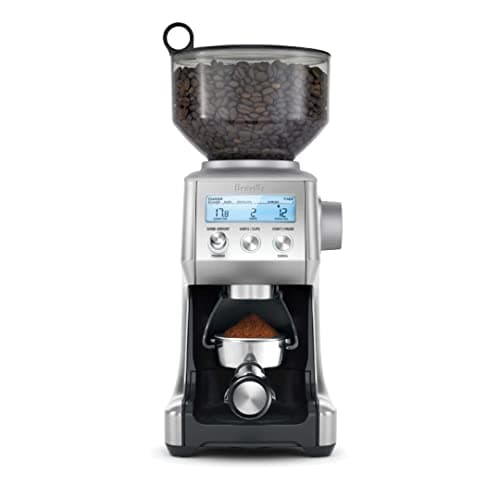
The Breville Smart Grinder Pro exists for the household that does not brew just one way. Maybe it is espresso on weekday mornings and a pour-over or French press at the weekend; maybe two people in the house like their coffee made differently. The Smart Grinder Pro handles all of it from a single machine: 60 stepped settings run from a fine espresso grind all the way out to a coarse French press one, a clear display shows you the dose and the grind time so tomorrow's grind matches today's, and it grinds hands-free straight into the portafilter or a container. It is not the sharpest espresso tool on this hub, but for sheer versatility and ease of living, it is one of the friendliest grinders you can put on a counter, which is why it sits in our best electric espresso grinders under $500.
The headline feature is the range. Because the 60 settings span the whole brewing spectrum, one grinder covers a shot of espresso, a Hario V60, an AeroPress and a French press without a compromise you have to think about. You dial to the espresso end for a fine, portafilter grind; you dial toward the coarse end for a big, even French press grind that will not over-extract. That flexibility is the entire reason to choose this grinder over a single-purpose one, and it is why it lands on our best grinders for drip and pour overas well as its espresso credentials — a genuine do-it-all for a mixed-brewing home.
The living-with-it details are what make the Smart Grinder Pro so approachable. The digital display shows the grind time and the dose, so you set it once and get the same amount of coffee every day, and timed dosing lets the grinder run hands-free straight into the portafilter cradle or a catch container while you do something else. There is nothing to learn and very little to get wrong — it is widely available, familiar, and forgiving, which is exactly what a first electric grinder should be. If you are weighing it against the other genuinely capable starter on this hub, our Baratza Encore ESP review covers the grinder most people cross-shop against it.
The honest catch is resolution and burr type. Sixty steppedsettings spread across the entire brewing range put fewer of them in the tight espresso window than a stepless dial does, so a picky machine may occasionally leave you wishing for a setting between two clicks. And the conical burrs, efficient and forgiving as they are, trail the flat-burr grinders on this hub for the last increment of espresso clarity. Neither is a flaw so much as the price of being a do-everything grinder rather than an espresso specialist — if espresso is the only thing you brew and you want the finest possible dial-in, our best grinders for espresso points you to the specialists instead.
Who the Smart Grinder Pro is really for
The Smart Grinder Pro suits one buyer especially well: the household that brews more than one way and wants a single, fuss-free grinder to do all of it. If your week includes espresso and also pour-over, drip, AeroPress or French press — or if two people brew differently under one roof — the 60-setting range means you dial from a shot to a carafe and back without owning two grinders. Add the display and timed dosing and it is genuinely easy to live with, which makes it a strong first electric grinder. Where it is notthe right pick is the espresso purist. If shots are the only thing you make and you want the finest adjustment and the cleanest, most separated cup, a stepless flat-burr grinder will out-dial and out-clarify it — our best grinders for espresso covers those specialists. Match the grinder to how you actually brew, and the Smart Grinder Pro is a smart, versatile buy; buy it as a dedicated espresso tool and you are paying for range you do not need.
60 stepped settings vs a stepless dial for espresso
This is the trade that defines the grinder, so it is worth being precise. The Smart Grinder Pro uses 60 stepped settings— fixed clicks you dial between — spread across the entire brewing range from espresso to French press. That is plenty of resolution for filter brewing, where a small grind difference matters far less, and it is enough for most home espresso setups. But because those 60 steps have to cover the whole spectrum, relatively few of them fall inside the narrow espresso window, and espresso is the brew method most sensitive to a tiny grind change. A steplessgrinder, by contrast, moves continuously, so you can land on any point between two of the Breville's clicks. In practice, most people dial in a fine espresso setting on the Smart Grinder Pro without trouble; the limitation shows up when a fussy machine or a light roast wants a grind that sits between two steps and you cannot get there. It is the honest ceiling of a do-everything stepped grinder.
Conical burrs, the display and the hands-free workflow
The Smart Grinder Pro runs conical burrs, which are efficient, forgiving and make genuinely good coffee across the whole range. Conicals tend to run a touch more bimodal than flat burrs, which reads in the cup as more body and a rounder, more blended sweetness — lovely for milk drinks and darker roasts, and very forgiving of a slightly-off dose. What they give up is the last increment of clarity a flat burr delivers on black, light-roast espresso, which is the honest reason the flat-burr grinders on this hub score higher for espresso specifically. Around the burrs, the living experience is the selling point: the dose-and-timer display shows how long the grinder runs and lets you set a repeatable dose, and timed dosinggrinds hands-free straight into the portafilter cradle or a container. The one workflow cost is retention — a hopper-fed grinder like this keeps more coffee inside between doses than a purpose-built single-doser, so bean changes take a small purge. If near-zero waste and constant bean-swapping matter to you, our best single-dose grinders roundup is the better starting point.
What we did not test
We have not run this grinder on a bench for months, and we will not pretend otherwise. This review compiles Breville's published specifications, cross-checks how conical burrs and stepped adjustment work, and weighs aggregated owner reports against our scoring rubric. The specs — the conical burrs, the 60 stepped settings, the dose-and-timer display and the hands-free dosing — come from Breville's own materials, listed in Sources. Our scores are editorial judgments from that documented research, not measured numbers: there is no particle-size rig or retention scale behind them. Where hands-on time would tell you more than a spec sheet — exactly how many of the 60 steps land usefully inside the espresso window on your machine, or how much coffee the hopper holds back between two beans — we say so rather than invent a figure. The claim we are most confident in is the simplest: 60 stepped settings across the whole range make this an outstanding all-rounder and a coarser espresso tool than a stepless flat-burr grinder, and every published spec and owner account we found supports that.
How we picked
We did not lab-test this gear
Everyone in this category says they tested twenty machines. We have not pulled shots on every product here, and we say so. What we did instead: compiled the published specifications, cross-checked the manufacturer manuals, computed the running cost (wattage to energy, grams-per-shot to cost-per-cup), weighed aggregated owner reports, and scored each product against a published rubric. The scores are judgments from documented research — not measurements we took, because we do not have a test lab and we will not pretend we do. Where hands-on time would tell you more than a spec sheet, we flag it. Where a number came from someone else's work, we name them in Sources.