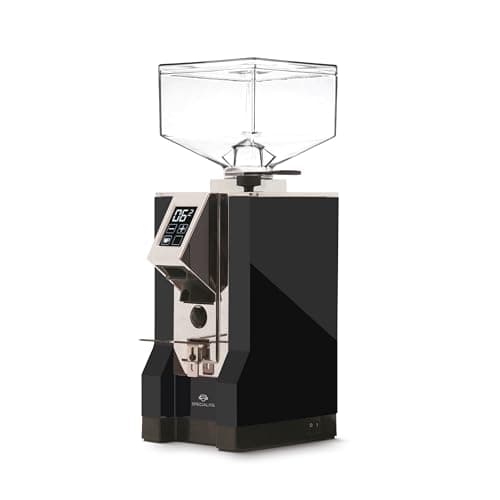
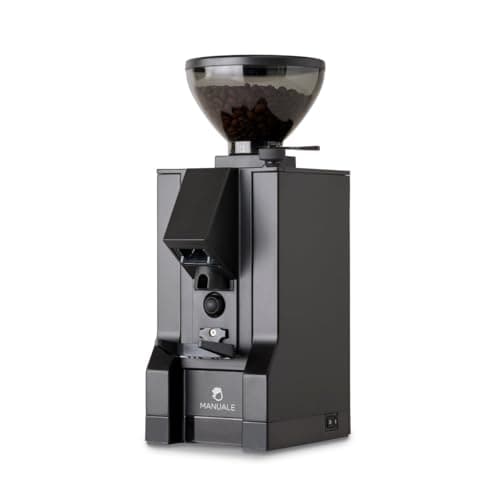
The Eureka Mignon Notte and the Eureka Mignon Specialita are close cousins: both are compact, Italian-built, hopper-fed on-demand espresso grinders, both run flat steel burrs behind a stepless collar, and both belong to Eureka's quiet Mignon line. If you have decided you want a Mignon — and a lot of home baristas do, because it is the classic step up from a stepped starter grinder — the real question is not whether to buy one but which one. This page puts the newer, streamlined Notte next to the established, feature-rich Specialita and sorts out where the money and the differences actually go.
The short version is a difference of philosophy inside one family. The Notte is the pared-back, notably quiet Mignon: 50mm flat steel burrs, a clean stepless dial, grind-on-demand straight into the portafilter, and a body that keeps the price closer to earth. The Specialitais the more feature-laden model that has been the default Mignon recommendation for years: slightly larger 55mm flat burrs, Eureka's patented micrometric stepless collar, and a front touchscreen that stores two programmable timed doses so a dialed-in shot repeats with a tap. Both are genuinely quiet, both hold their setting, and both make espresso that will out-class whatever came bundled with your machine. You can read each on its own in our Eureka Mignon Specialita review; this page is about which of the two suits you.
One honest framing before the specs, because it decides more than the burr size does: both of these are hopper-fed on-demand grinders, not purpose-built single-dosers. Many owners single-dose either one by pulling the hopper and dropping a weighed dose straight onto the burrs, and it works, but there is modest, real retention to purge and no bellows in the box. If a low-retention, weigh-in-weigh-out workflow is your actual priority, a dedicated single-doser will serve you better — start with our best single-dose grinders. If you want a quiet, precise, grind-and-walk-away Mignon and are relaxed about that, read on.
Burrs: 50mm vs 55mm, and what the difference is really worth
Both grinders use flat steel burrs, which is exactly why both make the clean, separated espresso the Mignon line is known for. The headline difference is size: the Notte's 50mm set against the Specialita's 55mm. It is tempting to read that as a straight upgrade, but burr diameter is only one input into grind quality, and the gap between 50mm and 55mm is small. A larger flat burr can cut a dose a touch faster and run a little cooler, which nudges consistency in its favor, and the Specialita's 55mm set is a genuinely excellent espresso burr. But you are not choosing between good and bad grounds here — both produce uniform, espresso-ready coffee that will flatter a single-boiler or prosumer machine. Treat the extra 5mm as a refinement, not a revolution: it is part of what you pay more for on the Specialita, alongside the touchscreen and the micrometric collar, rather than the reason to buy it on its own. If burr format is the thing you want to understand better before you spend, our best flat-burr grinders page lays out what flat geometry actually buys you and who benefits.
Adjustment: a plain stepless dial vs the micrometric collar
Both Mignons are stepless, which is the single most important thing for espresso: instead of jumping between fixed clicks, you sweep the collar continuously and settle on the exact point the shot wants. That alone puts either grinder well ahead of a stepped starter for dialing in. Where they part is feel and legibility. The Specialita uses Eureka's patented micrometric regulation, and in practice it moves in whispers — the resolution is fine enough that you can creep up on a target shot time rather than bracket it, which is a real pleasure when you are chasing a fussy light roast. The Notte's stepless dial does the same fundamental job, but it is a plainer mechanism with no numbered scale, so you keep track of your setting yourself — a reference mark, a photo, or just muscle memory. Neither approach is wrong. If you dial in rarely and leave the grinder on one bean, the Notte's simplicity is fine. If you switch beans and want to return to a known point confidently, the Specialita's more refined, more legible collar earns part of its premium. Our best grinders for espresso puts both in the wider context of how much adjustment resolution actually matters.
The touchscreen timer: the everyday difference you feel
This is the feature that most separates living with a Specialita from living with a Notte. The Specialita carries a front touchscreen that stores two programmable timed doses plus a continuous mode, so once you have dialed a single and a double, you tap and it grinds exactly that weight of coffee hands-free into the portafilter fork every time. For a household that pulls the same one or two drinks each morning, that repeatability is genuinely convenient — it takes the guesswork and the second-guessing out of dosing. The Notte is the simpler machine: you grind on demand and manage the dose yourself, whether by time, by feel, or by grinding onto a scale. Plenty of serious baristas prefer to weigh every dose regardless of what the grinder offers, and for them the touchscreen is a convenience they will not use and should not pay for. So be honest about your routine. If “press a button, get my usual double” is the dream, the Specialita is built for it. If you are going to put a cup on a scale anyway, the Notte does the grinding just as well and keeps the money in your pocket.
Noise, build and the shared single-dose caveat
Both grinders are quiet, and that is not a small thing — a lower, calmer grind at 6am in a sleeping house is one of the main reasons people move up to a Mignon at all. The Specialita is part of Eureka's Silent Technology range and is one of the quietest on-demand grinders you can buy; the Notte is likewise built around quiet operation and is notably calm for an electric. Neither is silent, because both are still crushing beans, but you will not wince using either early. Build is shared DNA too: compact, planted, Italian, and clearly a tier above a plastic starter grinder. The honest caveat applies equally to both, so it is worth repeating rather than burying — these are hopper-fed on-demand grinders, not dedicated single-dosers. You can pull the hopper and single-dose either one, and many owners do, but there is no bellows and retention is modest but real, so back-to-back bean changes want a small purge. If bean-swapping and near-zero waste is the thing you care about most, neither Mignon is the ideal tool, and a purpose-built single-doser from our best single-dose grinders roundup will suit you better. We did not bench-test either grinder; our methodology explains how we score from documented specs and aggregated owner reports instead.
Price and where each Mignon sits in the range
The last piece is money. Both Mignons are a genuine step up in price from a stepped starter grinder — that is the cost of the stepless collar, the quiet motor and the Italian build. Between the two, the Notte generally lands at the more approachable price and the Specialita commands the premium for its touchscreen timer, larger 55mm burrs and micrometric feel. We keep the exact figures out of the prose on purpose, because prices move and the live price renders in the buy button, but the relationship is the useful part: the Notte is the value-forward Mignon and the Specialita is the do-more Mignon. If even the Notte is more than you want to commit right now, the value tier below both lives in our best electric espresso grinders under $500roundup, which ranks the Notte among cheaper on-demand and single-dose options and shows you exactly what you would be trading away. Whichever Mignon wins for you, budget for it as the part of the setup that most decides your cup — a great grinder feeding a modest machine beats a great machine fed by a poor grinder every time.