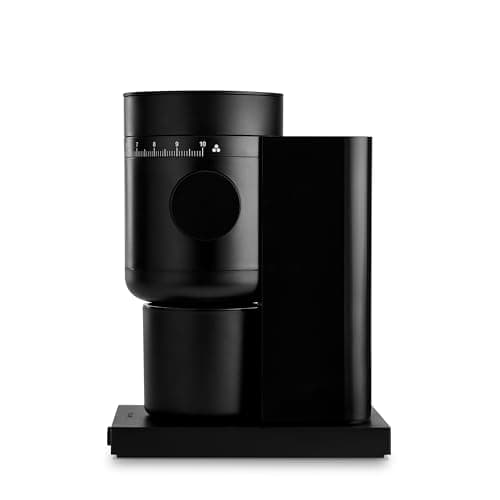
The Fellow Opus 2 is a good espresso grinder sold as a good everything grinder, and the gap between those two claims is the whole review. What Fellow actually built is a compact 48mm conical with a stepless dial, near-zero retention, an ionizer that keeps static down, and — the detail that matters most for this site's readers — a 30 gram espresso dosing cup that drops into both 54mm and 58mm portafilters. On espresso it is fast, tidy and easy to dial in. On pour-over it is adequate rather than special, which is not what the marketing suggests.
Some context on what changed, because "Opus 2" is a real redesign rather than a new color. The original Opus ran 40mm burrs and a stepped adjustment. The Opus 2 moves to 48mm stainless steel conical burrs, swaps in a stepless external dial marked with 48 positions, reworks the grind path for lower retention, upgrades the ionizer, and grinds noticeably faster. Fellow publishes 300 W, a 100 gram single-dose load bin, 8.1 × 5.1 × 10.5 inches, 5.1 pounds, auto-stop when the beans run out, and a two-year warranty. Two magnetic catch cups come in the box: a 100 gram standard cup and the 30 gram espresso dosing cup.
The speed claim holds up. Coffee Chronicler, reviewing it hands-on, ground 18 grams of espresso in 9 seconds and measured retention at 0.1 to 0.2 grams. Those are genuinely good numbers for a conical at this price, and they add up to a workflow that feels like a much more expensive grinder: you weigh beans into the bin, press one button, and the dose arrives in your dosing cup with almost nothing left behind. Because retention is that low, a grind adjustment lands on your very next shot instead of the one after it, which is the single most underrated quality in an espresso grinder.
The honest caveats are three, and none of them is a dealbreaker. First, it is loud— the same reviewer put it at 84 to 85 dB, with some rattle. Second, the grind chamber and impeller are plastic, which is normal at this price but worth knowing if you expect metal for two hundred dollars. Third, owner reports on retention conflict with the measured figure: a number of Reddit owners describe getting 1 to 2.5 grams out only after tapping the body and using the lid as a bellows. We have not benched this grinder, so we report both: a careful reviewer measured a tenth of a gram, and a meaningful group of owners are not seeing that in practice.
Where we part company with Fellow's own positioning is filter coffee. Coffee Chronicler's verdict after side-by-side brewing was blunt: it lost every comparison, and the cup "just lacks sweetness and development". Their recommendation was to skip it if pour-over is your main method and buy it if espresso is — which is the opposite of how a grinder with "espresso to cold brew" on the box tends to be read. That matches the physics: a 48mm conical is a sensible espresso burr and a modest filter burr, and flat-burr grinders in the same money produce more separated, sweeter filter coffee. Our best flat burr grinders page covers that tier, and our Fellow Ode Gen 2 review covers Fellow's own 64mm flat-burr brew grinder, which is the Fellow to buy if filter is the point.
So: buy the Opus 2 if espresso is your main brew method, you want a compact single-dose workflow, and you would rather spend two hundred dollars than four. Skip it if pour-over is your morning, or if you are chasing light-roast espresso clarity — both of those point at flat burrs. Our best espresso grinders page places it against the field.
What the Opus 2 changed, spec by spec
The Opus 2 is a real redesign rather than a refresh, and it is worth being precise about what moved. Figures are Fellow's published specifications for this listing.
| | Opus (original) | Opus 2 |
|---|
| Burrs | 40mm conical | 48mm stainless conical |
| Adjustment | Stepped | Stepless dial, 48 marked positions |
| Grind path | Standard | Redesigned for lower retention |
| Anti-static | Ionizer | Upgraded ionizer |
| Catch cups | One | 100g standard + 30g espresso dosing cup |
| Load bin | Hopper-style | 100g single-dose bin, auto-stop |
The single-dose bin with auto-stop is the quiet workflow change. You weigh beans in, the grinder runs until they are gone and switches itself off, and you do not stand there guessing at a timer. Combined with low retention, that is the whole reason this grinder feels more expensive than it is. Our single dosing explained guide covers the workflow if it is new to you.
The 30g dosing cup, and why it matters here
Most grinders at this price grind into a generic cup and leave you to tip it into a basket, losing grounds on the counter. Fellow ships a dedicated 30 gram espresso dosing cup that seats in both 54mm and 58mm portafilters, which covers essentially every home espresso machine with a portafilter — the 54mm Breville machines on one side, the 58mm commercial standard on the other. In practice that turns a transfer step into an invert-and-tap, and it is a meaningfully tidier daily routine than the alternative.
It is not a substitute for a real dosing funnel if you work with a bottomless portafilter and want zero spill, and you will still want a scale, because 30 grams is the cup's capacity and not a dose. Our best dosing cups page covers the category, and best espresso scales covers the other half of a weighed workflow.
Conical burrs: what you gain and give up
A 48mm conical is a sound espresso burr and a modest filter burr, and understanding why explains every review of this grinder. Conicals produce a slightly wider spread of particle sizes than flat burrs of similar diameter. In espresso that spread is partly an asset — the finer fraction helps build resistance in the puck, and medium and dark roasts taste full and sweet through it. In filter brewing, where you want uniform particles so every ground extracts at the same rate, that same spread costs you clarity and separation. That is exactly what Coffee Chronicler found: good dark-roast espresso, and filter coffee that lost every side-by-side against a comparably priced flat burr.
The practical consequence for shopping is that you should buy the burr geometry that matches your main brew method, not the grinder with the widest range printed on the box. Our best grinders for drip and pour over page ranks the filter field, and best espresso grinders ranks the espresso one.
Where it sits against the obvious alternatives
At roughly this money the Opus 2's real rival is the Baratza Encore ESP, and the two have opposite characters. The Encore ESP is stepped with 40 settings re-geared into the espresso range, grinds on demand straight into a portafilter, and has the best parts and repair support in home coffee. The Opus 2 is stepless, grinds into a cup rather than the basket, is faster and tidier, and comes with the 30 gram dosing cup. Pick the Encore ESP if you want repeatable numbered settings and serviceability; pick the Opus 2 if you want stepless adjustment, speed and single-dosing.
Step up and the comparison gets harder for the Opus 2. The DF54 costs more but brings 54mm flat burrs, stepless micrometric adjustment and sub-0.1 gram retention, which is a real increase in espresso grind uniformity rather than a workflow change. If you are building around a 58mm machine and intend to keep it, that is the upgrade that changes the cup. Our best grinders for the Gaggia Classic page works through that decision for a specific machine, and best grinders for the Breville Bambino does the same for 54mm Breville owners.
What we did not test
We have not benched this grinder. We do not have a lab, and we say so on our methodologypage. Every figure above is either Fellow's published specification or a measurement attributed to the named hands-on reviewer who took it. We have not measured particle distribution, long-term burr wear, or motor life, and we have not verified the conflicting owner reports on retention in either direction — which is exactly why both the measured figure and the owner complaints appear above instead of only the flattering one.