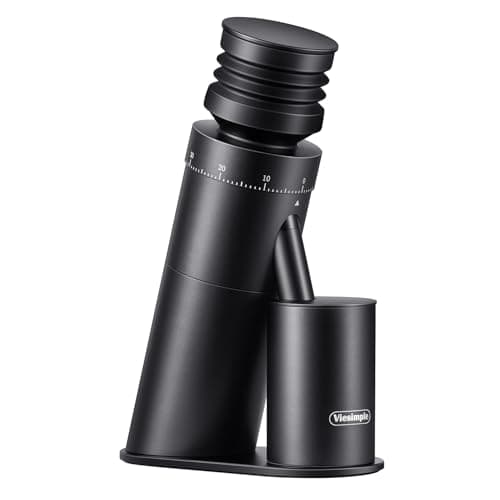
The Viesimple Gen 4 is the kind of product that only exists on a marketplace: a single-dose electric grinder with 48mm five-blade conical burrs, a body that the listing describes as made of high-quality aluminum, a magnetic dosing cup with a sealed lid, a 30 g capacityand a two-year warranty — sold at roughly the price of a Fellow Opus 2, with no brand behind it that you have heard of and no manufacturer website we could verify. It has a 4.5-star average from several hundred ratings and Amazon lists it as a top-50 seller in burr coffee grinders, so it is not vaporware. Real people are buying it and most of them are pleased.
We still cannot recommend it for espresso, and the reason is specific rather than snobbish: Viesimple does not publish a grind-adjustment specification anywhere on the listing. Not a step count, not a micron-per-step figure, not even whether the adjustment is stepped or stepless. For drip, press and pour over that omission is survivable. For espresso it is the entire question, because dialing a shot means moving in increments of roughly 10 to 25 microns inside a window you cannot see, and a grinder that will not tell you how far one click moves the burrs is a grinder you are dialing in blind. Our espresso grind size guide explains the window; our dial-in guide explains the hunt.
A note on how we work before the specifics: this is a desk review built from Viesimple's own listing copy and product-details table, plus Amazon's aggregated owner reports, all named in Sources. We have not bench-tested this grinder, we do not have a lab, and our methodology pagesays so plainly. For this product that matters more than usual, because the third-party “reviews” you will find in search results disagree with each other about basic specifications in ways that suggest nobody had one in front of them.
What the manufacturer actually states
Everything in this section comes from the listing itself — the feature bullets and the product details table. We have labeled the claims that are claims.
A 48mm conical burr described as five-blade. 48mm is a real step up from the 38 to 40mm cones in budget grinders and matches the burr diameter in the Fellow Opus 2 and the 1Zpresso J. Viesimple does not state the burr material. The “five-blade” description refers to the cutting geometry; one third-party page describes a seven-blade burr instead, which is one of several contradictions worth knowing about before you trust any single source on this grinder.
An aluminum body, 3.4 lb, 6 x 3 x 9 inches, 30 g capacity.That is a genuinely small footprint — narrower than almost any electric grinder with burrs this size — and 30 g is a single-dose capacity by design rather than a hopper. Single dosing is the workflow where you weigh exactly the beans you are about to grind and put them straight in, which our single dosing guide covers and our best single-dose grinders roundup ranks.
A magnetic dosing cup with a sealed lid, and a blow-out funnel. The cup returns to position magnetically and the lid is claimed to be 100% anti-fly. This is the part owners mention most approvingly and it is the hardest part of a single-dose grinder to get right, because grounds that spray are the whole reason people dislike the workflow.
Under 50 dB claimed, with a motor the listing describes as 99% trouble-free with a lifespan over ten years.The noise figure is a manufacturer claim with no stated test conditions; the reliability figures are marketing and should be read as such. Owners do consistently report it as quiet — 52 of 61 reviewers who mention noise are positive — which supports the direction if not the number.
“Less than 0.2% debris residue” from a food-grade anti-static coating.Read that carefully, because it is widely misquoted. Several affiliate pages report it as “retention below 0.2 g”, which would be an excellent figure for a 48mm grinder. The listing says 0.2 percent, which on an 18 g dose is 0.036 g — an implausibly good number, and in any case a different quantity measured a different way. We are reporting the claim, not endorsing either reading.
Voltage, stated twice and inconsistently.The feature bullets say 100–240V for worldwide use; the product details table on the same listing says 110 volts. If you need a dual-voltage grinder, treat this as unresolved and ask the seller.
Two-year warranty, handled through Amazon messaging. That is the stated support channel. There is no service network and no manufacturer site we could verify, which is the structural risk with marketplace-brand appliances: the warranty is only as durable as the seller account.
The missing specification, and why it decides the purchase
Here is the gap. Nowhere on the listing — not in the title, the bullets, the details table or the A+ content — does Viesimple state how the grind adjustment works. There is no step count, no step size in microns or millimeters, and no statement of whether the mechanism is stepped or stepless.
Third-party pages fill the vacuum with numbers, and the numbers do not agree. We found “90 grind settings”, “60 settings”, “90 per rotation” and “17 fine settings plus 80 coarse positions” across different pages, several of which also disagreed about the burr blade count and the weight. Those are not independent measurements converging on a figure; they are the signature of generated content copying each other. We are not going to add a fifth number to that pile.
Why it matters so much for espresso: a shot that gushes in 18 seconds and a shot that chokes at 45 can be separated by a single small adjustment, which is why espresso-capable grinders advertise their resolution in microns per click and why espresso-geared models exist as separate SKUs from otherwise identical filter grinders. A grinder that does not publish the number may well have fine enough adjustment — several owners report pulling good shots, including one who reports landing between settings 2.5 and 3.0 on a Flair-style manual press, which implies a numbered dial with fractional positions. But “may well” is not a specification, and you would be buying on hope.
The honest framing: for filter brewing, where adjacent settings differ by something you can taste and nothing you need to split, the missing figure costs you very little. For espresso on an unpressurized basket, it is a disqualifying unknown. On a pressurized basket, which manufactures its own back-pressure and forgives grind imprecision, it matters much less — and that is the setup most people who buy a $170 grinder are actually brewing on.
What owners report
Amazon's aggregated review data is the closest thing to hands-on evidence available for this grinder, and it is worth reading carefully rather than as a star average. Treating each aspect separately:
| What owners mention | Mentions | Positive | Negative |
|---|
| Grind quality | 129 | 120 | 9 |
| Grind consistency | 72 | 59 | 13 |
| Functionality | 68 | 62 | 6 |
| Noise level | 61 | 52 | 9 |
| Value for money | 61 | 50 | 11 |
| Appearance | 43 | 42 | 1 |
| Grind size | 38 | 31 | 7 |
| Build quality | 33 | 33 | 0 |
Two patterns stand out. Build quality is unanimously positive— 33 mentions, zero negative — which is unusual and consistent with the aluminum body claim. And grind consistency is the weakest column: 13 negative out of 72, roughly one in five, against only 9 of 129 negative on grind quality generally. Those two aspects should track each other, and when consistency underperforms quality it usually means the grinder produces a good grind that is not perfectly repeatable between doses — which is precisely the symptom you would expect from an adjustment mechanism with poor indexing, and precisely the thing the unpublished specification would have told us about.
Amazon's own summary of the review text notes that customers praise the grind results and specifically that it works well with Flair espresso presses, along with the quiet operation, solid construction and compact size. That is owner reporting, not measurement, and we are presenting it as such.
Where it sits against grinders we can specify
The comparison that matters is not against cheaper grinders — it is against the grinders at the same money whose adjustment mechanisms are documented.
Fellow Opus 2 is the direct rival: the same 48mm burr diameter, a published stepless adjustment, a real company with a published spec sheet and a support line, in the same price neighborhood. If you want 48mm burrs at this price and you want to know what you are buying, this is the default answer.
The DF54 is the single-dose enthusiast pick in this bracket, with a documented adjustment mechanism and an owner community that has mapped its behavior in detail. Our DF64 vs DF54 comparison covers where it lands against the step up.
Baratza Encore ESP costs similar money with smaller burrs and worse single-dose ergonomics, and buys you the thing Viesimple cannot sell you: a documented grind range, a repair-friendly design and a company that will still exist in five years.
Hand grinders deserve a mention because at this price they win the spec argument outright. A 1Zpresso J publishes its burr diameter, its micron-per-click figure and its total travel, and costs less. What you give up is the button. Our hand versus electric guide is the honest version of that trade.
Who should buy it
If you single-dose for filter coffee, want 48mm burrs and a small aluminum footprint, like the magnetic-cup workflow and are comfortable buying a marketplace brand on the strength of several hundred owner reviews rather than a spec sheet, this is a defensible purchase and the owners largely agree.
If you are buying a grinder to dial in espresso on an unpressurized basket, buy something that publishes its adjustment specification. Not because the Viesimple is necessarily bad at it, but because you will spend the first month unable to tell whether a bad shot is your technique or the grinder — and that is a miserable way to learn espresso. Our best grinders for espresso page ranks the field on documented resolution.
How to buy a marketplace-brand grinder without getting burned
The Viesimple is one of dozens of near-identical single-dose grinders sold under brand names that did not exist three years ago. Some are genuinely good value and some are a bad burr set in a nice aluminum tube. The specifications below are the ones that separate them, in order of how much they tell you.
| Specification | What a good listing states | Viesimple Gen 4 |
|---|
| Adjustment mechanism | Stepped or stepless, with a step count or micron figure | Not published |
| Burr diameter | A number in millimeters | 48mm |
| Burr material | A named steel grade, e.g. SUS420 or S2C | Not stated |
| Capacity | Grams, and whether it is a hopper or single dose | 30 g, single dose |
| Retention | Grams left in the grinder after a dose | Claims <0.2% debris residue (not the same thing) |
| Body material | Named metal or polymer, not “premium” | Aluminum |
| Warranty route | A company, an address, a support channel | Two years via Amazon messaging |
A listing that states the top row is telling you it expects espresso buyers. A listing that omits it is telling you something too. That is not a verdict on the hardware — it is a read on who the product was specified for.
Reading retention claims honestly
Retention is the coffee that stays inside the grinder after you finish a dose, and it is the reason single dosing exists as a workflow: yesterday's stale grounds mixing into today's shot is a real and tasteable problem. The useful figure is in grams, measured by grinding a known dose and weighing what comes out.
“Less than 0.2% debris residue” is not that figure. As a percentage of an 18 g dose it works out to 0.036 g, which would be an extraordinary result for a 48mm conical grinder, and nothing on the listing says how it was measured or of what the percentage is taken. The anti-static coating and blow-out funnel the claim is attached to are real design features that plausibly help; the number attached to them is not something you can plan around.
What to do instead: grind 18 g, weigh the output, and if the gap bothers you, run a single-bean “bellows shot” or a small purge dose before each grind. Our single dosing guide covers the routine and our grinder cleaning guide covers the buildup that makes retention worse over months.
Where 48mm burrs actually land
Burr diameter is the specification people over-read, so it is worth being plain about what 48mm buys. Bigger burrs grind faster and generate less heat for a given dose, and at the extremes they change the grind particle distribution. Between 38mm and 48mm on an electric grinder, the honest effect for home doses is mostly speed and consistency under load rather than a dramatically different cup.
48mm is the diameter in the Fellow Opus 2 and in the top tier of hand grinders. It is a genuine specification advantage over the 38 to 40mm cones in most sub-$150 electrics, and it is not the reason a grinder is or is not espresso-capable — that is the adjustment mechanism, every time. Our burr versus blade guide covers what burr geometry does and our flat burr page covers the conical-versus-flat question, which also matters less than the marketing suggests.
What we did not test
We have not bench-tested this grinder. Every specification above — the 48mm five-blade conical burr, the aluminum body, the 3.4 lb weight, the 6 x 3 x 9 inch dimensions, the 30 g capacity, the sub-50 dB and sub-0.2% residue claims, the two-year warranty and both conflicting voltage figures — is taken from Viesimple's own Amazon listing, which is the only first-party source we could verify for this brand. The owner-report table is Amazon's aggregated review data, reported as owner sentiment and not as measurement. We have not measured particle distribution, retention in grams, grind time, noise in decibels or burr life, and we have not pulled espresso on this grinder. Where third-party sites state figures the manufacturer does not — grind step counts in particular — we have reported that they disagree rather than choosing one.