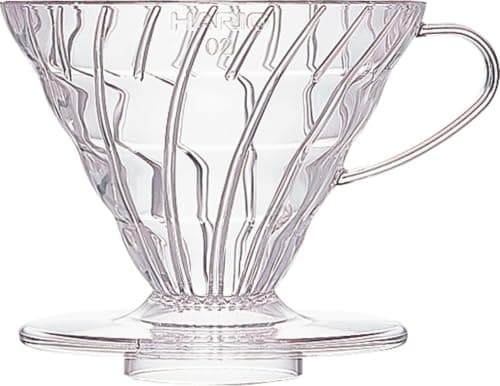
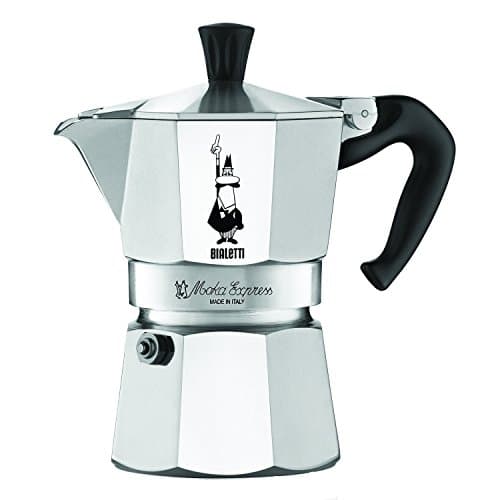
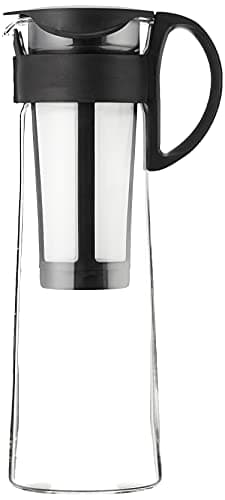
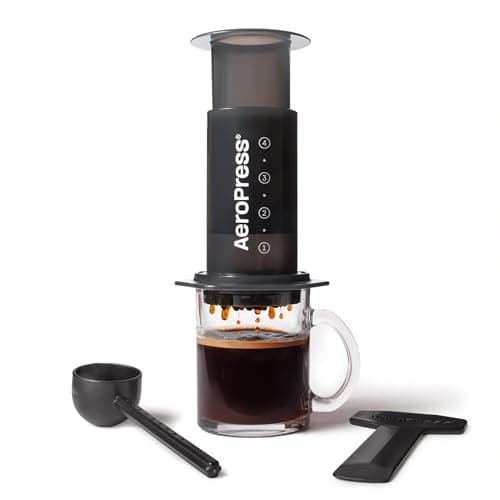
The best coffee maker for one person is the AeroPress Original — it brews one excellent cup in about two minutes, cleans up in ten seconds, forgives an imprecise grind, and costs less than two bags of good beans. If you want the cleanest, most aromatic cup and do not mind a kettle and a little attention, the Hario V60 in plastic is the cheapest great brewer made. If you want something small, strong and espresso-adjacent on a stovetop, a 3-cup Bialetti Moka Express is the one. And if you drink iced coffee, a Hario Mizudashi brews a few days of cold brew in your fridge door with no effort at all.
The reason this needs its own page is that the default purchase — a 10 or 12-cup drip machine — is actively bad at making one cup, and most buying guides will not tell you so because they are written around the machines that sell best.
Why a carafe drip machine fails at one cup
The coffee bed is the wrong shape. A drip basket is sized for 50 to 60 grams of coffee. Put 15 grams in it and you get a thin layer spread across a wide flat filter, so water races through in a fraction of the intended time and extracts far too little. The result is weak and sour at the same time — the signature of under-extraction. You cannot fix it by using less water, because less water through a shallower bed is exactly the problem.
The shower head does not wet it evenly. Most home drip machines dribble water from a few holes in the middle of the basket and rely on a deep bed to even it out. With a shallow single-cup bed, the middle over-extracts while the edges stay dry. A good single-cup brewer either immerses the coffee (so wetting is total by definition) or lets you pour where you choose.
Then it stews what it made. A hotplate holds brewed coffee at a temperature where it continues to change, and twenty minutes of that turns a fresh pot bitter and flat. For one person that is almost the entire pot.
And it is the most cleaning per cup of coffee of any method here. A carafe, a basket, a filter and a reservoir, for one drink.
What actually matters in a one-person brewer
Dose-matched geometry. The brewer should be designed around 12 to 20 grams of coffee — that is one strong mug. Every pick below is.
Total time, including cleanup. This is the spec that decides whether you still use it in six months. An AeroPress is roughly two minutes to brew and ten seconds to clean. A V60 is three minutes and thirty seconds. A moka pot is five minutes on the hob and a rinse. A drip machine is two minutes of attention and several minutes of washing up. On a weekday the difference between ten seconds and three minutes of cleaning is the difference between a habit and a cupboard ornament.
Tolerance for an imprecise grind. If you are brewing one cup you probably do not own a $300 grinder, and some methods punish an uneven grind far more than others. Immersion brewing — where coffee sits in water — is the forgiving category, which is why the AeroPress leads this page. Pour over is less forgiving. Espresso is brutal, which is why no espresso machine appears here at all.
Storage footprint. A single drinker is often a single drinker in a small kitchen, a dorm or an office. Three of the four picks below live in a drawer.
No electricity needed, ideally. Every pick here needs hot water, not a socket — which means a kettle you probably own, a stovetop, or nothing at all for the cold brew. That makes them travel, survive power cuts and work in rooms where appliances are not allowed.
A note on what we have left out. There are genuinely good single-serve pod machines and small one-cup drip brewers, and we have not ranked any of them here because the whole case for this page is that a brewer matched to one dose, with coffee you ground yourself, beats a machine built around a sealed portion. If convenience outranks that for you, read Nespresso vs an espresso machine — the same argument, with the numbers.
The four brewers compared
Times below are our own working figures for a single 12-16 oz drink, including cleanup. Specs are the manufacturers' published figures; prices come from the live price layer with the "as of" date in the quick picks table.
| Brewer | Method | Dose | Time incl. cleanup | Grind | Needs power? |
|---|
| AeroPress Original | Immersion + paper filter | ~15 g | ~2 min | Medium-fine, forgiving | Kettle only |
| Hario V60 (02, plastic) | Pour over | ~15 g | ~4 min | Medium, unforgiving | Kettle only |
| Bialetti Moka Express 3-cup | Steam pressure | ~15-17 g | ~7 min | Medium-fine, specific | Stovetop |
| Hario Mizudashi 1 L | Cold immersion | ~70-80 g per litre | Overnight, then instant | Coarse, very forgiving | No |
The grinder question, for one person
You do not need to spend much, and you should not skip it. Pre-ground coffee stales within days of opening the bag, and for a single drinker a bag lasts weeks — so pre-ground means most of your coffee is stale by the time you drink it. That is a bigger quality loss than any brewer choice on this page.
A hand grinder is the right tool here for a reason that has nothing to do with purism: at a single 15-gram dose, cranking takes about thirty seconds, which is nothing, and a hand grinder at any given price has better burrs than an electric at the same price because there is no motor to pay for. Best hand grinders ranks the field, hand vs electric grinders covers the trade, and burr vs blade grinders explains why the cheap blade grinder in the supermarket is not an option.
Storing beans when you only drink one cup a day
This is the single-drinker problem nobody mentions. A standard 12 oz bag is roughly 22 single cups, so at one a day it is open for three weeks — and coffee degrades fastest in the first two weeks after the bag is opened. Two practical fixes: buy smaller bags more often, or decant into a smaller airtight container so the coffee is not sitting in a part-empty bag of air. How to store coffee beans covers what actually helps, and best coffee canisters has the containers worth owning.
If you want a machine rather than a brewer
Two legitimate reasons to go electric as a single drinker: you want to press one button while half asleep, or you want milk drinks. For the first, a small drip machine is a reasonable buy as long as you accept the compromise — best drip coffee makers ranks them and the smaller models brew a single mug far better than a 12-cup does. For the second, you are really asking about espresso, and best espresso machines for small kitchens plus best espresso machines for beginners are the right pages.
The complete one-person kit
For well under $150 total: the AeroPress, a hand grinder, a scale you probably already own in the kitchen drawer, and a kettle. Add a gooseneck kettle only if you buy the V60 — for an AeroPress any kettle is fine. That kit makes better coffee than a $300 appliance, travels in a bag, and fits in a drawer. It is also the kit we would recommend to someone living alone who is not sure how much they care about coffee yet, because nothing in it is wasted if the answer turns out to be "quite a lot".