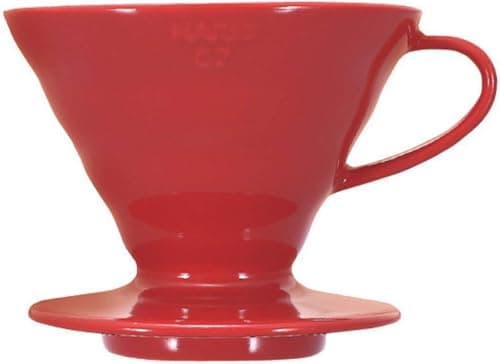
If you have ever watched a barista at a specialty roaster hand-brew a single cup to show you what a bag of beans actually tastes like, there is a very good chance they reached for a Hario V60. It is the dripper the industry standardized on — a plain, inexpensive ceramic cone that, in the right hands, pulls the cleanest, brightest, most articulate cup out of good coffee that any popular brewer can. This review is about why that is true, and about the honest condition attached to it.
What you are actually buying is deceptively simple. The V60 is a 60-degree cone (that angle is where the name comes from) with one large hole at the bottom and tall spiral ribs running up the inside walls. Those two design choices matter more than they look: the big single hole imposes no flow restriction of its own, and the ribs hold the paper filter off the wall so air can escape and water can drain freely. Together they hand the control of the brew back to you. Pour fast for a lighter body and a brighter cup; pour slowly, in careful circles, for more contact time and a heavier, sweeter one. The dripper does not decide the coffee — your pour and your grind do.
We reviewed the ceramic Size 02, and the material is a deliberate pick. Ceramic is the heat-retaining choice: it warms up with your rinse water and then holds temperature through the brew, which keeps extraction more even than a thin plastic cone that sheds heat as you go. Size 02 is the one most people want, covering roughly one to four cups from a single brew. It is the version we would point a first-time pour-over buyer at, and the version that anchors our best pour-over coffee makers guide.
Now the honest part. The V60 is the most technique- and pour-sensitive of the popular brewers, precisely because it gives you so much control — control you can use badly. A gushed, uneven pour or an inconsistent grind shows up in the cup as a thin or muddy result far more readily than it would in a more forgiving brewer. So the V60 really wants a gooseneck kettlefor a controlled stream and a consistent grind from a decent burr grinder. It also brews one to a few cups at a time, not a big carafe for a crowd, and you buy its cone-shaped paper filters separately. Pair it with fresh, well-roasted coffee — the kind of quality beansthe V60 was built to show off — and it is hard to beat for the money. Want set-and-forget convenience instead? The V60 is not that, and this review will say so plainly.
Why the cone shape matters
Pour-over drippers come in two broad shapes, and the V60's steep 60-degree cone is the reason it tastes the way it does. In a cone, the coffee bed is deep and narrow, so water filters down through a tall column of grounds and converges on a single large exit hole at the tip. Nothing about the dripper throttles that flow — the tall spiral ribs even hold the paper off the wall so water drains freely and air can escape. The upshot is that how fast the water moves through the coffee is set almost entirely by two things you control: your grind size and how you pour. Grind finer or pour slower and you slow the flow for a heavier, more extracted cup; grind coarser or pour faster and you get a brighter, lighter one. That is the V60's whole appeal — and, as the ease-of-use section below admits, its whole demand.
Ceramic vs plastic vs glass vs metal
Hario sells the same V60 cone in several materials, and the differences are real. We reviewed ceramic, the heat-retaining pick: it takes a moment to warm up with your rinse water, then holds that temperature steadily through the brew for more even extraction. It is also the most solid and the most pleasant to use daily — the trade-offs are that it is heavier and it will break if you drop it on tile. Plastic is the cheapest, lightest and most travel- and camping-friendly, and it preheats almost instantly, but it retains the least heat and can pick up odors over the years. Glass is the good-looking middle ground with decent clarity of appearance but similar fragility to ceramic. Metal drippers look bomb-proof and never break, but thin metal actually sheds heat fastest of all unless preheated well. For a home kitchen where the cup is the point, ceramic Size 02 is the one we would buy; for a backpack, plastic wins.
What you need to brew it well (kettle, grinder, filters)
This is the part of a V60 review that too many skip, and it is the most important. The dripper is inexpensive, but it is only one third of the setup. First, a gooseneck kettle: the narrow spout lets you lay down a slow, precise, controllable stream, which on a V60 is not a luxury but close to a requirement — a wide-mouth kettle dumps water, channels the bed and gives you a muddy or thin cup. Second, a consistent grind from a burr grinder; the V60 rewards uniform particle size, and if you are brewing filter coffee our best grinders for drip and pour over and best hand grinders guides cover the affordable options that pair naturally with a V60. Third, the filters: the V60 uses cone-shaped papers made specifically for it, so budget for those as an ongoing consumable and rinse each one with hot water before brewing to knock back any papery taste. Get these three pieces right and the dripper does the rest.
Who it is for / alternatives (AeroPress, flat-bottom)
The V60 is for the person who genuinely enjoys the ritual — the two or three minutes of pouring in slow circles — and who wants to taste everything a good, fresh bag of coffee has to give. It is not for someone who wants coffee to happen while they are in the shower. If the technique sensitivity puts you off, there are honest alternatives. The AeroPress is far more forgiving and near-impossible to ruin, which is exactly why we compare the two in AeroPress vs pour over. A flat-bottom dripper spreads the bed wider and shallower, which many people find more consistent and forgiving to pour into than a steep cone. And if you want body and low fuss over ultimate clarity, a French press is the classic full-immersion answer — weigh it against the cone in French press vs pour over, or browse the whole field in our coffee makers hub.
What we did not test
We did not run this dripper through months of side-by-side blind cuppings on a bench, and we will not pretend we did. This review compiles Hario's published specifications for the ceramic Size 02 — the cone geometry, spiral-rib design, single-hole drainage and one- to-four-cup capacity — and weighs them against a large body of aggregated owner reports and the wider specialty-coffee consensus, scored against our methodology. What that means in practice: claims about how the V60 is built and what it is designed to do come from Hario's own materials, listed in Sources; judgments about how it behaves — how sensitive it really is to your pour, how much a gooseneck kettle changes the result — are drawn from the weight of owner experience rather than a single controlled measurement we ran ourselves. Where a spec sheet cannot tell you something, we say so instead of inventing a number.
How we picked
We did not lab-test this gear
Everyone in this category says they tested twenty machines. We have not pulled shots on every product here, and we say so. What we did instead: compiled the published specifications, cross-checked the manufacturer manuals, computed the running cost (wattage to energy, grams-per-shot to cost-per-cup), weighed aggregated owner reports, and scored each product against a published rubric. The scores are judgments from documented research — not measurements we took, because we do not have a test lab and we will not pretend we do. Where hands-on time would tell you more than a spec sheet, we flag it. Where a number came from someone else's work, we name them in Sources.