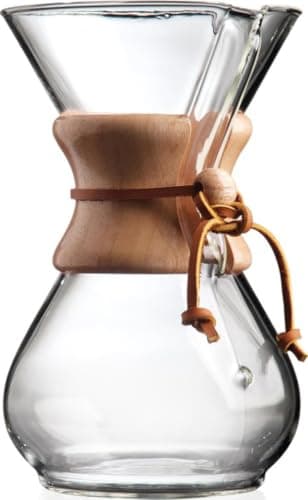
The Chemex is the only coffee brewer most people will ever own that also lives in a museum. Peter Schlumbohm drew the hourglass in 1941, and the Museum of Modern Art has kept one in its permanent design collection ever since — a single piece of borosilicate glass pinched at the waist, wrapped with a wood collar and a leather tie. It is genuinely beautiful. But the reason it earns a place on your counter is not the shape; it is the cup, and the cup comes from the filter. This review is about what that filter does for you, and the honest condition it attaches.
What you are actually buying is a one-piece carafe you both brew in and serve from. Ground coffee goes into a thick paper filter seated in the top cone; you pour hot water over it in slow stages by hand; the brewed coffee collects in the 30 oz lower chamber, ready to pour straight into cups. There is no separate pot, no machine, and nothing with moving parts to fail. The whole object is glass, so it goes in the dishwasher once you slip off the wood collar and its tie. It is the pour-over that doubles as the thing on the table, and it is the carafe member of our best pour-over coffee makers lineup.
The Chemex's signature is the cleanest, brightest cup of any popular brewer, and that is the filter's doing. Chemex bonded filters are markedly thicker than an ordinary cone paper — roughly the reason the brand exists — so they trap more of the oils and fine sediment that a thinner filter lets slip through. The result in the cup is a transparent, tea-like clarity with almost no grit and very little body-muddying oil: fruit, florals and acidity read cleanly, the way a good roaster meant them to. If you have ever found a French press too heavy and silty, the Chemex is the far end of the same spectrum.
Now the honest part, because it is the same thick filter twice over. That thickness is what makes the clean cup, and it is also the catch. It slows the drawdown, so the Chemex brews more slowly than a V60 and rewards a patient, even pour rather than a gush — it really wants a gooseneck kettleand a medium-coarse grind to flow well, and it will stall on a fine grind or a careless stream. The filter is also proprietary: you commit to buying Chemex's own bonded papers, not a cheap everywhere-shape. And the vessel is glass — lovely, but fragile in a way a stainless dripper is not. None of that is a dealbreaker; all of it is worth knowing before you buy.
The thick bonded filter is the whole story
Everything the Chemex is famous for — and everything you have to accept to own one — comes down to a single design choice: the filter is thick. A Chemex bonded filter is made of a heavier, laboratory-grade paper than the thin cone papers a V60 or Kalita uses, and that extra mass does two things at once. It strips out more of the coffee's oils and the finest sediment, which is what gives the Chemex cup its trademark transparency and brightness — a clean, almost tea-like clarity with none of the grit or heavy body you get from metal or immersion brewing. And it slows the water down, because thicker paper drains more slowly. The same property that makes the cup clean makes the brew slow and pour-sensitive. You cannot have one without the other; the filter is genuinely the point and the catch in the same sheet of paper. Practically, that also means a commitment: the Chemex is built around its own proprietary bonded filters (folded circles or pre-folded squares), so you are buying Chemex's papers as an ongoing consumable rather than a common everywhere-shape.
The glass carafe: beauty, serving, and fragility
The body is a single piece of borosilicate glass — the same heat-resistant material as lab glassware — pinched into the hourglass and finished with a polished wood collar and a leather tie at the waist, which is what you hold when the carafe is hot. The upside is real and it is not just looks: you brew and serve from one vessel, so there is no second pot to pour into and nothing extra to wash, and the whole carafe (collar and tie removed) is dishwasher safe. The 6-Cup makes up to a 30 oz batch, enough to pour a table two or three cups, which is exactly the job a single-serve dripper cannot do. The honest trade-off is fragility. Borosilicate handles thermal shock well, but it is still glass: knock it against a tap or drop it on tile and it breaks, where a stainless Kalita Wave or a plastic V60 would shrug the same accident off. It is a countertop brewer to treat with a little care, not a throw-in-the-backpack traveler.
How to brew it well: grind, kettle, pour
The Chemex is inexpensive to buy but, like any pour-over, it is only one part of the setup, and the thick filter makes the other parts matter more, not less. Start with the grind: because the filter already slows the flow, you grind medium-coarsefor the Chemex — noticeably coarser than you would for a V60 — so the water can still move through the bed. Grind too fine and the thick paper clogs, the drawdown stalls, and the brew turns bitter and slow. Second, the kettle: a gooseneck kettle is close to a requirement here, because the Chemex rewards a slow, controlled, well-placed stream that saturates the bed evenly; a wide-mouth kettle dumps water, channels the grounds and gives you an uneven cup. Third, the filter itself: seat it with the triple-fold side against the pouring spout so it stays open, and rinse the paper with hot water before you brew to knock back any papery taste and to preheat the glass. Get the grind coarse enough, pour slowly, and the Chemex does the rest.
Chemex vs the Hario V60
These are the two brewers people cross-shop, and the difference is genuine, not marketing. The Hario V60is a thin-filtered cone that drains fast and hands you maximum control and speed: it makes a bright, articulate cup, brews one to a few cups quickly, and is cheap and near-unbreakable in plastic. The Chemex uses its much thicker bonded filter to make a cleaner, more polished, more sediment-free cup, and it brews and serves a bigger batch — but it is slower, more pour-sensitive, wants a coarser grind, and is fragile glass. Put simply: reach for the V60 when you are brewing for yourself and want speed and control; reach for the Chemex when you want the cleanest possible cup and a carafe to share. We settle the whole decision, ratios and all, in Chemex vs V60.
What we did not test
We did not run this coffeemaker through months of side-by-side blind cuppings on a bench, and we will not pretend we did. This review compiles Chemex's published specifications for the Classic Series 6-Cup — the one-piece borosilicate construction, the 30 oz capacity, the wood-collar-and-tie design, and the thick bonded filters the brewer is built around — and weighs them against a large body of aggregated owner reports and the wider specialty-coffee consensus, scored against our methodology. What that means in practice: claims about how the Chemex is made and what it is designed to do come from Chemex's own materials, listed in Sources; judgments about how it behaves — how much the thick filter slows the pour, how coarse you need to grind, how much a gooseneck kettle changes the result — are drawn from the weight of owner experience rather than a single controlled measurement we ran ourselves. Where a spec sheet cannot tell you something, we say so instead of inventing a number.