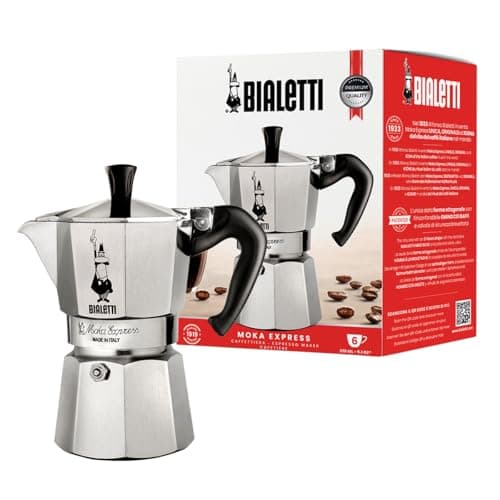
The Bialetti Moka Express is the pot that invented an entire category of home coffee. Alfonso Bialetti's octagonal aluminum design has sat on Italian stovetops since 1933, and more than ninety years later it is still made, still sold by the millions, and still barely changed — because the simple idea behind it works. Water in the base, ground coffee in the funnel, heat on the hob, and steam pressure pushes a rich, strong, almost syrupy coffee up into the top chamber. For a great many people it is the most rewarding cup you can make for the least money and the least fuss.
What you are really buying is heritage that happens to be practical. The Moka Express is cheap, near-indestructible, and about as simple as a kitchen tool gets: three parts, one safety valve, and a rubber gasket you can swap for pocket change. Those gaskets and spare funnels are sold almost everywhere, which is why a well-kept Moka Express can outlive most of the appliances around it. Set against the cost and clutter of an espresso machine, it is a rounding error — and that value is the whole point.
The honest part is what it is not. A moka pot builds only mild steam pressure, nothing like the nine bars of a real machine, so it makes a concentrated stovetop coffee rather than a true espresso shot with a thick crema. The bare aluminum is hand-wash only and will not sit on an induction cooktop without Bialetti's adapter, and the cup depends more on your grind and heat than the pot's simplicity lets on. To see where it lands against the stainless and induction-ready field, our best moka pots roundup ranks them all; if you are weighing stovetop against a real machine, the moka pot vs espresso machine comparison lays out the trade honestly.
Two caveats worth knowing before you buy this particular pot. It is cast aluminium, which means it will not work on an induction hob at all — can you use a moka pot on inductioncovers the stainless alternatives that do. And it wants a medium-fine grind, not the espresso grind the "stovetop espresso maker" label implies: moka pot grind size explains why.
So is it really espresso?
This is the single most common misunderstanding, so let us settle it. A real espresso machine forces hot water through a compacted puck at around nine bars of pressure; a moka pot generates only a small fraction of that from steam building in a sealed base — perhaps one to two bars. The result is genuinely delicious, but it is its own thing: concentrated, bold, brewed coffee closer to a very strong pour than to a cafe shot. You get little to no crema, and no amount of technique changes the physics. That is not a flaw — it is simply what a moka pot is — but it is worth knowing before you expect latte-art crema from a design older than most espresso machines. If crema and pressurized shots are the real goal, an entry espresso machine is the honest answer, not a hotter flame.
Aluminum, induction and keeping it alive
The classic Moka Express is made of bare aluminum, and that single choice explains most of its cons. Aluminum is light, cheap and heats fast, which is part of why the pot is so affordable and so pleasant on gas or electric coils. But it does not work on an induction cooktop on its own — induction needs a ferrous, magnetic base — so induction owners either need Bialetti's steel induction-plate adapter or should pick a stainless pot instead. Bare aluminum also should never go in the dishwasher: detergent and heat dull, pit and can corrode it, and Bialetti's own guidance is simply to rinse the pot with warm water and let it dry. Skip the soap, never scrub off the thin coffee-oil patina that builds inside, and the pot will reward you for years. If dishwasher convenience or induction compatibility matters more to you than tradition, the stainless options we cover in the roundup — the Bialetti Venus and Cuisinox Roma among them — solve both at a higher price.
Grind and heat: the parts that actually decide your cup
A moka pot has no dials, so the two things you do control — grind and heat — are what separate a great cup from a bitter one. Aim for a grind a touch coarser than espresso and finer than drip: too fine and the pot chokes and turns bitter, too coarse and the coffee comes through thin and sour. A pre-ground tin rarely nails that window, which is why even a modest grinder transforms moka coffee — our best hand grinders covers capable options that cost far less than a machine. Heat matters just as much: keep the flame at or below the base of the pot on medium-low, fill the funnel level without tamping, and pull the pot off the heat the moment you hear the gurgle so it does not scorch. Our step-by-step how to use a moka pot guide walks through the full method, including the pre-heated-water trick that keeps the coffee from stewing.
Which size, and living with spares
Bialetti sizes the Moka Express by “cups,” meaning small Italian espresso-sized servings, not mugs — so the six-cup pot reviewed here makes roughly six little cups, or two to three generous mugs, and suits most households. The important rule is to brew the pot close to full: a moka pot only makes the amount it is built for, and running a six-cup half-empty gives a weak, uneven cup. If you usually make one coffee at a time, a three-cup Moka Express is the better buy; if you serve a crowd, size up. Whatever size you land on, the gasket is a consumable — it hardens over a year or two of heat cycles — and Bialetti gaskets and replacement funnels are among the easiest coffee spares in the world to find and cost very little. That repairability is a real part of the value, not a footnote.
What we did not test
We have not run this pot on a bench for months, and we will not pretend otherwise. This review compiles Bialetti's published product and care information, weighs the long-documented behavior of aluminum moka pots, and scores it against our rubric. The material, cup count, safety valve and induction guidance come from Bialetti's own materials, listed in Sources below. Where hands-on time would tell you more than a spec sheet — exactly how one pot's gasket ages, or how a specific stove behaves — we say so rather than invent a number.
How we picked
We did not lab-test this gear
Everyone in this category says they tested twenty machines. We have not pulled shots on every product here, and we say so. What we did instead: compiled the published specifications, cross-checked the manufacturer manuals, computed the running cost (wattage to energy, grams-per-shot to cost-per-cup), weighed aggregated owner reports, and scored each product against a published rubric. The scores are judgments from documented research — not measurements we took, because we do not have a test lab and we will not pretend we do. Where hands-on time would tell you more than a spec sheet, we flag it. Where a number came from someone else's work, we name them in Sources.