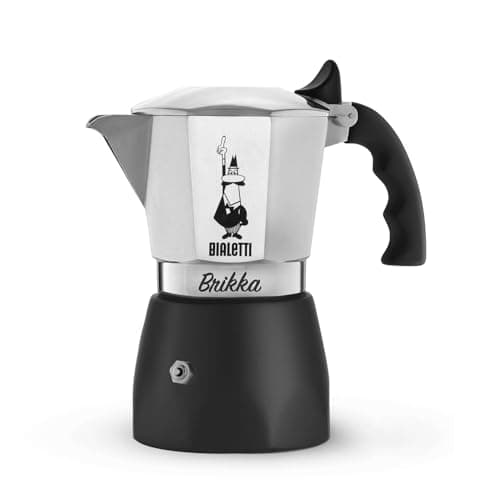
The Bialetti Brikka is a moka pot for people who miss crema. A standard stovetop pot pushes water up through the grounds at only about one to two bars of steam pressure and pours out a rich but flat, crema-free cup; the Brikka adds a weighted pressure valvethat holds the brew back until higher pressure builds behind it, then releases it in a burst that whips up a thicker, foamier layer on top than an ordinary pot can manage. In plain terms, it is Bialetti's answer to the single most common complaint about moka coffee — that it lacks the crema you get from a machine — and it is the closest a stovetop pot gets to a crema-topped cup. If you are choosing between the two, our Bialetti Moka Express review covers the classic the Brikka is built to improve on.
What the valve buys you is real, and it is worth being precise about it. The extra pressure gives the coffee a richer, thicker mouthfeel and a genuine foam cap that a standard Moka Express simply does not produce, which for a lot of people is exactly the missing piece. But it is a foamlayer, not the dense, persistent crema an espresso machine emulsifies at roughly nine bars — the Brikka narrows the gap, it does not close it. Set your expectations there and you will be delighted; expect cafe crema and you will be let down. If genuine pressurized crema is the whole point for you, the honest answer is a pump machine, and our moka pot vs espresso machine comparison lays out that gap in full.
The Brikka also asks a little more of you than a plain moka pot, and that is the trade for the foam. The weighted valve needs the right heat and the right fill to perform — too high a flame or a badly judged fill and it sputters instead of building a clean layer — so it is a touch more finicky to get right than the foolproof Moka Express. It is aluminum, like the classic, so it will not work on an induction cooktop and should be hand-washed. And grind and beans matter as much here as with any moka pot: pair it with a burr grinderand fresh coffee to get the best out of the valve. None of that undoes the appeal — it is the difference between a happy owner and a surprised one.
How the weighted valve works, and what it really produces
The whole reason to buy a Brikka over a standard pot is the weighted pressure valve that sits on top of the funnel. A normal moka pot lets coffee flow up into the top chamber as soon as steam pressure in the base overcomes gravity, which happens at a low pressure and produces a flat, crema-free pour. The Brikka's valve blocks that early flow: it stays shut until the pressure underneath builds higher, then pops open and releases the brew in a burst. That burst is what agitates and aerates the coffee into a thicker, foamier layer on top — the crema-like cap the Brikka is famous for — and it gives the cup more body than a standard pot delivers. It is a clever, genuinely effective piece of design. The honest framing is that it raises the pressure and the foam relative to a moka pot, not to machine levels; the layer it makes is a real, welcome foam, and calling it "crema" is a fair shorthand as long as you know it is not the emulsified crema of a nine-bar shot.
Brikka vs the standard Moka Express
This is the comparison most buyers are actually making. The Moka Expressis the foolproof classic: fill, heat, listen for the gurgle, pour. It is cheaper, simpler and almost impossible to get badly wrong, and it makes a wonderful, bold cup — it just has no crema. The Brikka trades some of that simplicity for the foam. Its valve rewards a bit of care with heat and fill, so it is a touch more finicky, but in exchange you get a richer mouthfeel and a foam cap the plain pot cannot produce. If you already love your Moka Express and only wish it had more body and a crema layer, the Brikka is the natural upgrade. If you value foolproof simplicity above all, the standard pot is the smarter pick and you will not miss the fuss. Both are ranked side by side in our best moka pots roundup.
Getting the most out of it: heat, fill and grind
The Brikka performs best when you give the valve what it needs. Use medium heat — too high a flame builds pressure too fast and makes the valve sputter rather than release a clean layer — and fill the base and basket as designed rather than improvising a smaller batch, because the valve is tuned around a proper fill. Grind matters as much here as with any stovetop pot: aim for a moka-appropriate grind, a touch coarser than espresso and finer than drip, from a burr grinder rather than a blade chopper, and start with fresh beans. Take the pot off the heat the moment it gurgles and turns pale and foamy, and do not let it keep boiling. Get those three things right — medium heat, a correct fill, a good grind — and the Brikka rewards you with the thick foam it is built for. Our how to use a moka pot guide covers the fundamentals that carry straight over.
Aluminum, induction and cleaning
The Brikka is aluminum, like the classic Moka Express: light, quick to heat, and traditional. That material choice has two consequences worth knowing before you buy. First, it will not work on an induction cooktop, because induction heats through a magnetic field and aluminum is not magnetic — if your kitchen is induction, a stovetop pot has to be stainless steel, and the Brikka is not, so it is out. Second, aluminum should be hand-washed, since a dishwasher dulls and pits it over time; a quick rinse and dry is all it needs, and skipping harsh detergent preserves the seasoned interior many moka drinkers prefer. On gas or a standard electric coil, none of this is a drawback — it is simply the classic moka material doing its classic job. But confirm your cooktop first, because an induction kitchen decides this on its own.
Who the Brikka is for
- Buy the Brikka if you already enjoy moka coffee and specifically want more body and a crema-like foam cap, and you do not mind a little care with heat and fill to get it. That foam is exactly what the valve buys, and nothing else in the stovetop category delivers it as readily.
- Buy a standard Moka Express instead ifyou want the simplest, most foolproof pot and are happy with a rich, crema-free cup — it is cheaper and easier, and you will not miss the fuss.
- Skip both ifgenuine pressurized crema is the point, or you have an induction cooktop and want stovetop coffee — a pump espresso machine is the real thing for crema, and induction needs stainless steel, which the Brikka is not.
What we did not test
We have not run this pot for months on a bench, and we do not claim to have. This review compiles Bialetti's published information for the Brikka, cross-checks the weighted-valve mechanism and the aluminum, size and induction facts, and weighs aggregated owner reports against our scoring rubric. The weighted pressure valve, the aluminum body, the 2 and 4 cup sizes and the induction incompatibility come from Bialetti's own materials and the physics of the material, listed in Sources. Where hands-on time would tell you more than a spec sheet — exactly how thick the foam runs with a given bean, how forgiving the valve is on a particular stove — we say so rather than invent a figure. We do not quote prices from memory; the live price renders from our pipeline with the date it was checked.