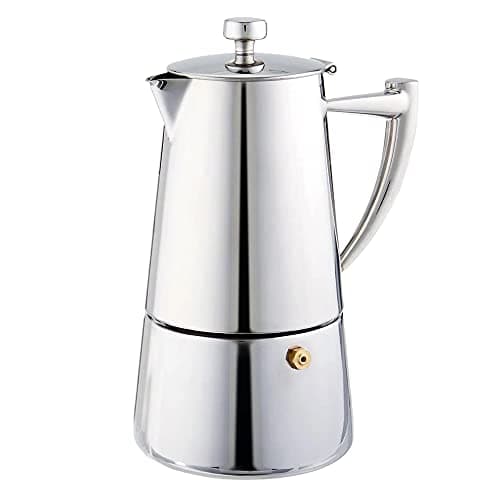
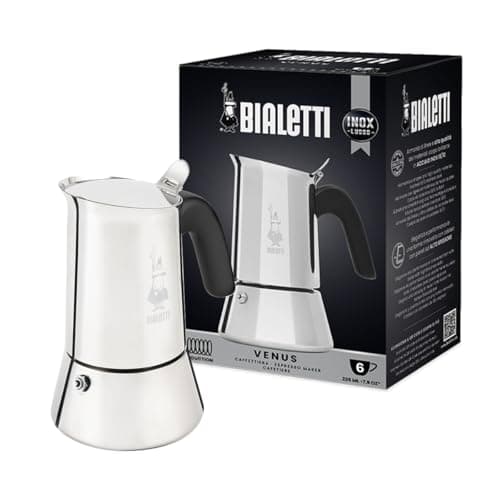
Yes, but only with a stainless steel moka pot. The classic Bialetti Moka Express and almost every other famous moka pot is cast aluminium, and an induction hob cannot heat aluminium at all — it will sit there and do nothing, or flash an error. If you have an induction cooktop, buy a steel pot: the Bialetti Venus is the value answer in 18/10 stainless, and the Cuisinox Roma is the buy-once version with a thick encapsulated base. An adapter plate is a workable fallback for a pot you already own, with real caveats we cover below.
Why aluminium simply does not work
A gas or electric ring heats the air and the metal above it, and it does not care what the pan is made of. An induction hob works completely differently: a coil under the glass generates a rapidly alternating magnetic field, and that field induces eddy currents in the base of the cookware sitting on it. Those currents meet electrical resistance in the metal, and that resistance is what produces the heat. The pan is the heating element.
For that to happen the base has to be ferromagnetic — it has to respond to a magnet. Cast aluminium does not, which is why the hob behaves as though nothing is there. This is not a matter of degree, or of a pot heating slowly, or of needing a higher power setting. The mechanism is absent. An aluminium moka pot on an induction hob is as inert as an empty hob.
Some modern hobs also need a minimum base diameter to register cookware at all, commonly somewhere around 110 to 120mm depending on the model. That is worth knowing even with a steel pot, because a 1 or 3 cup moka pot has a very small base and can fall below the threshold on some hobs even though the metal is correct.
How to test the pot you already own
Take a fridge magnet and put it on the bottom of the pot — the outside of the base, not the side. If it clings firmly, the pot will work on induction. If it slides off or does not stick at all, it will not.
Two things to watch for. Test the base specifically: some pots have a steel base bonded to a body made of something else, and the base is the part that matters. And test with the pot empty and cool — you are checking the metal, not the contents.
If the magnet does not stick, your options are an adapter plate or a different pot. There is no third answer, and no setting on the hob changes it.
What to look for in an induction moka pot
Four things, in order of how much they matter.
Stainless steel construction, confirmed by the magnet test.18/10 stainless is the usual specification. Do not rely on a listing that says "induction-compatible" without saying what the pot is made of — check the material, and magnet-test it when it arrives.
Base diameter against your hob's minimum.Check your cooktop manual for the smallest cookware it detects, then check the pot's base. This is where small pots fail even when the metal is right. If you are on the edge, size up a cup or two — a 6 cup pot has a base that most hobs will register.
A thick, flat, encapsulated base. Induction delivers heat into the base very directly and very fast, and a thin base means a hot ring where the coil sits and cooler metal around it. A thick encapsulated base spreads that out. On a moka pot this matters more than on a frying pan, because the brew is driven by how evenly the water in the lower chamber heats — uneven heating produces that violent sputtering finish.
Gasket and valve serviceability. Unrelated to induction but it decides how long the pot lasts. The rubber gasket between the chambers is a consumable and should be replaceable; the safety valve should be a cleanable part, not sealed.
With those established, these are the two genuinely induction-compatible moka pots we stock in our registry. There are only two, and we would rather say that than pad the list with an aluminium pot that physically cannot do the job.
What works and what does not
| Pot | Material | Induction? | Notes |
|---|
| Bialetti Moka Express | Cast aluminium | No | The classic. Physically cannot be heated by an induction coil |
| Bialetti Brikka | Aluminium | No | Pressure-valve design, same material limitation |
| Bialetti Venus | 18/10 stainless | Yes | The value induction answer; thinner base |
| Cuisinox Roma | 18/10 stainless, encapsulated base | Yes | Thick base spreads induction heat best |
| Any pot + adapter plate | Steel disc under aluminium pot | Workable | Slower, less controllable, one more thing to store |
Are induction adapter plates worth it?
An adapter plate — sometimes called an induction diffuser or interface disc — is a flat ferromagnetic steel disc with a handle. It sits on the hob, the hob heats the disc, and the disc heats your aluminium pot by conduction. It genuinely works, and if you already own a moka pot you love, it is the cheapest route to using it.
The honest trade-offs. It is slower, because you are now heating a steel plate first and the pot second. It is less controllable, because the plate has thermal mass and keeps delivering heat for a while after you turn the hob down — which on a brewer where "take it off the heat at the right moment" is the core technique is a real nuisance. It can get hot enough to mark some glass cooktops if used carelessly, so check your hob's manual. And it is another object to store and wash.
Our view: if you have a pot you are attached to, buy a plate. If you are buying a moka pot anyway and you have an induction hob, buy a steel pot instead. A plate is a workaround, and a steel pot is simply the correct tool.
How induction changes the brew
Induction is faster and more direct than gas, and a moka pot is small. Three practical consequences.
Use a lower setting than you think. Medium, not high. On gas the flame wraps the base and some heat escapes; on induction nearly all the energy goes into the metal. High heat drives the water up too fast and too hot, which is the main cause of a bitter, sputtering moka brew.
Pre-heated water helps more here. Starting with hot water in the lower chamber reduces the time the coffee spends sitting in a heating funnel, which is a widely used technique on any hob. On induction the chamber heats so quickly that the benefit is smaller, but it still smooths the result — and it lets you use a lower hob setting for the whole brew.
Get it off the heat decisively. Induction stops delivering heat the instant you turn it off, which is actually an advantage over gas — but the pot itself still holds heat. Lift it off as soon as the stream pales and starts to gurgle, and run the base under cold water to stop extraction. Leaving it on a hob that has just been switched off is a bitter cup.
The grind matters at least as much as the hob. A moka pot wants a medium-fine grind — table salt, not powdered sugar — because it builds only around 1 to 2 bar against an untamped bed. Our moka pot grind size guide covers that in full, and it is the first thing to fix if your brew is disappointing regardless of hob.
If induction is the problem, consider the alternative brewers
Worth naming, because for some kitchens it is the better answer. A moka pot is the only common brewer with a hard hob-material dependency — every other method on this site either plugs in or uses a kettle.
An AeroPress makes a concentrated, moka-adjacent cup with nothing but hot water and hand pressure, and AeroPress vs moka pot compares the two cups directly. A portable espresso maker goes further toward real espresso pressure. And if what you actually want is espresso rather than a moka pot's intense stovetop coffee, moka pot vs espresso machine is the honest comparison — the pressure difference is large, and so is the difference in the cup.