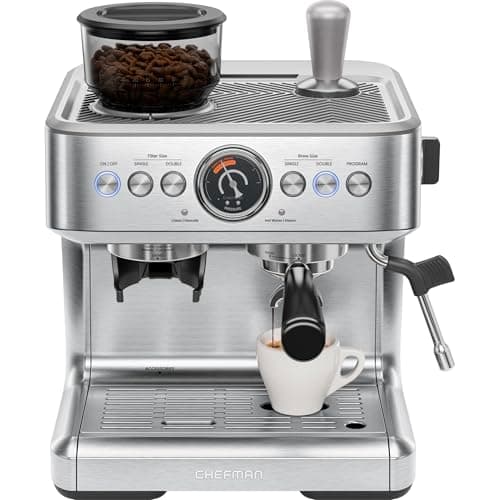
Most of the way through the Chefman Crema Supreme's spec sheet you find a number that does not belong there. This is a mid-priced grind-to-cup machine from a brand best known for air fryers and kettles, sold next to plastic pod machines, with a big 3-liter tank and a conical burr grinder bolted on top — and Chefman's retail listings say it takes a 58mm portafilter. Fifty-eight millimeters is the commercial standard: the size a La Marzocco uses, the size the entire prosumer world is built around, and the size with by far the deepest accessory ecosystem of any diameter you can buy into. Machines under a thousand dollars usually do not offer it. That single fact is why this machine is worth a full review rather than a line in a budget roundup — and it is why the query that brought most people here, “what portafilter size is the Chefman Crema Supreme,” is a better question than it looks.
The rest of the machine is a sensible, unglamorous grind-to-cup package. A 15-bar pump, a conical burr grinder with 30 settings that dispenses straight into the portafilter so you never handle loose grounds, a pressure gauge on the front, a steam wand for milk, and — the detail we like most, because it is genuinely rare below the enthusiast tier — three selectable brew temperatures rather than one fixed set point. Chefman rates it at 1450 watts on a 3-liter removable tank, which is a lot of water for a home machine and the reason a household of three or four is not refilling it constantly. It is the sort of specification list that reads like a machine costing considerably more, which is exactly the trap worth walking into carefully. If you are cross-shopping the whole grind-to-cup field, our best espresso machines with a built-in grinder roundup ranks the alternatives.
So here is the honest shape of this review. The Crema Supreme is a lot of machine for the money and its portafilter platform gives it an upgrade ceiling most of its rivals cannot touch. It is also physically enormous, its steam wand is competent rather than fine, Chefman does not publish whether the baskets in the box are pressurized, and the reliability picture in owner reviews is genuinely mixed — grinders that stop, gauges that break, units that arrive dead. Those are not deal-breakers for everyone, but they are the difference between a bargain and a gamble, and nobody selling you this machine is going to lead with them. Read the portafilter sizes guide alongside this if the 58mm point is what brought you here.
What portafilter size is the Chefman Crema Supreme?
Short answer: 58mm, according to Chefman's retail listings. Target's specification table for the Crema Supreme lists “Portafilter Size: 58mm”, and the Amazon listing copy describes a 58mm portafilter with single and double shot baskets. Those are two independent retailer sources saying the same number.
Here is the honest caveat, and it is the reason this page exists rather than a one-line answer: the manual does not say. We read the RJ54-G-SS instruction manual and it never states the portafilter diameter anywhere — a buyer even asks the question in the manual's Q&A section and gets no answer. Chefman's own product page lists wattage, tank capacity, dimensions and weight, and skips the portafilter size entirely. We have not put calipers on one ourselves, so what we can tell you is precisely this: the retailers say 58mm, the manufacturer does not say, and you should verify before spending money on accessories.
Verifying takes ten seconds. Pop the basket out of the portafilter and measure the outside diameter of the basket rimwith a ruler or calipers — not the group head, not the portafilter body, not the spouts. A basket measuring roughly 58mm across the top is the commercial standard; 54mm is Breville's size; 51mm is the entry De'Longhi and budget size; 53mm and 53.5mm turn up on some Delonghi and Ninja machines. If yours measures 58mm, the entire prosumer accessory world is open to you. Our portafilter sizes explained guide walks through the measurement and what fits each diameter, and what is a portafilter covers the anatomy if any of those part names are new.
Why 58mm matters more than any other number on this machine
Portafilter diameter looks like trivia and is actually the single specification that decides how far a machine can be improved after you buy it. Every upgrade an espresso hobbyist eventually makes — a single-wall precision basket, a bottomless portafilter to diagnose channeling, a proper calibrated tamper, a puck screen, a distribution tool — is sold by diameter, and the diameters are not interchangeable. Buy into a small ecosystem and your options are a handful of listings from the machine's own brand. Buy into 58mm and you are shopping the same parts bin as commercial cafes, because 58mm is what commercial group heads have used for decades.
That is why a 58mm machine at this price is a genuinely different proposition from the 51mm-and-53mm budget field. Compare it with the machines we cover nearby: the CASABREWS CM5418 is 51mm with a thin aftermarket; the Ninja Luxe Café Premieruses an odd 53mm that locks you into Ninja's own parts; even a Breville Bambino is 54mm, a well-supported size but a much smaller world than 58. The Crema Supreme, if the retail spec is right, hands you the biggest ecosystem in espresso on a machine that also has the grinder built in. Our best espresso machines with a portafilter roundup ranks machines specifically by which platform you are buying into, and our precision baskets and bottomless portafilters roundups are organized by size so you can see how much wider the 58mm shelf is.
One caution before you order parts. A matching basket diameter does not guarantee a matching portafilter. The lugs — the ears that twist the handle into the group — vary between manufacturers even at the same nominal size, so a 58mm bottomless portafilter built for one brand's group may not lock into another's. Baskets, tampers, puck screens and WDT tools are the safe cross-brand buys because they only care about diameter. A whole replacement portafilter is the risky one, and worth confirming with the seller first.
The basket question Chefman will not answer
The Crema Supreme ships with a single-shot and a double-shot basket, and nowhere — not the manual, not the product page, not the retail listings — does Chefman say whether they are pressurized. We are not going to guess, because the answer changes what the machine does more than any other variable.
A single-wall(non-pressurized) basket is a plain metal cup with dozens of fine holes. The coffee puck itself provides the resistance, which means the shot responds directly to your grind and tamp — rewarding, unforgiving, and the only way a built-in grinder's 30 settings actually earn their keep. A pressurized (dual-wall) basket hides a single pinhole behind a second wall and manufactures its own back-pressure, producing a thick crema from almost any grind. Forgiving on day one, and a hard ceiling forever after, because the basket rather than your coffee is controlling the flow.
Checking your own is easy: turn the basket over. A single-wall basket is perforated all the way through — hold it to the light and you see dozens of pinpricks. A dual-wall basket has a solid-looking underside with one small hole in the middle. If yours turns out to be pressurized, the fix on a 58mm machine is unusually cheap and easy, which is the whole argument for this platform: buy an 18-gram single-wall 58mm precision basket and drop it in. Our pressurized vs unpressurized baskets guide explains exactly what the second wall does to your shot, and single vs double shot covers the dose question that follows.
Living with the size
Chefman lists the Crema Supreme at 12.8 by 13.8 by 19.2 inches and 21.8 pounds, and that height is the number to take seriously. The standard clearance between a kitchen counter and the wall cabinet above it is commonly around 18 inches, so a machine over 19 inches tall will not slide into that gap — and you also need headroom above the bean hopper to pour beans in. Before you order, get a tape measure out and check the actual gap over the spot where the machine will live, then check whether the machine can be pulled forward far enough to fill the hopper if the clearance is tight. This is the most common avoidable regret with any grind-to-cup machine, and it applies just as much to a Barista Express.
The upside of the footprint is that 3-liter tank. Most home machines run somewhere between 1.5 and 2 liters, so the Crema Supreme roughly doubles the interval between refills — a real quality-of-life gain in a house where several people want milk drinks in the same half hour, and the reason it would not be a bad fit for a small office. If counter space is your binding constraint instead, our best espresso machines for small kitchens roundup is the better starting point, and best espresso machines for the office covers the shared-use case.
The reliability picture, stated plainly
The Crema Supreme reviews well on average at major retailers, and the enthusiastic reviews are enthusiastic for good reasons — people like the shots once the grind is dialed in, and they like not owning a separate grinder. But a review average hides its own tail, and the negative tail on this machine has a shape worth describing rather than averaging away.
The recurring complaints are not the usual grumbles about a fiddly tamper. They are hard failures: grinders that stop working, in some reports on the first day; grind markings that do not correspond to what the burrs actually do; pressure gauges that break; units that will not power on out of the box. Alongside those sit softer but common issues — the steam nozzle clogging with dried milk if you do not purge and wipe it after every use, grounds ending up in the cup, and weak-pressure complaints that in at least some cases are a grind-and-dose problem rather than a machine fault. Independent hands-on reviewers add drifting brew temperature, a drip tray that fills fast, and a descaling interval short enough to be a chore.
None of that makes it a bad machine, and a brand with real retail distribution and a one-year warranty is a much better position to be in than a marketplace listing that vanishes. But it does change the calculus. If this is the only coffee maker in the house and a two-week warranty turnaround would be a genuine problem, weigh that honestly against the price advantage. Keep the box and the paperwork for the first year, run the descaling cycle on schedule, and purge the wand every time. Our descaling guide and steam wand cleaning guide cover both routines, and they are the two habits that prevent most of what goes wrong here.
Which Chefman espresso machine should you buy?
Chefman sells several espresso machines that look similar in a search grid and are aimed at genuinely different buyers. Choose on the axis where they actually differ — whether a grinder is included, and whether milk is frothed for you or by you.
- Crema Supreme (this machine)— the grind-to-cup flagship. Built-in conical burr grinder, 3 L tank, manual steam wand, selectable brew temperature, and the 58mm platform. Buy it if you want one appliance to replace a machine plus a grinder, and you have the counter height for it.
- Crema Deluxe— the double-boiler sibling, also with a grinder and steam wand. Its distinguishing feature is being able to brew and steam at the same time rather than waiting between the two, which matters most if you make several milk drinks back to back. Stock on it has been thin, so check availability rather than assuming.
- CraftBrew— the compact 15-bar machine with a 1.5 L tank and a steam wand, and nogrinder. It is a fraction of the Crema Supreme's price and a completely different proposition: you are buying a small pump machine and supplying your own grind. Sensible if you already own a grinder, or as a first taste of espresso.
- Chefman 6-in-1— the older automatic with a built-in milk frother reservoir rather than a manual wand. Choose it only if you specifically want push-button milk and do not care about texturing it yourself; a frother reservoir will not make latte-art microfoam.
If the built-in grinder is the feature you are shopping for rather than the brand, the machines it competes with sit in our best espresso machines with a grinder roundup, and the separates route — a simpler machine plus a real grinder — is costed out in best coffee grinders for espresso.
Crema Supreme vs the alternatives
Against the Breville Barista Express, the archetypal grind-to-cup machine, the Chefman is the cheaper and larger-tanked option and the Breville is the more proven one. The Barista Express has a decade of owner data, an enormous parts and service network, a 54mm platform with good aftermarket support, and a steam wand people genuinely learn latte art on. The Chefman answers with a bigger tank, selectable brew temperatures and — if the retail spec holds — the larger 58mm accessory world. If reliability is what you are optimizing for, the Breville is the safer money; if platform and tank size are, the Chefman has a real argument.
Against the Ninja Luxe Café Premier, the two are aimed at opposite temperaments. The Ninja spends its engineering on removing decisions — it weighs your dose, tamps the puck and recommends a grind — and locks you into a 53mm accessory dead end. The Chefman gives you fewer guard rails, more adjustment and a much wider upgrade path. Beginners who want the machine to think for them should take the Ninja; anyone who expects to tinker should take the platform.
Against the budget tier — the CASABREWS CM5418 and the De'Longhi Stilosa— the Crema Supreme costs multiples more and includes a grinder those machines do not, which is roughly where the extra money goes. That comparison is only really interesting if you were going to buy a grinder anyway; if you were not, the budget machines plus a hand grinder remain the cheapest honest route into espresso. The whole field is laid out in our under $300 and under $500 roundups.
Who it is for
- Buy the Crema Supreme ifyou want a grinder and machine in one box, you have the counter height, and the 58mm platform appeals — it is the cheapest route we know of into the commercial accessory standard with a grinder attached.
- Buy it if your household drinks a lot of coffee in short bursts. The 3-liter tank and the grind-to-cup workflow suit a busy morning or a small office better than a 1.5-liter machine you keep refilling.
- Buy a Breville Barista Express instead if reliability is the thing you cannot compromise on. It is the more expensive and more proven machine, with a service network the Chefman cannot match.
- Skip it entirely ifyou have a wall cabinet at standard clearance over your counter, or if you want to chase the last ten percent of shot quality — in which case a simpler machine and a serious standalone grinder will out-perform any built-in unit at this price.
What we did not test
We have not had this machine on a bench, and we are not going to pretend otherwise. This review compiles Chefman's published specifications for the Crema Supreme RJ54-G-SS, the contents of its instruction manual, the live retail listing, and independent hands-on reviews and aggregated owner reports, weighed against our scoring rubric. The 15-bar pump, 1450W/120V rating, 3-liter removable tank, 30-setting conical burr grinder, adjustable shot volume, pressure gauge, internal cleaning function, 12.8 x 13.8 x 19.2 inch dimensions, 21.8 lb weight and one-year warranty come from Chefman. The three brew temperatures — 194°F, 201°F and 205°F — and the 15-minute standby default come from the manual. The 58mm portafilter figure comes from Target's specification table and the Amazon listing copy, not from Chefman's own documentation and not from our own measurement, which is why this page tells you how to measure it rather than simply asserting it. The temperature drift, steam wand limitations, drip tray and descaling notes come from named hands-on reviews; the grinder, gauge and power failures come from aggregated retailer reviews. Two things we genuinely do not know and will not invent: whether the included baskets are pressurized, and what the boiler or thermoblock arrangement is — Chefman publishes neither, and no source we could find states either.