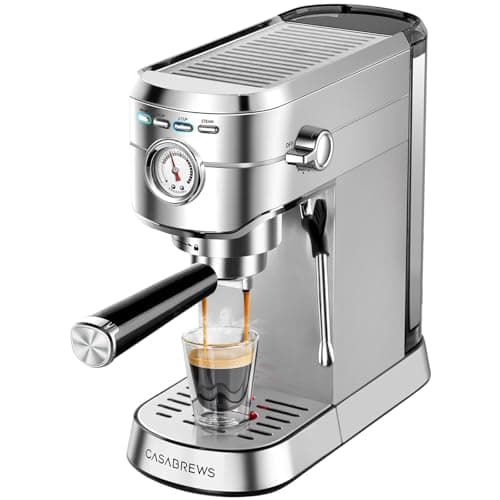
If you have shopped for a cheap espresso machine on Amazon in the last couple of years, you have seen CASABREWS. The brand barely existed before the 2020s and now occupies most of the top of the budget results with a family of near-identical stainless machines — and the CM5418 is the one people land on most, because it is the slim one. It is not a pod machine and not a steam toy: it has a real vibratory pump, a metal 51mm portafilter and a proper articulated steam wand, and it makes espresso the same basic way a machine ten times its price does. The question buyers actually ask is simpler and more useful than a spec sheet: is a no-name Amazon machine worth it, or is the money better spent on a name you recognize?
The short answer is that the CM5418 is a genuinely better-built budget machine than the rock-bottom tier, and that this buys you less than you would hope. What you get for the money is real: a body that is mostly stainless rather than mostly plastic, a heat-up of about a minute, a pressure gauge on the front, and — the part that actually matters — a single-hole commercial-style steam wand on a 360-degree ball joint instead of the sleeved panarello frother that machines at this price normally ship. That wand is the CM5418's best feature and the one place it genuinely out-specs the De'Longhi Stilosa.
What you do not get is any escape from the ceiling every machine in this band shares. The CM5418 ships with pressurized(dual-wall) baskets and nothing else, which means the basket — not your coffee — is manufacturing the crema on top of your shot. That is forgiving and flattering for a beginner, and it is also the reason the machine cannot show you what a good grinder is doing. Add two specific, independently reported annoyances (baskets that pop out of the portafilter when you knock the puck, and a steam wand that is too short to reach into a large pitcher) and you have an honest picture: a well-presented entry machine that is a good first taste of espresso and a poor long-term home. This review is about exactly where that line sits, and when the money is better aimed at the De'Longhi Dedica instead.
"20 bar" is marketing, and you should stop shopping by it
Almost every budget espresso machine sold on Amazon leads with a bar number, and CASABREWS leads with 20. It is worth being blunt about this: espresso is brewed at about nine barsof pressure at the puck, and that has been the standard since the modern pump machine was designed. A pump rated at 15 or 20 bar is describing its maximum unrestricted output, not the pressure your coffee sees; on a well-designed machine an over-pressure valve bleeds the excess away, and on a machine with a pressurized basket the basket's own restriction dominates anyway. A 20-bar machine is not brewing at 20 bar and would make worse coffee if it did — too much pressure compacts the puck and encourages channeling. So when you are comparing two budget machines, the bar rating tells you almost nothing. What tells you something is the basket, the wand and the build. Our espresso pressure problems guide walks through what pressure actually does in the group.
The baskets in the box are the whole story
The single most important fact about the CM5418 is that it ships with pressurized(dual-wall) baskets and no single-wall alternative. A normal espresso basket is a plain metal cup with dozens of fine holes, and the coffee puck itself provides the resistance — which is why it demands an even grind and a proper tamp, and why it rewards a good grinder. A dual-wall basket hides a single pinhole behind a second wall and manufactures its own resistance, so it produces a thick, crema-topped shot from almost any grind, including pre-ground supermarket coffee. For a first machine that is genuinely useful: you get a good-looking, drinkable espresso on day one without owning a grinder or knowing how to dial one in.
It is also the ceiling, and it is a low one. Because the basket controls the flow, the machine cannot show you the difference between a great grind and a mediocre one, which means the usual advice — spend less on the machine and more on the grinder — partly stops working here. Pairing a CM5418 with an expensive grinder is largely wasted money until you change the basket. Our pressurized vs unpressurized baskets guide explains exactly what the second wall is doing, and do you need a grinder for espresso covers where the grinder money genuinely pays off.
The 51mm question: what fits, and what does not
The CM5418 uses a 51mmportafilter, the same nominal diameter as many entry De'Longhi machines and a smaller ecosystem than Breville's 54mm or the 58mm prosumer standard. Two practical points follow, and they are easy to get wrong. First, 51mm baskets and tampersfrom the aftermarket — including precision baskets — generally do fit, which is the route to escaping the pressurized basket and the reason this machine has any upgrade path at all. Second, the portafilter itselfis not interchangeable with De'Longhi's: the ear pattern that locks the handle into the group differs between brands, so a Dedica portafilter will not twist into a CASABREWS group even though the basket diameter matches. If you want a naked portafilter for this machine, buy one sold specifically for the CASABREWS CM5418 / 3700 family — CASABREWS makes one, and we rank a 51mm option in our best bottomless portafilters roundup. And note the order of operations: a bottomless portafilter on a pressurized basket just sprays coffee across your counter, because the valve rather than your puck is controlling the flow. Fit the single-wall basket first, then the naked portafilter, then add a WDT tool— in that order, or not at all. Our portafilter sizes guide covers how to check what you actually have.
The steam wand: genuinely good, genuinely short
This is where the CM5418 earns its place. Instead of the panarello sleeve almost every budget machine uses — a shroud that sucks in air through a side hole and whips milk into stiff froth on its own terms — CASABREWS fitted a bare single-hole tip on a ball joint that rotates a full 360 degrees. That is the same arrangement a cafe machine uses, and it means you control where the air goes in and when to stop, which is the whole skill of texturing milk. Reviewers working with it have produced the glossy, paint-like microfoam that latte art needs, which is not something you can say about a Stilosa.
The catch is length. The wand is short, and hands-on testers have found it cannot reach far enough into a larger pitcher to set up the whirlpool that folds air evenly through the milk. On a small pitcher it is fine; scale up to a big one and you lose the technique. Steam power is also modest, so texturing is a slower, more patient job than on a mid-range machine, and with a single small thermoblock you brew first and steam second with a wait in between. None of that makes the wand bad — it is comfortably the best thing about the machine — but it does mean buying a pitcher sized for the wand rather than the wand serving whatever pitcher you own. Our milk pitcher roundup covers the smaller sizes, and how to steam milk covers the technique.
The two flaws worth knowing before you order
Most of what is wrong with a machine at this price is predictable from the price. Two things about the CM5418 are specific enough to be worth stating plainly, because they turn up independently in more than one hands-on review rather than in a single grumpy listing.
The first is the basket fit. The filter baskets do not seat firmly enough in the portafilter, and reviewers report the basket dropping out into the knock box when they tap the handle to release the spent puck. It is an irritation rather than a fault, but it is the kind of irritation you meet twice a day. The second is that the included tamper is a lightweight plastic piece that is not up to packing a level puck; treat it as packaging rather than a tool and budget for a metal 51mm tamper from the start. On top of those, the water tank is narrow and fiddly to fill without spilling, and the pressure gauge on the front — while a nice touch — has no numbered bar scale, only a shaded "espresso zone", so it is reassurance rather than a diagnostic you can dial against. Our tamper roundup is organized by size, and the 51mm section is the one you want.
Which CASABREWS should you actually buy?
CASABREWS sells several machines that look almost identical in a search results grid, and the honest guidance is that they are more alike than different: the same broad platform, the same pressurized baskets, the same class of steam wand. Choose on the one axis where they genuinely differ rather than assuming the pricier one makes better coffee.
- CM5418 (this machine)— the slim one, about five and a half inches wide. Pick it when counter space is the binding constraint, which is exactly why it also appears in our best espresso machines for small kitchens roundup.
- 3700 Essential— the value pick of the range and the one we rank highest of the CASABREWS machines in our best espresso machines under $200 roundup. Choose it if footprint is not the deciding factor.
- 5418 PRO— a modest step up whose headline is a faster-heating system. You are paying for heat-up speed and a little polish, not a fundamentally better shot; it sits alongside the others in our best espresso machines under $300 roundup.
- Ultra— the top of the current range and the priciest. At that money you are into range of machines from established brands with larger accessory ecosystems, so check the alternatives before you stretch.
CASABREWS vs the alternatives at this money
Against the cheapest thing that still counts as an espresso machine — the De'Longhi Stilosa— the CM5418 is the better object. More metal, a faster heat-up, a pressure gauge, and above all a real articulated steam wand rather than a panarello sleeve. Both are capped by pressurized baskets, so the espresso itself is a wash; the CASABREWS wins on milk and on feel.
Against the De'Longhi Dedica Deluxe — also slim, also 51mm, a little more money — the argument flips. The Dedica takes aftermarket non-pressurized 51mm baskets readily, has programmable volume buttons, and comes from a brand with decades of spare parts, service and accessories behind it. That last point is not sentimental: when a budget machine develops a leak or a seal fails, the size of the parts ecosystem decides whether you fix it or bin it. Several reviewers land on the Dedica as the safer buy for exactly this reason, and we think that is right if the extra spend is available.
Against the Breville Bambino, there is no contest on espresso and there should not be — it costs meaningfully more and gives you a real single-wall 54mm basket, near-instant ThermoJet heating and genuine temperature control, which is a different tier of machine. If you already know home espresso is going to be a hobby rather than an experiment, that is where the money should go. The whole field sits in our under $200, under $300 and best for beginners roundups.
Who it is for
- Buy the CM5418 ifyou want the best-presented machine at the very bottom of the market, counter width is tight, and milk drinks matter to you — the articulated steam wand is a real advantage over everything else at this price, and the pressurized baskets mean you can start without a grinder.
- Buy it as a gift or a first machine if the recipient is espresso-curious but unproven. It looks like a much more expensive machine on a counter and delivers the experience without the spend.
- Buy the De'Longhi Dedica instead if you can stretch a little and want a similarly slim 51mm machine that takes non-pressurized baskets out of the gate, with a far deeper parts and accessory ecosystem behind it.
- Skip the budget tier entirely ifyour goal is cafe-quality shots, or you are pairing the machine with a serious grinder — the dual-wall baskets will hide what that grinder does, and a Bambino or a Gaggia Classic is the honest starting point instead.
What we did not test
We have not run this machine on a bench for months, and we do not claim to have. This review compiles CASABREWS's own published specifications for the CM5418, cross-checks them against the live retail listing, and weighs multiple independent hands-on reviews against our scoring rubric. The 20-bar pump, 1350W rating, 34oz removable tank, 51mm aluminum portafilter, dual-wall one-cup and two-cup baskets, claimed PID and low-pressure pre-infusion, roughly one-minute heat-up and the compact dimensions all come from CASABREWS and the retail listing; the steam wand's 360-degree ball joint, the microfoam results, the basket-fit problem, the short wand reach, the narrow tank and the plastic tamper all come from named hands-on reviews, listed in Sources. Where hands-on time would tell you more than a spec sheet — how much the brew temperature actually drifts across back-to-back shots, and how the machine holds up after two or three years of daily use, which is the open question with any newer budget brand — we say so rather than invent a figure. What needs no bench to establish is the mechanism: a dual-wall basket manufactures crema, and that single fact defines the ceiling of this machine.