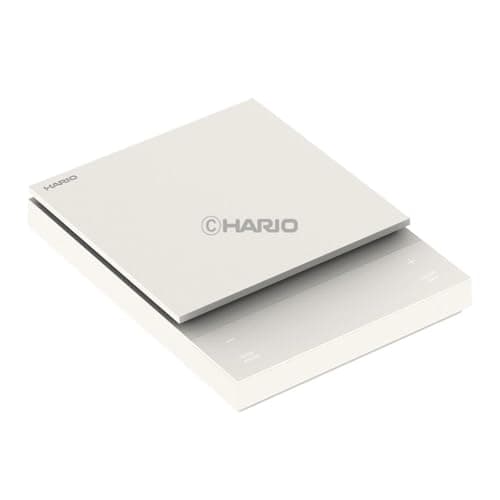
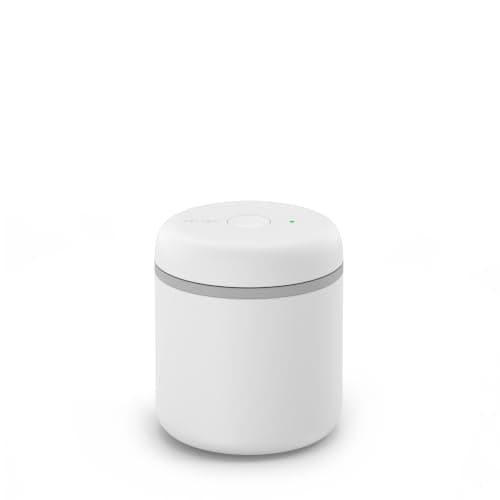
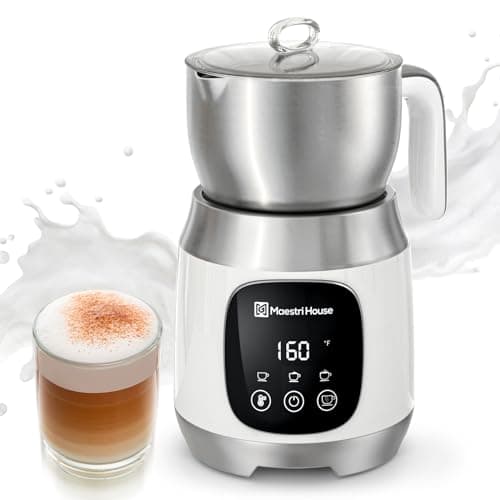
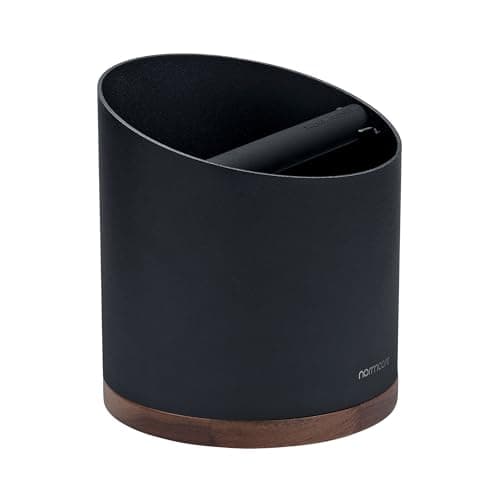
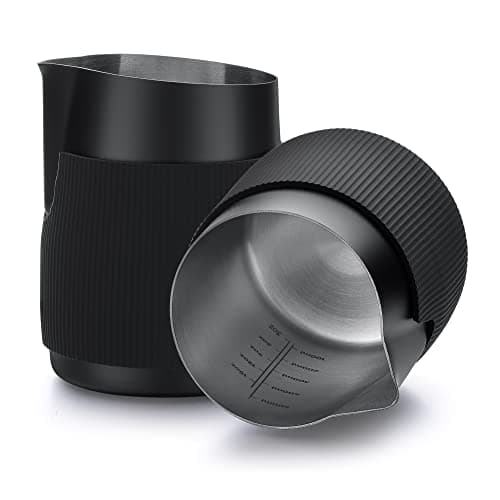
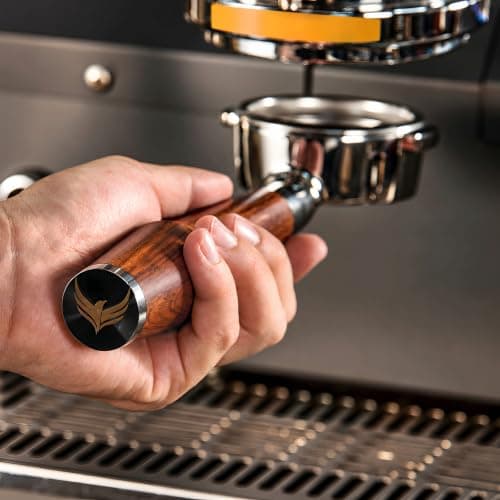
Our pick is the KNODOS 54mm bottomless portafilter— the only accessory on this site that tells you why a shot went wrong rather than making the next one marginally better. The budget pick is the Normcore handleless 600 ml milk pitcher, the cheapest thing here and the one an experienced pourer will reach for daily. In between: the scale with a ratio readout, the canister that vacuums itself, the heated milk jug and the knock box you will not want to hide.
These six share nothing with our cheaper brackets, on purpose. The under-$25 page covers the almost-free wins and the under-$50 page covers puck prep — calibrated tamper, precision basket, distribution tool, dosing funnel. Buy those first; nothing here replaces them. What changes at this bracket is the kind of tool, not the grade: a portafilter with the bottom cut off is not a better portafilter, it is a diagnostic instrument. A canister with a motor in the lid is not a nicer jar, it is a different behaviour.
How we ranked: what the cheaper tier physically cannot do. Every pick here had to pass that test. A bottomless portafilter shows the underside of the puck while the shot runs, which is the fastest channeling diagnosis there is and has no cheap equivalent. A brew-ratio scale does arithmetic for you mid-pour. A self-sealing canister removes the one step people forget. A heated jug makes milk drinks possible on a machine with no steam wand at all. Each solves a problem the under-$50 list leaves standing.
What we deliberately left out.Pressure gauges and flow-control paddles are machine modifications rather than accessories, and both are cheaper in regret than in cash. Grinders are not accessories and cost far more than this bracket — best coffee grinders under $100 is the honest page for anyone with a hundred dollars and a blade grinder, and we would send you there before any of this.
Check the fit before you spend. Two of these six are diameter-specific. The bottomless portafilter in particular has to match both the diameter andthe machine's lug pattern, so a 58mm Gaggia portafilter will not go into a 54mm Breville and vice versa. Portafilter size by brandis the lookup, and the per-diameter pages — 58mm, 54mm, 51mm— list the alternatives at each size.
Buy the bottomless portafilter first, and buy it early
Of everything on this page, the bottomless portafilter is the one that changes how fast you improve rather than how good your current shots are. Channeling is invisible through a spouted basket: the shot simply tastes thin or sour and you guess at the cause. Through a naked basket you see it happen, you see which side of the puck it came from, and the fix — more thorough distribution, a flatter tamp, a different dose — becomes obvious. Buy it with a WDT tool and a level tamp, use it for a fortnight, and you will have learned more than any upgrade teaches.
When a $44 scale is enough and when it is not
A basic 0.1 g scale with a timer costs about fourteen dollars and is genuinely accurate; our under-$25 page picks one. What the scales in this bracket add is speed of response, better displays, and in the Polaris's case a ratio readout that spares you mental arithmetic during a pour-over. If you only pull espresso, the cheap scale on the drip tray is the better tool. If you brew filter as well and want one scale for both, this is where the money goes.
The milk question: electric jug or steam wand
These are not competing products, they are answers to different machines. If your espresso machine has a steam wand, learn it: a twenty-dollar pitcher and a fortnight of practice produce microfoam no electric jug can match, and how to steam milkis the whole method. If your machine has no wand — a Nespresso, a moka pot, a manual lever, a drip maker — then an electric jug is the only route to a cappuccino at home, and the DualFro is the capable end of that category.
Check the lug pattern, not just the diameter
Portafilters are the one accessory where diameter alone is not enough. A 58mm portafilter for a Gaggia Classic will not lock into a Rancilio Silvia, because the lugs and the handle geometry differ between machines even at the same basket size. Buy the portafilter listed for your machine family, and if you are not sure what you own, start with portafilter size by brand. Baskets, puck screens, funnels and tampers care only about the diameter — the portafilter itself cares about both.
What this bracket still cannot buy
A grinder. Every accessory here assumes your grind is in roughly the right place, and none of them compensates for a blade grinder or a burr grinder whose steps are too coarse for espresso. If you have a hundred dollars and no real grinder, spend it on a grinder under $100instead and come back to this page later — the shots will improve more. Once the grinder is sorted, the under-$50 bracket is the list to work through before this one.
How we picked
We did not lab-test this gear
Everyone in this category says they tested twenty machines. We have not pulled shots on every product here, and we say so. What we did instead: compiled the published specifications, cross-checked the manufacturer manuals, computed the running cost (wattage to energy, grams-per-shot to cost-per-cup), weighed aggregated owner reports, and scored each product against a published rubric. The scores are judgments from documented research — not measurements we took, because we do not have a test lab and we will not pretend we do. Where hands-on time would tell you more than a spec sheet, we flag it. Where a number came from someone else's work, we name them in Sources.