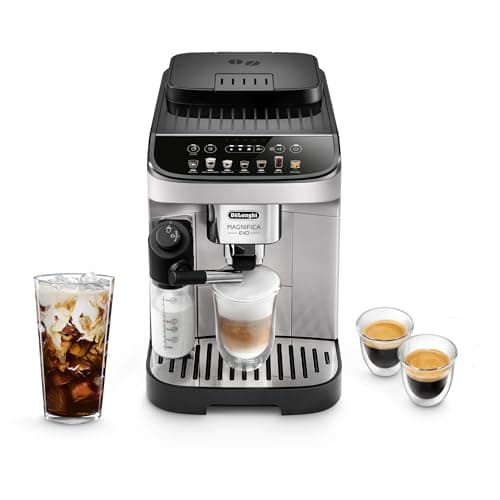
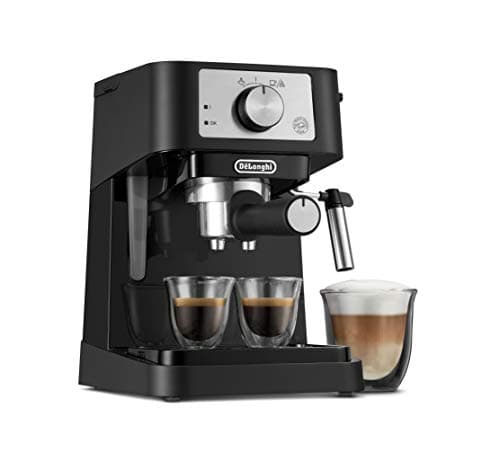
The De'Longhi Stilosa and the De'Longhi Magnifica Evo wear the same badge and make espresso at home, and that is roughly where the similarity ends. The Stilosa is the cheapest genuine pump machine the brand sells — a real 15-bar pump, a pressurized portafilter and a panarello steam wand that you operate entirely by hand. The Magnifica Evo is a one-touch bean-to-cup super-automatic that grinds, doses, tamps, brews and froths a milk drink at the press of a single button. Same company, opposite philosophies: one is budget-first and hands-on, the other is convenience-first and hands-off.
That split is the entire decision, so it is worth naming plainly before any specs. The Stilosa is about spending as little as possible to find out whether home espresso is a hobby you actually want. Its pressurized basket forgives a cheap grind, its all-manual controls are simple, and it costs less than a nice dinner out — but you froth the milk yourself with a weak panarello wand, and there is no temperature control at all. The Magnifica Evo is about spending meaningfully more to remove every step: you load beans and milk, walk up, tap a button, and walk away with a latte in about ninety seconds and no skill required. Read the two in full in our De'Longhi Stilosa review and our De'Longhi Magnifica Evo review; this page is about which of the two suits you.
The honest way to frame it is that these machines answer two different questions. If your question is “is espresso for me, and can I do it cheaply?” the Stilosa is the answer. If your question is “how do I get a good milk drink every morning with zero effort?” the Magnifica Evo is the answer. Neither is a compromise on the other — they are built for different owners, and the gap between them is not really quality so much as intent. What follows is which intent is yours, and exactly what the price difference buys.
Two philosophies from one brand: manual pump vs bean-to-cup
The cleanest way to understand these two is to name what kind of machine each one is, because that decides everything else. The Stilosa is a manual pump machine: it has a pump, a boiler and a portafilter, and you supply the coffee, the tamp and the milk technique. The Magnifica Evo is a super-automatic bean-to-cup: a built-in grinder and a sealed brew group do the grinding, dosing, tamping and brewing for you, and a milk carafe froths on its own. This is the same fork every espresso buyer faces, and it is the subject of our semi-automatic vs super-automatic guide. The Stilosa sits at the very bottom of the manual side; the Magnifica Evo is a mainstream pick on the automatic side. Neither is a “better version” of the other — they are different machines for different mornings, and the price gap between them reflects how much hardware and automation the Magnifica adds, not a difference in category quality.
What each does to the espresso in the cup
Both pull a real shot, but they get there in opposite ways, and both have an honest ceiling. The Stilosa ships with a pressurized (double-walled) basketthat builds its own back-pressure, so it forces a thick, crema-topped shot out of almost any grind — forgiving for a beginner, but the crema is partly manufactured by the basket rather than proof of a well-extracted shot, and there is no temperature control to dial the taste in. The Magnifica Evo grinds fresh beans across 13 settings and brews under pump pressure into a sealed group, so every cup is consistent, hot and hands-off — but a fixed dose and fixed tamp mean it is tuned to be reliably good with any bean rather than exceptional with one. So the trade is not Stilosa-bad-versus-Magnifica-good. It is that the Stilosa flatters any coffee and caps the top end, while the Magnifica raises the floor and seals the ceiling. If chasing a genuinely great shot is the point, neither is really the machine — a manual machine paired with a good grinder is, and both of these sit below that target for different reasons.
Milk: panarello froth vs one-touch LatteCrema
Milk is where the convenience gap is widest. The Stilosa's steam wand is a panarello— a sleeved wand that pulls in air to whip milk into quick, forgiving foam. It makes a warm, airy cappuccino, but it adds air on its own terms, so you get froth rather than the glossy microfoam latte art needs, and you do the work standing at the machine. The Magnifica Evo's LatteCrema carafeis the opposite experience: it draws milk from a sealed jug, textures it and pours it straight into the cup on one touch, handles oat and other plant milks per De'Longhi, and lifts off into the fridge between drinks so the daily cleanup is a rinse cycle. It is not hand-steamed microfoam either — you will not pour a rosetta with it — but for a no-effort cappuccino or flat white it is genuinely good and completely hands-free. If milk drinks are the main event and you do not want to learn to steam, that alone points hard at the Magnifica. If a passable foamy cappuccino from a cheap machine is plenty, the Stilosa covers it.
Price, and how we score
The last honest point is money, and it is a wide gap. The Stilosa is an entry-level machine that anchors the very bottom of our best espresso machines under $200 field; the Magnifica Evo is a mid-range bean-to-cup that competes in our best super-automatic espresso machines roundup and costs many times more. What that money buys is automation and a milk system, not a dramatically better espresso — a fact worth sitting with, because it means the decision is about how you want to spend your mornings, not about which machine makes a “better” cup. We did not bench-test either machine. Our scores are editorial judgments drawn from De'Longhi's published specifications and aggregated owner reports, weighed against a consistent rubric; our methodology explains exactly how we score without a lab, and where hands-on time would tell you more than a spec sheet we say so rather than invent a figure. Live prices render automatically on each machine, so weigh the current numbers alongside the intent that fits you.
How we picked
We did not lab-test this gear
Everyone in this category says they tested twenty machines. We have not pulled shots on every product here, and we say so. What we did instead: compiled the published specifications, cross-checked the manufacturer manuals, computed the running cost (wattage to energy, grams-per-shot to cost-per-cup), weighed aggregated owner reports, and scored each product against a published rubric. The scores are judgments from documented research — not measurements we took, because we do not have a test lab and we will not pretend we do. Where hands-on time would tell you more than a spec sheet, we flag it. Where a number came from someone else's work, we name them in Sources.