Skip to content
Portafilter Co

Machines · Espresso Machines

De'Longhi Magnifica Start vs Magnifica Evo: which should you buy?

Two De'Longhi bean-to-cup machines built on the same engine. The Evo premium buys a fridge-storable LatteCrema milk carafe and a longer one-touch menu; the Start is the cheaper, simpler machine. Here is exactly who each one is for.

By Stephen V.Updated How we pick
#ad

We earn a commission when you buy through our Amazon links, at no extra cost to you. It never changes a verdict, and we say so when the cheaper product is the better buy. How this works.

The De'Longhi Magnifica Start and Magnifica Evo are two rungs of the same bean-to-cup ladder, and buyers cross-shop them constantly because, underneath, they are largely the same machine at two different prices. Both grind, dose, tamp, brew and froth at one touch; both use a built-in conical burr grinder with 13 grind settings and a sealed brew group that compacts the grounds into a dry puck. The espresso they pull is, for practical purposes, the same. What separates them is milk — how they texture it and how many drinks they make on one touch — and that single difference is the whole decision. See where both land against the wider field in our best super-automatic espresso machines roundup.

The Magnifica Startis the value end of the pair. It makes about five one-touch recipes from a short, legible control panel, and it froths milk with a plainer automatic frother built into the machine — there is no separate carafe to store, and a manual-pannarello variant also exists if you would rather texture the milk yourself. The Magnifica Evo reviewed in depth on its own Magnifica Evo review page adds the piece that changes the daily routine: the fridge-storable LatteCrema milk carafe, which textures dairy and plant milks properly, lifts off into the fridge between drinks, and drives a longer menu of seven dedicated one-touch drinks. That carafe, and the extra drinks it unlocks, is essentially the entire reason to spend up.

So the question is refreshingly narrow. Do you live on lattes, cappuccinos and flat whites — and want the machine to texture the milk, keep it cold in the fridge, and make more of those drinks on one touch — or do you drink mostly black coffee and the occasional cappuccino and would rather have a simpler, cheaper machine? Answer that honestly and the winner is obvious. This page walks through the milk system, the one-touch menus and the things that are genuinely identical, then tells you who each machine is for. If you are still deciding whether a one-touch bean-to-cup is even the right kind of machine, our semi-automatic vs super-automatic guide is the place to start, and the best machines for lattes roundup covers the wider milk-drink field.

The short answer

Quick picks

#ProductBest forScorePrice
01
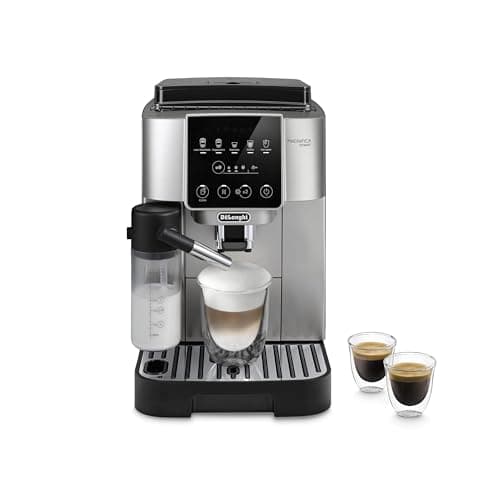
De'Longhi De'Longhi Magnifica Start (auto frother)
De'Longhi Magnifica Start (auto frother)

The one to buy if you want the same De'Longhi bean-to-cup espresso for less and do not need a full milk carafe. The Start runs the identical core engine as the Evo — a built-in conical burr grinder with 13 grind settings, a sealed brew group and a dry-puck bin — from a short, legible control panel with about five one-touch recipes. It froths milk with a plainer automatic frother built into the machine, so there is no separate carafe to wash and store, and a manual-pannarello variant exists if you would rather do the milk yourself. What you give up is milk range: no fridge-storable LatteCrema carafe, no plant-milk texturing claim, and a shorter menu than the Evo's seven drinks. For a black-coffee-and-occasional-cappuccino household that wants the appliance to disappear into the routine, the Start is the smarter spend.

Best simpler, cheaper bean-to-cup
7.3
$799.99Amazon
02
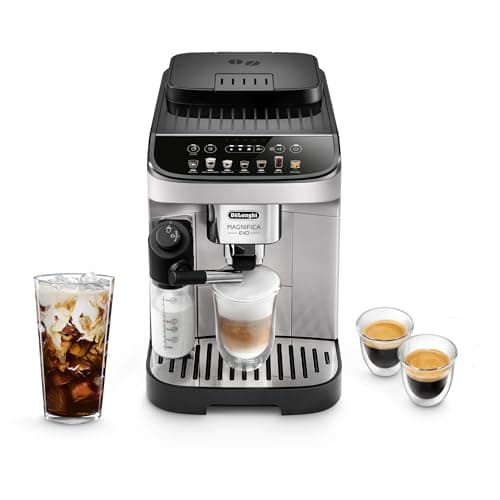
De'Longhi De'Longhi Magnifica Evo with LatteCrema (ECAM29084SB)
De'Longhi Magnifica Evo with LatteCrema (ECAM29084SB)

The one to buy if milk drinks are the whole reason you want the machine. The Evo runs the same bean-to-cup engine as the Start — the same 13-setting grinder, the same sealed brew group — and adds the piece that changes the daily routine: the fridge-storable LatteCrema milk carafe. It textures dairy and plant milks properly, lifts off into the fridge between drinks, and drives seven dedicated one-touch buttons rather than the Start's shorter list. The espresso is good rather than great, and the carafe is one more thing to wash and find fridge space for. But as an everyday, no-skill latte-and-cappuccino machine it is hard to beat, which is exactly why it sells the way it does. You are paying the premium for milk range, not a better shot.

Best for milk drinks
7.7
$749.95Amazon

#ad · Live prices from the Amazon Product API, as of Jul 30, 2026. Where we have no verified live price, we show none — a gap beats a number that has rotted.

In detail

The picks, in full

01
De'Longhi De'Longhi Magnifica Start (auto frother)

Best simpler, cheaper bean-to-cup

De'Longhi Magnifica Start (auto frother)

13 grind settingsAutomatic frother (manual variant exists)About 5 one-touch recipesRemovable, dishwasher-safe parts
7.3/10

The one to buy if you want the same De'Longhi bean-to-cup espresso for less and do not need a full milk carafe. The Start runs the identical core engine as the Evo — a built-in conical burr grinder with 13 grind settings, a sealed brew group and a dry-puck bin — from a short, legible control panel with about five one-touch recipes. It froths milk with a plainer automatic frother built into the machine, so there is no separate carafe to wash and store, and a manual-pannarello variant exists if you would rather do the milk yourself. What you give up is milk range: no fridge-storable LatteCrema carafe, no plant-milk texturing claim, and a shorter menu than the Evo's seven drinks. For a black-coffee-and-occasional-cappuccino household that wants the appliance to disappear into the routine, the Start is the smarter spend.

Shot quality
7
Milk system
7
Grinder
8
Ease of use
8
Ease of cleaning
8
Value
6

Pros

  • Same core bean-to-cup engine as the Evo — 13 grind settings, built-in conical burr grinder, dry-puck bin — for less money
  • Short, legible control panel with about five recipes and no deep menu tree to learn
  • Automatic frother handles the milk without a separate carafe to store, and a manual-pannarello variant exists if you prefer
  • Removable, dishwasher-safe parts keep the daily cleanup to about a minute
  • De'Longhi's most widely stocked bean-to-cup, so it is rarely hard to find

Cons

  • Shorter menu than the Evo's seven drinks — about five recipes, and fewer dedicated milk drinks
  • No fridge-storable LatteCrema carafe and no plant-milk texturing claim like the Evo's
  • Frequently priced at or above machines that do considerably more — check the live price
  • Least customization of the pair — no long list of tunable milk drinks
  • The sealed brew group does not pull out for hand-cleaning, the same as the Evo

Don't buy this if…

you live on lattes and flat whites and want a fridge-storable carafe that textures dairy and plant milks across a longer one-touch menu — that is exactly what the Magnifica Evo adds, and it is the only real reason to spend up.

$799.99View on Amazon

Price as of Jul 30, 2026. Prices change — Amazon's at checkout is the one that counts.

#ad · we may earn a commission from this link to De'Longhi Magnifica Start (auto frother)

02
De'Longhi De'Longhi Magnifica Evo with LatteCrema (ECAM29084SB)

Best for milk drinks

De'Longhi Magnifica Evo with LatteCrema (ECAM29084SB)

13 grind settingsLatteCrema carafe frother7 one-touch drinksAuto-clean cycle + dry-puck bin
7.7/10

The one to buy if milk drinks are the whole reason you want the machine. The Evo runs the same bean-to-cup engine as the Start — the same 13-setting grinder, the same sealed brew group — and adds the piece that changes the daily routine: the fridge-storable LatteCrema milk carafe. It textures dairy and plant milks properly, lifts off into the fridge between drinks, and drives seven dedicated one-touch buttons rather than the Start's shorter list. The espresso is good rather than great, and the carafe is one more thing to wash and find fridge space for. But as an everyday, no-skill latte-and-cappuccino machine it is hard to beat, which is exactly why it sells the way it does. You are paying the premium for milk range, not a better shot.

Shot quality
7
Milk system
9
Grinder
8
Ease of use
8
Ease of cleaning
7
Value
7

Pros

  • LatteCrema carafe textures milk alternatives (oat, almond, soy) as well as dairy, per De'Longhi
  • The carafe lifts off and goes straight into the fridge between drinks, so nothing sits out
  • Seven dedicated one-touch drinks versus the Start's shorter menu, each on its own button
  • 13 grind settings on the built-in conical burr grinder — the finer end of super-automatic adjustment
  • Automatic rinse/clean cycle and a dry-puck bin, so day-to-day cleanup stays tidy

Cons

  • The milk carafe is one more bulky part to wash and find fridge space for
  • Costs meaningfully more than the Start for the same espresso in the cup
  • Espresso is good rather than great — a manual machine plus a real grinder still beats it
  • The sealed brew group does not remove for hand-cleaning, the same as the Start

Don't buy this if…

you drink your coffee black, or only the occasional cappuccino. The whole premium here is the LatteCrema carafe and the longer milk menu, and the simpler Magnifica Start makes the same espresso for less.

$749.95View on Amazon

$899.9517% off

Price as of Jul 30, 2026. Prices change — Amazon's at checkout is the one that counts.

#ad · we may earn a commission from this link to De'Longhi Magnifica Evo with LatteCrema (ECAM29084SB)

The one difference that matters: the milk system

Strip away the model names and almost the entire case for spending up on the Evo comes down to how it handles milk. The Magnifica Startfroths milk with a plainer automatic frother built into the machine — it heats and aerates the milk for you at one touch, which is genuinely hands-free, but there is no separate carafe, and De'Longhi does not make the same plant-milk texturing claims for it that it does for the carafe system. A manual-pannarello variant of the Start also exists for buyers who would rather texture the milk themselves. The Magnifica Evo reviewed here uses the fridge-storable LatteCrema milk carafe: the machine draws milk from a sealed carafe, textures it, and pours it straight into the cup on one touch, and De'Longhi states it handles plant milks — oat, almond, soy — as well as dairy. The carafe lifts off and goes into the fridge between drinks, which keeps the milk cold and cuts the daily cleaning down to a rinse cycle the machine runs itself. That carafe is the whole premium, and for a latte-and-cappuccino household that wants the milk done properly and kept cold, it is a real, repeatable convenience.

The honest trade is range versus simplicity. The LatteCrema carafe gives you more milk drinks, plant-milk capability and cold storage — but it is also one more bulky part to wash and find fridge space for. The Start's built-in frother is simpler and there is nothing extra to store, but its milk menu is shorter and it does not make the same plant-milk claim. Neither system is the same as steaming milk by hand— you do not get latte-art microfoam from either — so if hands-on milk is the appeal, the Start's manual-pannarello variant, or a manual machine entirely, is the honest direction. For everyone who just wants the drink to appear, the question is simply how much milk range you actually need.

One-touch menus: 7 drinks vs 5 recipes

The second difference follows from the first. Because the Evo has the LatteCrema carafe, it can offer seven dedicated one-touch drinks, each on its own button, so a latte, a cappuccino, a flat white and the rest come off a single press with no menu to scroll. The Start keeps things deliberately short with about five recipeson a legible panel, which is plenty for a household that drinks one or two things and would rather not learn a menu. If more than one person makes drinks, or people want different milk coffees through the day, the Evo's longer menu is a genuine daily convenience. If your household drinks the same one or two coffees every morning, the Start's shorter list is not a limitation — it is one less thing to think about. Be level-headed about it, though: a longer menu is worth paying for only if you will actually use the extra drinks, and the Start's espresso button pulls the same shot either way.

What is genuinely the same

This is the part the price gap hides. Both machines are built on the same De'Longhi bean-to-cup engine, and they share the things that actually determine the shot: the same style of built-in conical burr grinder with 13 grind settings, which is the finer end of adjustment at this level and gives you room to correct a shot that runs too fast or too slow; the same sealed brew groupthat doses, tamps and brews behind the panel; and the same dry-puck bin that compacts the spent grounds so emptying it is tidy rather than a wet mess. When two machines share the grinder, the brew group and the brew path, they make the same espresso — and these two do. The Evo's espresso is good rather than great, and so is the Start's, because it is the identical cup. If grind quality and a truly excellent shot are what you are chasing, note that a dedicated espresso grinder paired with a manual machine will out-brew either of these, which is the argument for the separates route over any bean-to-cup.

Cleaning, upkeep and the variants

Day to day, both are low-effort. Each runs an automatic rinse when you switch it on and off, the used grounds drop into a dry-puck bin you empty every few days, and the removable parts are dishwasher-safe. The Evo's LatteCrema carafe adds its own clean cycle and, being a carafe, one more component to rinse and store — the price of the milk range. Both use a sealed brew groupthat does not pull out for hand-cleaning the way a Gaggia super-auto's does, so on either machine you rely on the automatic cycles and periodic descaling to clear mineral scale from the boiler. Two honest notes on the Start: it ships in more than one configuration — an automatic-frother version, which is the one anchored here, and a manual-pannarello version — so check which milk system a given listing includes before you buy. And one caveat that applies to every bean-to-cup: keep oily dark roasts and flavored beans out of the hopper, because the oils and sugars gum up the grinder over time. Medium roasts are the safe default, and our espresso bean picks flag which are safe for a bean-to-cup hopper. We did not bench-test either unit; our methodology explains how we judge.

Which De'Longhi fits you

  • Buy the Magnifica Evo ifyou live on lattes, cappuccinos and flat whites and want the machine to texture the milk, keep it cold in the fridge, and make more of those drinks on one touch. The LatteCrema carafe and the longer menu are exactly what the premium buys — the Magnifica Evo review covers it in full.
  • Buy the Magnifica Start if you drink mostly black coffee and the occasional cappuccino, you want the same espresso for less, and you would rather have a simpler machine with nothing extra to store. Its shorter menu and plainer frother are a feature for that household, not a downgrade.
  • Consider a different milk machine ifmilk drinks are the whole point but you want the easiest system to clean — the tube-free Philips 3300 LatteGo is our overall bean-to-cup pick, and the best machines for lattes roundup covers the wider field.

What we did not test

We have not run either machine on a bench for months, and we do not claim to. This comparison compiles De'Longhi's published specifications for the Magnifica Start and the Magnifica Evo with LatteCrema, cross-checks them against each other and against the shared Magnifica platform, and weighs aggregated owner reports against our scoring rubric. The 13-setting grinder, the sealed brew group and dry-puck bin, the LatteCrema carafe and its plant-milk claim, and the one-touch drink counts all come from De'Longhi's own materials, listed in Sources. Where hands-on time would tell you more than a spec sheet — exactly how each milk system textures over months, how the sealed brew group holds up with hard water, how consistent the automatic frothers are across dairy and plant milks — we say so rather than invent a figure. Prices are never quoted from memory; the live price renders from our price pipeline with the date it was checked.
How we picked

We did not lab-test this gear

Everyone in this category says they tested twenty machines. We have not pulled shots on every product here, and we say so. What we did instead: compiled the published specifications, cross-checked the manufacturer manuals, computed the running cost (wattage to energy, grams-per-shot to cost-per-cup), weighed aggregated owner reports, and scored each product against a published rubric. The scores are judgments from documented research — not measurements we took, because we do not have a test lab and we will not pretend we do. Where hands-on time would tell you more than a spec sheet, we flag it. Where a number came from someone else's work, we name them in Sources.

Questions

Frequently asked

What is the difference between the De'Longhi Magnifica Start and the Magnifica Evo?
The milk system and the menu. The Magnifica Evo adds the fridge-storable LatteCrema milk carafe, which textures dairy and plant milks and drives seven dedicated one-touch drinks. The Magnifica Startkeeps a plainer automatic frother built into the machine (a manual-pannarello variant also exists) and about five recipes. Everything that makes the espresso — the 13-setting built-in grinder, the sealed brew group, the dry-puck bin — is the same, so the two pull an identical shot. You can read the Evo in full in our Magnifica Evo review.
Is the Magnifica Evo worth the extra over the Start?
Only if you value the LatteCrema milk carafe and the longer one-touch menu. The Evo's espresso is not better than the Start's — same grinder, same sealed brew group, same brew path — so you are paying purely for the fridge-storable carafe, its plant-milk capability and the seven dedicated drinks. If you live on lattes and flat whites, that is well worth it; if you drink mostly black coffee, the Start makes the same shot for less. Both are ranked in our super-automatic roundup.
Do the Magnifica Start and Magnifica Evo make the same espresso?
For practical purposes, yes. Both are built on the same De'Longhi bean-to-cup engine, with the same built-in conical burr grinder and 13 grind settings, the same sealed brew group, and the same dry-puck bin. When two machines share the grinder, the brew group and the brew path, they make the same coffee. The differences between these two are entirely in how they handle milk and how many drinks they make on one touch, not in the shot itself.
Does the Magnifica Start froth milk, and does it have a carafe?
The Start froths milk, but not with a fridge-storable carafe. The version anchored here uses a plainer automatic frother built into the machine that textures milk hands-free at one touch, and a manual-pannarello variantalso exists if you would rather texture it yourself. What it does not have is the Evo's LatteCrema carafe, which lifts off into the fridge and makes the plant-milk texturing claim. If a full carafe and a longer milk menu matter to you, the Magnifica Evo is the one.
Which De'Longhi Magnifica is better for lattes?
The Magnifica Evo. Its fridge-storable LatteCrema carafe textures dairy and plant milks and drives a longer one-touch menu, so lattes, cappuccinos and flat whites come off a single press with the milk kept cold between drinks. The Start can make milk coffee with its simpler frother, but the Evo is built around exactly that job. If milk drinks are your whole reason to buy, also look at the best machines for lattes for the wider field.

Keep reading

Receipts

Sources

We do not run a testing lab, and we do not pretend to. Where a measured number came from someone else's work, we name them and link them. Where we could not verify something, we say so on the page rather than quietly leaving it out. Read our full method.