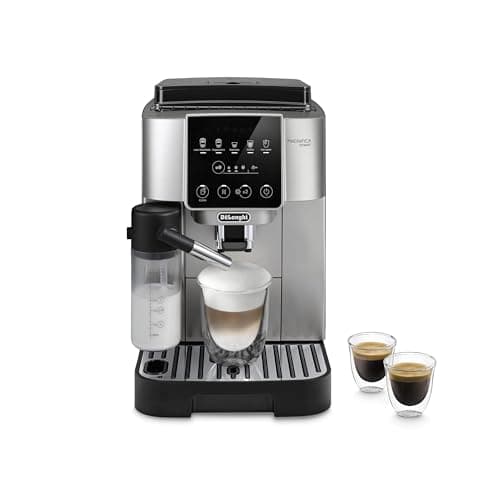
The De'Longhi Magnifica Start is a bean-to-cup super-automatic— a grinder, a brew unit and a milk frother packed into one body, controlled by one button. You fill the hopper with whole beans and the tank with water, press a recipe, and the machine grinds, doses, tamps, brews and ejects the puck on its own; on the automatic-frother version it textures the milk for you too. There is no dialing in, no separate grinder to buy, and effectively no learning curve. It is the entry point to De'Longhi's huge bean-to-cup range, and the whole appeal is stated in the name: you start here when you want coffee, not a hobby. If you are still weighing that fork, our semi-automatic vs super-automatic guide is the honest place to decide before you spend.
What you are buying is convenience, and it is real. The Magnifica Start collapses the whole espresso routine — the part that takes a manual-machine owner four minutes and a fair bit of practice — into a single press and about ninety seconds of waiting. It is one appliance rather than two, the parts that touch coffee and milk are removable and dishwasher-safe so daily cleanup stays close to a minute, and because it is one of De'Longhi's most widely stocked machines it is easy to find and to get serviced. The honest caveat is the flip side of that same design: the machine makes the decisions, so the grind, the dose and the extraction are fixed, and the built-in grinder is the only grinder you get. On a super-automatic that grinder matters as much as anything, and it is not the equal of a good standalone espresso grinder.
So the espresso the Magnifica Start pulls is good rather than great, and that is the trade to go in clear-eyed about. It will make a genuinely enjoyable cappuccino faster than you could froth milk by hand, but it will not out-brew a manual machine paired with a real grinder, and it will not teach you anything about the craft. If you want a slightly richer milk system and a longer drink menu from the same family, the step up is the Magnifica Evo; if you would rather learn to pull shots and are open to a manual machine plus a grinder, the field in our best espresso machines under $1,000 roundup is where most of that money is better spent. For the right buyer, though, the Start does exactly what it says on the box.
What “one-touch” actually means here
A super-automatic like the Magnifica Start automates the entire chain that a manual-machine owner does by hand. Press a recipe and the machine grinds a fresh dose from the hopper, tamps it inside a sealed brew unit, forces water through it at pressure, and drops the spent puck into an internal bin — and on the automatic-frother model it heats and textures milk on top, finishing a cappuccino or latte in one go. You never touch a portafilter, never weigh a dose, never judge a shot by eye. That is the whole product, and it is genuinely valuable for the buyer it is aimed at: someone who wants a consistent drink every morning without acquiring a skill. The catch built into that same convenience is that the machine, not you, owns every variable, so the ceiling is set by De'Longhi's recipe rather than by how good you get. For a lot of households that is exactly the right deal; for anyone who wants to chase a better shot, it is the reason to look at a manual machine instead.
The built-in grinder is the only grinder you get
On any bean-to-cup machine, the built-in grinder is the single component that most determines the cup, because it is the only grinder in the system and you cannot swap it. The Magnifica Start's integrated burr grinder is perfectly capable of feeding the machine a fresh, consistent-enough dose — which is already a huge step up from pre-ground coffee — but it has to fit inside the body and hit a budget price, so it is not the equal of a dedicated standalone espresso grinder. That matters because espresso lives or dies on grind consistency: no brew unit can rescue a grind that is uneven, and the difference between good home espresso and great home espresso is usually the grinder, not the machine. It is worth being honest that this is the same reason a manual machine plus a serious grinder will out-brew the Start — you are trading a little grind ceiling and all of the control for the convenience of never having to think about either.
Milk, menu and daily cleaning
Two practical things decide whether a super-automatic actually gets used six months in: the milk system and the cleaning. The automatic-frother Magnifica Start textures milk for you without a separate carafe to wash and store, which keeps the daily footprint small; the parts that touch coffee and milk are removable and dishwasher-safe, so the routine stays close to a minute rather than the five-minute strip-down that sends fussier machines into a cupboard. The trade-off is on the menu side. The Start is deliberately kept simple — a short list of one-touch recipes with no saved user profiles and little per-drink customization — so if you want to tune strength, volume and temperature per drink, or you want cortados and flat whites stored to a button, this is not that machine. That simplicity is a feature for the buyer who wants the appliance to disappear into the routine, and a limit for the buyer who wants to fiddle.
Super-automatic vs a manual machine and a grinder
The comparison that actually matters is not against another bean-to-cup machine — it is against the whole alternative category. For roughly what the Magnifica Start costs, you could buy a capable manual machine and a decent separate grinder, and that setup will make a better shot and let you pour real latte art. It will also ask you for a few minutes and a little skill every time, and it will need dialing in whenever you change beans. So the decision is genuinely about you, not the gear: buy the Start if you want coffee rather than a hobby, if more than one person in the house makes drinks, or if the realistic alternative is not making espresso at all; buy a manual machine and a grinder if you find the process interesting, care about the gap between a good shot and a great one, or want to learn. Our semi-automatic vs super-automatic guide walks that fork in more depth, and the best machines under $1,000 roundup covers the manual field the Start cross-shops against on price.
Who it is for
- Buy the Magnifica Start if you want a genuinely good milk drink every morning at one touch, you would rather not learn to pull shots, and one appliance instead of two is the appeal. That convenience is exactly what it is built to deliver.
- Step up to the Magnifica Evo instead ifyou want a richer milk carafe, more grind settings and a longer one-touch menu — our Magnifica Evo review covers where the extra money goes.
- Skip it ifyou actually want to learn espresso or chase a better shot — a manual machine plus a real grinder teaches you more and reaches a higher ceiling for similar money.
What we did not test
We have not run this machine on a bench for months, and we do not claim to have. This review compiles De'Longhi's published specifications, cross-checks them against the wider Magnifica bean-to-cup range, and weighs aggregated owner reports against our scoring rubric. The built-in grinder, the automatic frother, the one-touch recipes and the removable, dishwasher-safe parts all come from De'Longhi's own materials, listed in Sources. Our scores are editorial judgments from that documented research, not lab measurements — we do not have a lab, and our methodology says exactly that. Where hands-on time would tell you more than a spec sheet — exactly how consistent the built-in grinder stays over months, how the automatic frother handles plant milks, how the brew unit holds up with daily use — we say so rather than invent a figure, and we never quote a price from memory; the live price renders from our pipeline with the date it was checked.