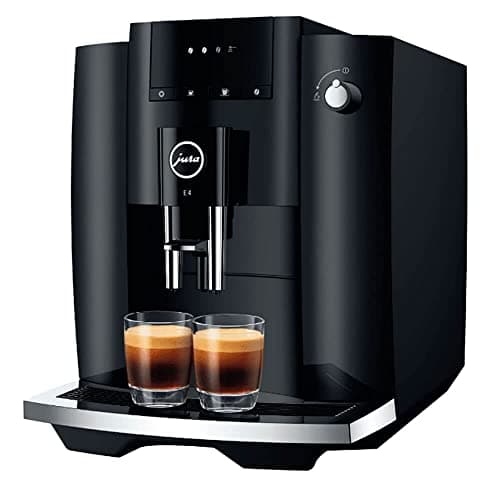
The Jura E4 is the premium, Swiss-made end of the bean-to-cup world — but it is a specialist, and the single most important thing to know before you buy it is what it does not do. The E4 has no milk system at all: no frother, no steam wand, nothing. It is built purely for black coffee — ristretto, espresso, coffee, americano and lungo, plus hot water — and it spends the whole budget on brewing those well rather than on a milk carafe. Its signature is Jura's Pulse Extraction Process (P.E.P.), which pushes water through the puck in short bursts to lengthen the extraction, a genuinely different approach aimed at ristretto and espresso quality. If you drink your coffee black and want it made beautifully at one touch, this is a serious machine — see where it lands against the field in our best super-automatic espresso machines roundup. If anyone in your house drinks lattes, read on, because the E4 physically cannot make one.
What you are really paying for is brewing, and it helps to be clear-eyed about that. The E4 uses a variable brewing chamber that takes roughly 5 to 16 grams of coffee, so a short espresso and a longer coffee actually get a different dose rather than the same puck brewed two ways; the Professional Aroma Grinder grinds fresh for every cup; and a 64 oz water tank — the largest in its class — with built-in Clearyl filtration keeps refills and descaling to a minimum. A coffee-only design also means far fewer parts to fail than a milk machine carries. The E4 is the accessible end of Jura's line, and it gets there partly by leaving out the milk system that its pricier siblings include, putting everything into the shot instead. Even so, it still costs meaningfully more than a mainstream milk-capable bean-to-cup like the Philips 3300 LatteGo, which does more for less — so the E4 only makes sense if black-coffee quality is genuinely your priority.
The honest part is who this machine is wrong for. Because it has no frother, a milk-drink household would have to buy a separate standalone milk frother to make a cappuccino, or simply choose a different machine — and for most people, that is the deciding factor. Add a bean hopper that is small for a machine at this price, and the E4 becomes a narrow, deliberate recommendation rather than a do-everything one. If lattes and flat whites are the point of owning a machine, a carafe bean-to-cup like the De'Longhi Magnifica Evo makes them on one touch for far less, and the machines in our best machines for lattes roundup are built around exactly that job. The E4 is for the black-coffee drinker who wants Swiss build and a serious shot, full stop.
What P.E.P. changes about the shot
The engineering headline on the E4 is Jura's Pulse Extraction Process. Instead of pushing water through the coffee in one continuous flow, P.E.P. sends it through in rapid bursts, which lengthens the contact time between water and grounds on short drinks in particular. Jura designs it around ristretto and espresso — the very short drinks where a continuous flow can run through too quickly to build flavor — and it is a genuinely different approach to the problem than a fixed-flow super-automatic takes. Paired with the variable brewing chamber, the effect is that the E4 treats a short shot as a short shot rather than a scaled-down coffee. It will not turn a bean-to-cup into a hand-dialed manual machine — the dose, tamp and yield are still the machine's to decide — but for a category built around convenience, P.E.P. is a real attempt to raise the ceiling on the cup, and it is the clearest reason the E4 spends its money the way it does.
No milk system — and why that is the point
Here is the fact that decides whether the E4 is right for you: it has no milk system at all. There is no automatic frother, no milk carafe and no steam wand, so the machine makes ristretto, espresso, coffee, americano and lungo, plus hot water — and nothing with milk. That is not an oversight; it is the design. By leaving out the frother, Jura removes the most failure-prone, hardest-to-clean subsystem a super-automatic carries and puts the whole budget into the brewing, which is why the E4 can pull the shot it does at the price it does. For a genuine black-coffee drinker that is a clean, honest trade. But it means the E4 is the wrong machine for a milk-drink household in a way no setting can fix: to make a cappuccino or latte you would have to buy a separate, standalone milk frotherand texture the milk on the side, which defeats the one-touch convenience most people buy a super-automatic for. If your mornings run on lattes and flat whites, a machine built around milk — like the ones in our best machines for lattes roundup — is the honest choice, and it will cost you less.
The grinder and the variable brewing chamber
A super-automatic's built-in grinder is the only grinder you get, and the E4's Professional Aroma Grinder grinds fresh for every cup as part of a brew path built to protect flavor. The more unusual piece is the variable brewing chamber, which accepts roughly 5 to 16 grams of coffee. That range matters more than it sounds: on many bean-to-cup machines a short and a long drink come off the same puck, whereas the E4 can actually put more coffee behind a longer cup and less behind a ristretto, so the dose scales with the drink. It is the same philosophy as the rest of the machine — spend the engineering on the shot rather than on a menu of milk drinks it does not make. One caveat that applies to every bean-to-cup, not just this one: keep oily dark roasts and flavored beans out of the hopper, because the oils and sugars gum up the grinder over time. Medium roasts are the safe default, and our espresso bean picks flag which are safe for a bean-to-cup hopper.
Living with a Jura: filtration and upkeep
Day to day, the E4 is designed to stay low-effort. A 64 oz water tank — the largest in its class — means fewer refills, and built-in Clearyl filtration stretches the interval between descales while protecting the internals, which matters on any machine with long, sealed plumbing you cannot reach. The machine runs automatic rinse cycles and prompts you for cleaning tablets and descaling when they are due, so the maintenance is guided rather than guesswork — and with no frother, there is no milk-wetted carafe or tubing to strip down and clean every day, which is a genuine upside of the coffee-only design. Two honest limitations to weigh: the bean hopper is small for a machine at this price, so a heavy-use household refills it more often, and the brew unit is sealed — it does not pull out for hand-cleaning the way a Gaggia super-auto's does, so you rely on the automatic cycles and tablets. We did not bench-test the machine; our methodology explains how we judge.
Who it is for
- Buy the Jura E4 ifyou drink your coffee black — espresso, coffee, americano — you value Swiss build and a serious shot, and P.E.P. with a variable dose is worth a clear premium to you. That engineering is exactly what the extra money buys.
- Buy a milk machine instead ifanyone drinks lattes or cappuccinos — the De'Longhi Magnifica Evo and the Philips 3300 LatteGo make one-touch milk drinks the E4 cannot, for far less money.
- Skip a bean-to-cup entirely ifyou would rather chase a great shot by hand — a manual machine from our best machines for beginners paired with a dedicated grinder gives you more control over the cup for a similar spend.
What we did not test
We have not run this machine on a bench for months, and we do not claim to. This review compiles Jura's published specifications for the E4, cross-checks the Pulse Extraction Process, grinder and filtration details against our super-automatic roundup, and weighs aggregated owner reports against our scoring rubric. The P.E.P. brewing, the 5-16 g variable chamber, the Professional Aroma Grinder, the 64 oz tank with Clearyl filtration and the fact that the E4 carries no milk system all come from Jura's own materials, listed in Sources. Where hands-on time would tell you more than a spec sheet — exactly how the shot holds up over months, how the sealed brew unit ages with hard water — we say so rather than invent a figure. Prices are never quoted from memory; the live price renders from our price pipeline with the date it was checked.