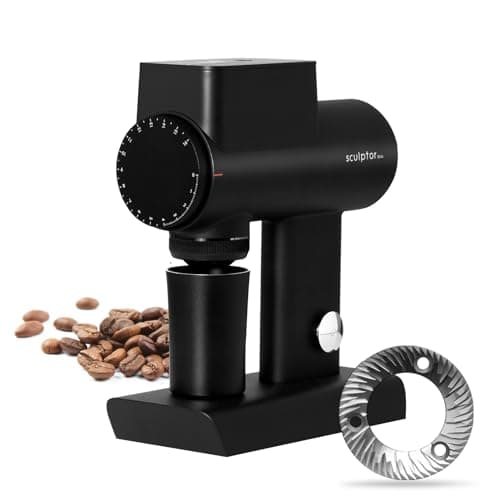
The TIMEMORE Sculptor 064S is what happens when a maker takes the affordable 64mm flat-burr single-doser formula and builds it properly. Where the value grinders in this class feel functional, the Sculptor feels engineered: 64mm stainless steel flat burrs driven by a PID-controlled brushless motor, a rotary knocker that drives single-dose retention very low, all wrapped in a heavy, all-metal body that feels a genuine class above. It grinds cleanly and consistently for both espresso and filter, with the clarity a good flat burr promises, and it does it at a price that is competitive for how premium the object is. It sits among our best flat burr grinders as the refined 64mm single-dose pick for someone who wants the polish and will pay a little for it.
The 64mm flat-burr set is the heart of the appeal. Sixty-four millimeters is the size most boutique espresso grinders use, and it turns out the tighter, more unimodal grind that reads in the cup as clarity and separation — a bright single-origin's acidity sitting distinct from its sweetness. Paired with the PID brushless motor, which holds a steady speed under load, the Sculptor grinds cleanly and consistently across the range, from a fine espresso grind to a coarse filter one. Stepless adjustment across its settings lets you creep in on a shot by the smallest amount, so it dials espresso in with a smooth, planted feel rather than coarse clicks. If you want to see how it compares against the value benchmark of this whole category, our DF64 Gen 2 review is the essential companion read.
The single-dose workflow is where the engineering shows. You weigh in exactly the beans you want, grind them all out, and a rotary knockerplus a straight grind path push retention very low, so almost nothing is left inside between doses — the freshness and near-zero waste that make single-dosing worth the extra ritual. The motor is quiet and controlled with adjustable speed, which makes the daily experience feel refined rather than industrial. For anyone whose priority is clean, low-retention single-dosing with premium build, the Sculptor is a strong pick, and it earns a place in our best single-dose grinders for that reason.
The honest catch is value and support. The Sculptor costs well above the DF64 for a grind that is more refined than dramatically better — you are paying for the build, the motor and the polish, not a night-and-day jump in the cup. And TIMEMORE's electric-grinder service and parts network is newer and less proven than Baratza's long-established one, so the long-term repair story is less certain. It is also single-dose only, with no hopper option for walk-away batch grinding. Accept those and it is a lovely premium single-doser; if maximum flat-burr capability per dollar is the goal, our best electric espresso grinders under $500 shows where the value lands.
Who the Sculptor 064S is really for
The Sculptor suits a particular buyer: someone who has decided on 64mm flat-burr single-dosing and wants the nicest version of it they can reasonably afford — a heavier, quieter, better-built grinder than the value benchmark, and is willing to pay a premium for that polish. If a grinder that feels engineered and looks the part on the counter matters to you, and clean low-retention single-dosing is the workflow you want, the Sculptor delivers. Where it is notthe right pick is for the value-maximizer or the batch-grinder. If you want the most flat-burr capability per dollar, the DF64 gets you most of the way for meaningfully less; if you want walk-away hopper grinding for big batches, the Sculptor's single-dose-only design will frustrate you; and if long-term repairability is your top priority, Baratza's established parts-and-service network is more proven than TIMEMORE's newer one. Be honest about which of those you are, because the Sculptor's case rests entirely on wanting the refinement, not the lowest price. The wider value picture lives in our best electric espresso grinders under $500.
64mm flat burrs and the PID brushless motor
The Sculptor's grind quality rests on two things: the burrs and the motor. The 64mm stainless steel flat burrsare the size most boutique espresso grinders use, and the flat geometry throws a more unimodal grind — more particles clustered near your target size — which reads in the cup as clarity and flavor separation, the whole reason to buy a flat burr. Driving them is a PID-controlled brushless motor, which holds a steady grinding speed under load rather than bogging down when it hits a dense dose; a stable speed means a more consistent particle size, which is what you actually taste. Together they give clean, consistent grinding for both espresso and filter. Stepless adjustment across the settings lets you creep in on an espresso shot by the smallest amount, with a smooth, planted feel rather than coarse stepped clicks. Sixty-four millimeters is a big burr, but as we always say, burr size is one input, not a ranking — our best flat burr grinders roundup explains why alignment, tuning and adjustment matter as much as diameter.
Low-retention single-dosing and the premium build
The Sculptor is a single-dose grinder, and it is engineered to do that job cleanly. You weigh in exactly the beans you want and grind them all out; a rotary knockerand a straight, short grind path push retention very low, so very little is trapped inside between doses. That is the point of single-dosing — every dose is as fresh as the moment you scoop it, switching beans is effortless, and there is almost no stale coffee handed to you later. The cost, as with every single-doser, is the ritual: you weigh and load each dose rather than filling a hopper and walking away. What sets the Sculptor apart from cheaper single-dosers is the build. The heavy, all-metal body feels a genuine class above the functional-but-plasticky value grinders, and the quiet, controlled motor with adjustable speed makes the daily experience feel refined. That refinement is what you are paying the premium for — it does not make the coffee dramatically better than a DF64 does, but it makes the grinder much nicer to own and use. If low-retention single-dosing is your priority above all, our best single-dose grinders roundup ranks the field, and the broader espresso comparison is in our best grinders for espresso.
What we did not test
We have not run the Sculptor on a bench for months, and we will not pretend otherwise. This review compiles TIMEMORE's published specifications and authorized-retailer listings, cross-checks how 64mm flat burrs and a PID brushless motor work, and weighs aggregated owner reports against our scoring rubric. The specs — the 64mm stainless flat burrs, the stepless adjustment, the rotary-knocker single-dose design and the PID brushless motor — come from TIMEMORE and authorized-retailer materials, listed in Sources. Our scores are editorial judgments from that documented research, not measured numbers: there is no particle-size rig or retention scale behind them. Where hands-on time would tell you more than a spec sheet — exactly how much cleaner the Sculptor's grind is than a DF64's on the same bean, or how the newer TIMEMORE service network actually performs when a part fails — we say so rather than invent a figure. The claim we are most confident in is the honest one: the Sculptor is a more refined, better-built 64mm single-doser than the value benchmark, and that refinement is what the premium buys, not a transformed cup — every published spec and owner account we found supports that reading.
How we picked
We did not lab-test this gear
Everyone in this category says they tested twenty machines. We have not pulled shots on every product here, and we say so. What we did instead: compiled the published specifications, cross-checked the manufacturer manuals, computed the running cost (wattage to energy, grams-per-shot to cost-per-cup), weighed aggregated owner reports, and scored each product against a published rubric. The scores are judgments from documented research — not measurements we took, because we do not have a test lab and we will not pretend we do. Where hands-on time would tell you more than a spec sheet, we flag it. Where a number came from someone else's work, we name them in Sources.