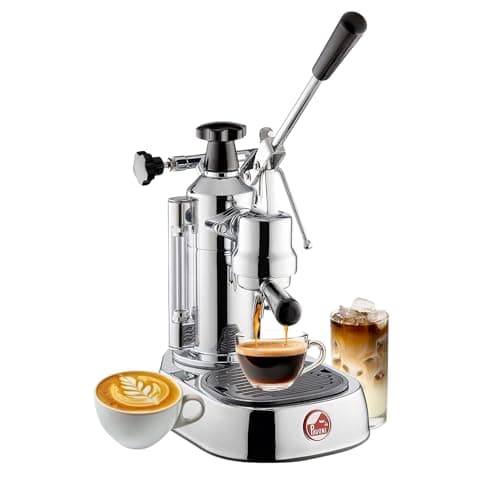
The La Pavoni Europiccola is the romantic one — a chrome-and-brass manual lever espresso machine whose silhouette has barely changed since the late 1960s, and the rare manual maker that can make a whole cappuccino unaided. Unlike a cold-press Flair, it plugs in and heats its own nickel-plated brass boiler, and it carries a steam wand to froth milk. But it is still, emphatically, a manualmachine: you pull the shot on a piston lever, and the brew pressure comes entirely from your arm, not from a pump. It is an object first and a coffee maker second — a genuine mechanical heirloom that happens to pull espresso.
What you get for that is a machine you can hand down. The chrome-and-brass build lasts decades and is fully rebuildable with inexpensive gasket kits, so it is a tool you repair rather than replace, and the lever gives you real, tactile control over pressure and pre-infusion once you have learned it. On sheer build and espresso romance, nothing else in our manual espresso roundupcomes close — it is the splurge of the category, and for the right person it is a machine they will keep and love for twenty years. If a coffee ritual with a bit of ceremony is the appeal, this is the machine that delivers it.
The honesty is in the apprenticeship. The Europiccola has no PID and no modern thermostat, so you manage brew temperature by timing and feel; the boiler is small; and the group and lever get genuinely hot in use, so early shots will be rough while you learn the rhythm. It is overkill for anyone who just wants a quick, reliable cup, and it demands a good grinder like every lever does — a real espresso grinder is not optional. If you want plug-in espresso without the learning curve, this is not the machine; if the craft is the point, read how to pull an espresso shot and read on.
A heated lever, not a cold-press maker
The Europiccola sits in a different family from a Flair or a Wacaco. Those are cold-pressmakers with no heating element — you add hot water from a kettle. The Europiccola is a heated lever: it plugs in, heats its own nickel-plated brass boiler, and can therefore also produce steam to froth milk. That is why it can make a whole cappuccino on its own, which no cold-press maker can. But do not mistake "plugs in" for "automatic." The electricity heats the water; it does nothing to pull the shot. When you raise and lower the piston lever, your arm is what forces water through the puck at espresso pressure. It is a manual machine with a kettle built in, not a pump machine — and that distinction is the entire character of the thing.
Chrome, brass and a machine you rebuild
The reason people keep these for decades is the build. The body is chrome over brass, the boiler is nickel-plated brass, and almost every wearing part — the group gasket, the piston seals — is a cheap, replaceable component you can fit yourself with a basic gasket kit. Nothing about it is designed to be thrown away. A Europiccola bought today can be running in twenty years on a handful of inexpensive seals, and a used one from the 1980s can be brought back to life the same way. That rebuildability is a real, practical value that a spec sheet undersells: you are buying a mechanism you maintain, not an appliance you replace. It also means the secondhand market is genuinely worth watching, because these machines do not die — they get restored.
Two practical notes on buying follow from that. First, the price: the Europiccola is the premium splurgeof the manual category, well above the cold-press Flair and Wacaco levers, and you are paying for the boiler, the steam wand, the materials and the heritage — not for a shot that is dramatically better than a good cold-press lever can pull. Second, where you buy matters: Amazon stock is thin and often third-party, and a machine you may want serviced or rebuilt is one to buy from an authorized dealer with parts support behind it. That is not a knock on the machine; it is simply how to buy a long-lived, rebuildable tool sensibly.
The learning curve is real: temperature by feel
Here is the part the beautiful photos never mention. The Europiccola has no PID and no modern thermostat, so you manage brew temperature yourself, by timing how long the machine has been on and by feel. Leave it too long and the small boiler runs too hot, scorching the shot; pull too soon and it brews under-temperature. The group and the lever get genuinely hot in use, so technique and a bit of care matter. Your first week of shots will be rough — that is normal, and it is the price of admission. Owners who love these machines describe the temperature dance as part of the pleasure; owners who wanted a reliable morning cup often find it maddening. Which of those you are is the whole buying decision, so be honest about it before you spend.
The grinder still decides the shot
A lever rewards a good grind and punishes a bad one, exactly like every manual maker, and no amount of chrome changes that. You need a burr grinder that can reach a fine, even espresso grind — our best grinders for espresso covers the options, and if you like the idea of a hand-operated setup to match the hand-operated machine, a quality hand grinder like the 1Zpresso K-Ultra is a fitting partner. If you are still deciding how to split the budget, read do you need a grinder for espresso— for a lever, the answer is unambiguous, and a scale plus fresh espresso beans finish the kit that makes the shot repeatable.
Who it is for
- Buy the Europiccola if you want a beautiful, rebuildable heirloom that makes whole milk drinks by hand, and you genuinely want to learn the temperature dance rather than avoid it. For romance, build and longevity, nothing in the manual category matches it.
- Consider a cold-press lever instead ifstraight espresso is the point and you would rather put the money into the cup than into chrome — a Flair-style all-stainless lever from our manual roundup pulls a superb shot for a fraction of the price, with a steam-free simplicity many people prefer.
- Skip it if you want a dependable cup on day one with no apprenticeship. A plug-in pump machine from our best machines for beginners— or a serviceable classic like the Gaggia Classic Evo Pro— gives you consistent espresso far sooner, with a PID and a pump doing the hard parts.
What we did not test
We have not run this machine for months on a bench, and we do not claim to. This review compiles La Pavoni's published specifications for the Europiccola and an authorized retailer's listing, cross-checks them against the wider manual field in our roundup, and weighs aggregated owner reports against our scoring rubric. The manual piston lever, the brass boiler, the steam wand and the rebuildable chrome-and-brass construction all come from La Pavoni's own materials and retailer specifications, listed in Sources. Where hands-on time would tell you more than a spec sheet — exactly how steep the temperature learning curve feels for a first-time lever owner, how the seals hold up across years of daily pulls — we say so rather than invent a figure. Prices are never quoted from memory; the live price renders from our pipeline with the date it was checked.