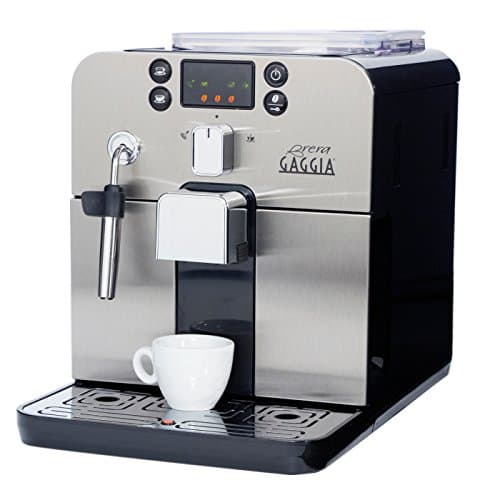
The Gaggia Brera is a super-automatic espresso machine — whole beans in, a shot out, with the grinder and brew unit built into one body — but it is the compact, slightly old-school member of the family, and it does one thing differently from almost every rival: it hands the milk back to you. The Brera grinds, doses, tamps and brews at the press of a button, then stops. To make a cappuccino you texture the milk yourself with a manual pannarello steam wand, rather than letting a carafe do it hands-free. For a certain kind of buyer — someone who wants bean-to-cup convenience on the espresso but a little hands-on control over the milk — that is exactly the right compromise. See where it lands against the wider field in our best super-automatic espresso machines roundup.
The two things people notice first are the size and the serviceability. At roughly 12.4 inches wide, with a front-loading water tank and a front dreg drawer, the Brera slides under wall cabinets and into narrow kitchens where a taller, deeper machine simply will not go — it is one of the more genuinely compact bean-to-cup machines you can buy. Underneath, it uses 100% ceramic burrs and a brew group you can pull out and rinse under a tap, which is the difference between a machine you can maintain yourself and one you eventually have to send away. If you want to know what the pannarello actually asks of you before you commit, our guide to steaming milk at home walks through the skill it replaces automation with.
The honest part is where the Brera shows its age and its price point. The built-in grinder has only five grind settings — the coarsest adjustment among the super-automatics we track — so you have less room to correct a shot that runs too fast or too slow than a machine with 12 or 13 steps gives you. The pannarello makes foam rather than latte-art microfoam, the 40 oz tank asks to be refilled more often than a carafe machine, and the design looks and feels its years next to a modern touchscreen unit. If you want the machine to make the whole drink while you walk away, a carafe machine like the Philips 3300 LatteGo is the honest answer; and if grind quality is the thing you care about most, a manual machine paired with a dedicated espresso grinder will out-grind any built-in unit.
What "compact super-automatic" actually gets you
The Brera's headline feature is its footprint. Most bean-to-cup machines are tall and deep because the bean hopper, grinder and brew unit all have to stack inside one body; the Brera keeps that stack narrow, at roughly 12.4 inches wide, and puts the water tank and the spent-grounds dreg drawer at the front so you are not reaching behind or above the machine to service it. In practice that means it fits under a run of wall cabinets and into a galley kitchen where a wider or deeper machine would not, and you can refill and empty it without pulling it off the counter. If counter space or cabinet clearance is the constraint that has kept you from buying a super-automatic, this is the machine that removes it. Measure your space regardless — compact is relative, and the hopper still sits up top — but the Brera is one of the few bean-to-cup machines designed around a small kitchen rather than in spite of one.
The pannarello wand: more control, not latte art
Here is the Brera's defining quirk. Where nearly every modern super-automatic textures milk for you — a carafe or an automatic frother heats and foams it hands-free — the Brera stops after it pulls the espresso and hands you a manual pannarello wandto finish the drink yourself. A pannarello is a frothing sleeve over the steam wand that introduces air as you texture, so it is more forgiving than a bare commercial wand and easier for a beginner to get workable foam from. The honest framing is that it makes foam, not the glossy microfoam a barista pours latte art with, and it asks you to be present for the milk rather than walking away. For some buyers that is the whole appeal: you get bean-to-cup convenience on the fiddly part (grinding, dosing, tamping, brewing) and keep your hands on the part that is actually satisfying to do. If that reads as a chore rather than a feature, this is the wrong machine — our guide to steaming milk shows exactly what the pannarello involves so you can decide before you buy.
The grinder, and why 5 settings is the honest limit
A super-automatic's built-in grinder is the only grinder you get, so the number of adjustment steps matters more than it does on a machine you pair with a standalone unit. The Brera grinds fresh for every cup on 100% ceramic burrs — ceramic is hard-wearing and runs cool, which is a genuine plus — but it offers only five grind settings, the coarsest adjustment range among the bean-to-cup machines we track. That is the Brera's clearest limitation. Five steps give you less room to correct a shot that pours too fast or too slow than the twelve or thirteen you get on a Philips 3300 or a De'Longhi Magnifica, so you lean more on the programmable strength settings and on choosing a bean the machine gets along with. One caveat that applies to every bean-to-cup, not just this one: keep oily dark roasts and flavored beans out of the hopper, because the oils and sugars gum up the grinder and chute over time. Medium roasts are the safe, sensible default — our espresso bean picks flag which are safe for a bean-to-cup hopper.
Serviceability: the removable brew group
The brew group is the moving assembly that doses, tamps, brews and ejects the puck, and it accumulates coffee oils no matter how you use it. The Brera lets you pull it out and rinse it under a tap, which is the same serviceability advantage the pricier Gaggia Cadorna offers and something a lot of sealed rivals will not allow — on those machines the brew group is fixed in, fine until it is not, and then it is a service visit. Being able to clean the part that does the work yourself is a real long-term advantage: it keeps the flavor clean, and it is the kind of maintenance that decides whether a machine lasts years or gets tired and replaced. Beyond that, day-to-day upkeep is the usual bean-to-cup routine — empty the dry-puck dreg drawer every few days, and descale periodically to clear mineral scale from the boiler, which matters more here than on a manual machine because the internal plumbing is longer and you cannot get at it. Filtered water from the start is the cheapest maintenance decision you can make.
Who it is for
- Buy the Gaggia Brera if your kitchen is tight on space, you want one-touch espresso, and you would rather froth the milk yourself with a wand than let a carafe do it. The compact footprint and the removable brew group are exactly what you are buying.
- Buy a carafe machine instead ifyou want a hands-free, walk-away cappuccino — the Philips 3300 LatteGo and the De'Longhi Magnifica Evo texture the milk for you and offer far more grind adjustment.
- Skip a bean-to-cup entirely ifgrind quality and a truly excellent shot matter more to you than single-box convenience — a manual machine from our best machines for beginners paired with a dedicated grinder is the better long-term setup.
What we did not test
We have not run this machine on a bench for months, and we do not claim to. This review compiles Gaggia's published specifications for the Brera, cross-checks them against the rest of our super-automatic roundup, and weighs aggregated owner reports against our scoring rubric. The compact dimensions, the ceramic burrs and five-setting grind range, the removable brew group and the manual pannarello wand all come from Gaggia's own materials, listed in Sources. Where hands-on time would tell you more than a spec sheet — exactly how the pannarello textures over months, how the grinder holds its setting, how the brew group wears with hard water — we say so rather than invent a figure. Prices are never quoted from memory; the live price renders from our price pipeline with the date it was checked.
How we picked
We did not lab-test this gear
Everyone in this category says they tested twenty machines. We have not pulled shots on every product here, and we say so. What we did instead: compiled the published specifications, cross-checked the manufacturer manuals, computed the running cost (wattage to energy, grams-per-shot to cost-per-cup), weighed aggregated owner reports, and scored each product against a published rubric. The scores are judgments from documented research — not measurements we took, because we do not have a test lab and we will not pretend we do. Where hands-on time would tell you more than a spec sheet, we flag it. Where a number came from someone else's work, we name them in Sources.