Skip to content
Portafilter Co

Makers & Brewers · Coffee Makers

The best coffee percolators

Six percolators ranked on build, brew character, ease and versatility — the durable, camping-friendly, unapologetically old-fashioned way to make coffee, chosen honestly, with the coarse-grind and don't-over-perc tips that keep it from turning bitter.

By Stephen V.Updated How we pick
#ad

We earn a commission when you buy through our Amazon links, at no extra cost to you. It never changes a verdict, and we say so when the cheaper product is the better buy. How this works.

A percolator is the coffee maker your grandparents used, and it works exactly the way it looks like it should. Water sits in the bottom, a hollow stem rises up the middle to a basket of grounds near the top, and once the base boils, the pressure pushes water up the stem and showers it back down over the grounds — over and over, in that unmistakable perking rhythm, until you pull it off the heat. It is one of the oldest brewing methods still in daily use, and it survives for reasons that have nothing to do with fashion: durability, dead simplicity, and the fact that it will make coffee on a camp stove, a wood fire, or a cabin's single electric ring when nothing else will.

Here is the honest part, and we will not pretend otherwise: a percolator is not a specialty-coffee tool. Because it recirculates already-brewed coffee back through the grounds, it extracts hard, and if you grind too fine or let it perk too long it will pull out the bitter, astringent compounds a pour-over is designed to leave behind. What it makes, done right, is a robust, full, slightly old-fashioned cup — strong and satisfying rather than bright and nuanced. If you want clarity and delicate flavor notes, a percolator is the wrong pick and a good drip machine is the right one. If you want a pot that is nearly indestructible, needs no filters or pods, and makes a bold cup anywhere, read on.

A percolator is also not a moka pot, even though people mix them up. A moka pot pushes water up through the grounds exactly once, under steam pressure, to make a small, concentrated, near-espresso shot; a percolator cycles ordinary hot water through the grounds repeatedly to make a full pot of everyday coffee. Different pressure, different strength, different drink. The real decisions on this page are simpler than any of that: stovetop versus electric, how many cups you brew, and what the pot is made of. Get those three right and the percolator itself is hard to get wrong.

The short answer

Quick picks

#ProductBest forScorePrice
01
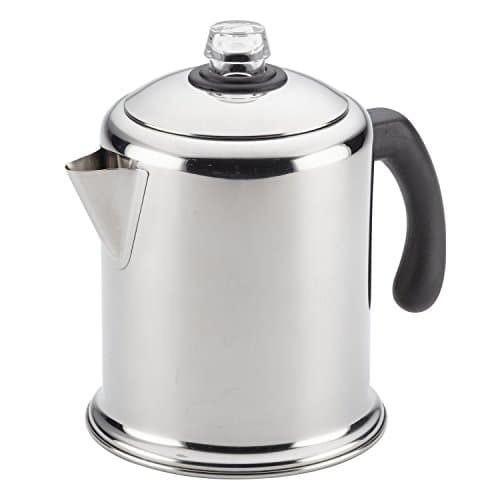
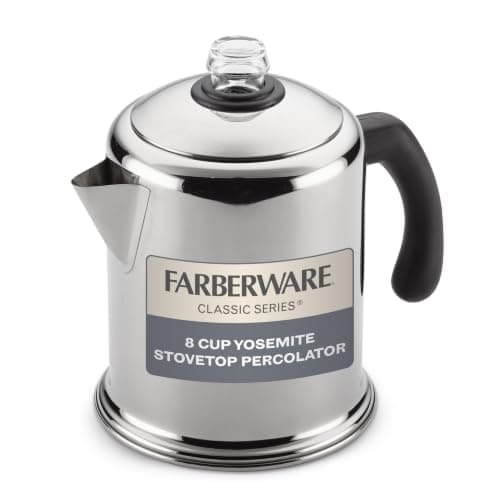
Farberware Farberware Classic Stainless Steel Yosemite Percolator (8-Cup)
Farberware Classic Stainless Steel Yosemite Percolator (8-Cup)

The percolator most people picture when they hear the word, and the one we would hand a first-time buyer. A one-piece stainless body with a permanent basket and stem, a clear knob on the lid so you can watch it perk and pull it at the right moment, and a size that suits a couple or a small household. It works on any stovetop, cleans up in seconds, and it is close to unbreakable. It will not out-nuance a pour-over, but it makes an honest, strong old-fashioned cup and it will do it for decades.

Best overall stovetop
8.4
$33.08Amazon
02
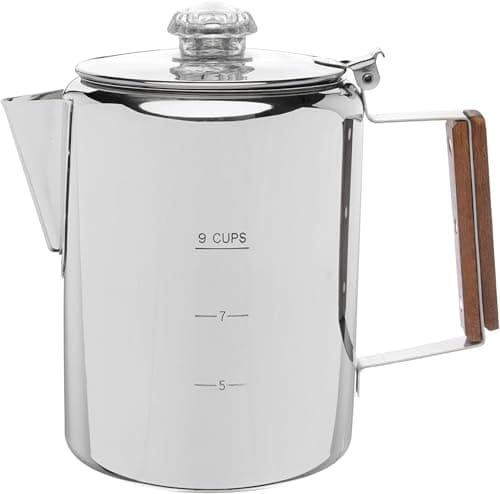
COLETTI COLETTI Bozeman Percolator (9-Cup)
COLETTI Bozeman Percolator (9-Cup)

The percolator for people who care that their coffee never touches aluminum or plastic. COLETTI builds the Bozeman from heavier food-grade stainless than the classic Farberware, with no aluminum or plastic anywhere in the brew path, a solid feel in the hand, and paper filters included if you want to cut the sediment. It is aimed squarely at campers and home users who want the best-made stovetop pot rather than the cheapest, and it delivers on that — you pay more, and you can feel where the money went.

Best premium stovetop
8.2
$35.89Amazon
03
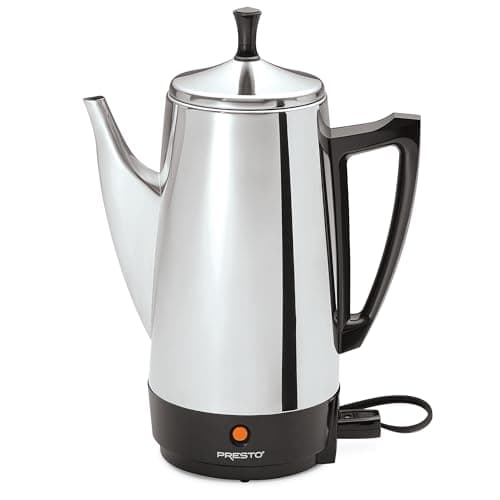
Presto Presto 02811 Stainless Steel Electric Percolator (12-Cup)
Presto 02811 Stainless Steel Electric Percolator (12-Cup)

The percolator that takes the one hard part — timing the perk — out of your hands. Plug it in and it brews, senses when the coffee is ready, then automatically drops to a keep-warm setting so it does not keep perking into bitterness. No stove, no watching, no thermometer. At 12 cups it is built for a full breakfast table or an office, and the stainless body wipes clean. It gives up the go-anywhere freedom of a stovetop pot for the freedom of not having to think about it.

Best electric
7.6
$76.79Amazon
04
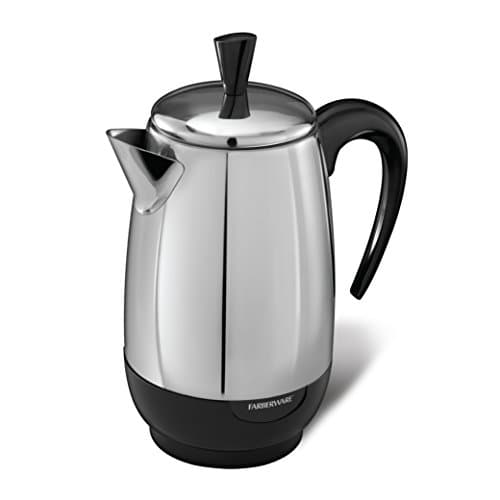
Farberware Farberware Electric Coffee Percolator (8-Cup)
Farberware Electric Coffee Percolator (8-Cup)

The value electric — the same set-and-forget convenience as the Presto in a smaller, cheaper package. It brews on its own, keeps the pot warm automatically once it is done, and adds a no-drip spout that makes pouring cleaner than most percolators manage. At 8 cups it suits a household rather than an office, and it costs less than the 12-cup Presto. If you want a plug-in percolator and do not need to brew for a crowd, this is the sensible buy.

Best value electric
7.4
$64.79Amazon
05
Farberware Farberware Classic Yosemite Percolator (12-Cup)
Farberware Classic Yosemite Percolator (12-Cup)

The larger Yosemite — the same trusted stainless stovetop pot as our top pick, scaled up for a crowd. If your mornings mean several cups, a full breakfast table, or a cabin full of people, the 12-cup handles the volume the 8-cup cannot while keeping the durability, the clear watch-knob and the go-anywhere flexibility that make the Yosemite worth owning. The only trade is that a bigger pot takes longer to perk and asks a little more attention so you do not overdo it.

Best for a crowd
7.2
$34.99Amazon
06
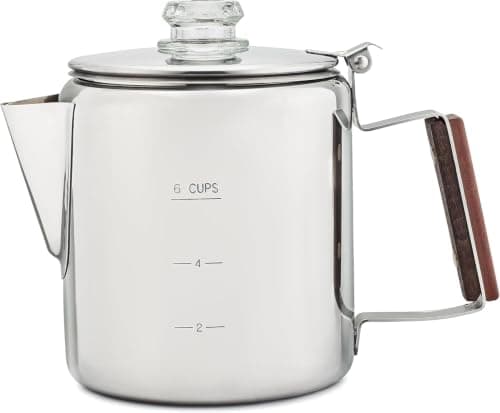
COLETTI COLETTI Bozeman Percolator (6-Cup)
COLETTI Bozeman Percolator (6-Cup)

The compact Bozeman, built for the trail and the small kitchen. It carries the same food-grade stainless construction and aluminum-and-plastic-free brew path as its 9-cup sibling in a smaller, lighter pot that suits one or two drinkers and packs easily for backpacking or a weekend campsite. You pay a premium per cup for a small pot of this quality, but for someone who wants the best-made percolator for solo mornings or the trail, it is the right size of a very good thing.

Best for camping / small
7.0
$32.79Amazon

#ad · Live prices from the Amazon Product API, as of Jul 27, 2026. Where we have no verified live price, we show none — a gap beats a number that has rotted.

In detail

The picks, in full

01
Farberware Farberware Classic Stainless Steel Yosemite Percolator (8-Cup)

Best overall stovetop

Farberware Classic Stainless Steel Yosemite Percolator (8-Cup)

Stainless steelStovetop (any burner)8-cup capacityClear brew-view knob
8.4/10

The percolator most people picture when they hear the word, and the one we would hand a first-time buyer. A one-piece stainless body with a permanent basket and stem, a clear knob on the lid so you can watch it perk and pull it at the right moment, and a size that suits a couple or a small household. It works on any stovetop, cleans up in seconds, and it is close to unbreakable. It will not out-nuance a pour-over, but it makes an honest, strong old-fashioned cup and it will do it for decades.

Build quality
8
Coffee character
8
Ease of use
8
Versatility
9
Value
9

Pros

  • Classic all-stainless build with a permanent basket and stem — no filters, no pods, almost nothing to wear out
  • Clear knob on the lid lets you watch it perk so you pull it off the heat before it over-extracts
  • Works on gas, electric and standard stovetops, and packs happily for a cabin or campsite
  • 8-cup size fits a couple or a small household without brewing a wasteful full pot
  • Genuinely inexpensive for a stainless pot that lasts for years

Cons

  • Perks hard, so it will taste bitter if you use a fine grind or forget it on the heat
  • No temperature control or timer — you have to stand by it and pull it at the right moment
  • Thin stainless base can run hot fast on a powerful burner, which makes over-perking easy

Don't buy this if…

you want a set-and-forget machine or the clarity of a filter brew — an electric percolator or a good drip maker suits you far better.

$33.08View on Amazon

$34.995% off

Price as of Jul 27, 2026. Prices change — Amazon's at checkout is the one that counts.

#ad · we may earn a commission from this link to Farberware Classic Stainless Steel Yosemite Percolator (8-Cup)

02
COLETTI COLETTI Bozeman Percolator (9-Cup)

Best premium stovetop

COLETTI Bozeman Percolator (9-Cup)

Stainless steel (no aluminum/plastic in brew path)Stovetop (any burner)9-cup capacityGlass knob, filters included
8.2/10

The percolator for people who care that their coffee never touches aluminum or plastic. COLETTI builds the Bozeman from heavier food-grade stainless than the classic Farberware, with no aluminum or plastic anywhere in the brew path, a solid feel in the hand, and paper filters included if you want to cut the sediment. It is aimed squarely at campers and home users who want the best-made stovetop pot rather than the cheapest, and it delivers on that — you pay more, and you can feel where the money went.

Build quality
9
Coffee character
9
Ease of use
7
Versatility
9
Value
7

Pros

  • Heavier food-grade stainless than the budget pots, with a genuinely solid, built-to-last feel
  • No aluminum or plastic anywhere the coffee flows — a real draw for people who care about the brew path
  • Includes paper filters, so you can cut the sediment percolators are known for if you want a cleaner cup
  • 9-cup size and a rugged build make it a favorite for both the kitchen and the campsite
  • Glass knob lets you watch the perk and time the pull

Cons

  • Costs noticeably more than the classic Farberware for what is still a stovetop percolator
  • Still over-extracts if you grind fine or over-perc — better materials do not change the physics
  • Heavier to pack than a thin stainless pot, which matters if you count grams for backpacking

Don't buy this if…

you just want the cheapest pot that makes coffee, or you would rather plug something in and walk away — the extra spend is about materials, not convenience.

$35.89View on Amazon

Price as of Jul 27, 2026. Prices change — Amazon's at checkout is the one that counts.

#ad · we may earn a commission from this link to COLETTI Bozeman Percolator (9-Cup)

03
Presto Presto 02811 Stainless Steel Electric Percolator (12-Cup)

Best electric

Presto 02811 Stainless Steel Electric Percolator (12-Cup)

Stainless steelElectric (plug-in)12-cup capacityAutomatic keep-warm
7.6/10

The percolator that takes the one hard part — timing the perk — out of your hands. Plug it in and it brews, senses when the coffee is ready, then automatically drops to a keep-warm setting so it does not keep perking into bitterness. No stove, no watching, no thermometer. At 12 cups it is built for a full breakfast table or an office, and the stainless body wipes clean. It gives up the go-anywhere freedom of a stovetop pot for the freedom of not having to think about it.

Build quality
8
Coffee character
7
Ease of use
9
Versatility
6
Value
8

Pros

  • Brews automatically and switches itself to keep-warm, so it will not over-perc while you are distracted
  • No stove needed — ideal for an office, a party, or a kitchen with limited burners
  • 12-cup capacity handles a crowd or a long morning of refills in one go
  • Stainless body with a detachable cord makes it easy to fill, pour and clean
  • Consistent results without any technique — the machine handles the timing you would otherwise have to

Cons

  • Tied to an outlet, so it loses the camp-stove and off-grid versatility that is the whole point of a percolator
  • 12 cups is a lot of coffee if you usually brew for one or two
  • More parts and electronics to eventually fail than a solid one-piece stovetop pot

Don't buy this if…

you want a pot for camping or off-grid use, or you only ever brew a cup or two — a stovetop percolator or a smaller maker fits that better.

$76.79View on Amazon

Price as of Jul 27, 2026. Prices change — Amazon's at checkout is the one that counts.

#ad · we may earn a commission from this link to Presto 02811 Stainless Steel Electric Percolator (12-Cup)

04
Farberware Farberware Electric Coffee Percolator (8-Cup)

Best value electric

Farberware Electric Coffee Percolator (8-Cup)

Stainless steelElectric (plug-in)8-cup capacityKeep-warm + no-drip spout
7.4/10

The value electric — the same set-and-forget convenience as the Presto in a smaller, cheaper package. It brews on its own, keeps the pot warm automatically once it is done, and adds a no-drip spout that makes pouring cleaner than most percolators manage. At 8 cups it suits a household rather than an office, and it costs less than the 12-cup Presto. If you want a plug-in percolator and do not need to brew for a crowd, this is the sensible buy.

Build quality
7
Coffee character
7
Ease of use
9
Versatility
6
Value
8

Pros

  • Automatic brew-then-keep-warm cycle means no watching and no over-perking
  • No-drip spout pours more cleanly than the typical percolator lip
  • 8-cup size fits a household without the leftover waste of a 12-cup pot
  • Costs less than the larger Presto while doing the same core job
  • Stainless body and simple controls make it easy to live with day to day

Cons

  • Like any electric percolator, it is tethered to an outlet and no use off-grid
  • Smaller capacity than the Presto if you regularly brew for a group
  • Keep-warm left on for hours will still cook the flavor flat, as it does on any percolator

Don't buy this if…

you need to brew for a full table or office, or you want a pot you can take camping — size up to the Presto or choose a stovetop model.

$64.79View on Amazon

$69.997% off

Price as of Jul 27, 2026. Prices change — Amazon's at checkout is the one that counts.

#ad · we may earn a commission from this link to Farberware Electric Coffee Percolator (8-Cup)

05
Farberware Farberware Classic Yosemite Percolator (12-Cup)

Best for a crowd

Farberware Classic Yosemite Percolator (12-Cup)

Stainless steelStovetop (any burner)12-cup capacityClear brew-view knob
7.2/10

The larger Yosemite — the same trusted stainless stovetop pot as our top pick, scaled up for a crowd. If your mornings mean several cups, a full breakfast table, or a cabin full of people, the 12-cup handles the volume the 8-cup cannot while keeping the durability, the clear watch-knob and the go-anywhere flexibility that make the Yosemite worth owning. The only trade is that a bigger pot takes longer to perk and asks a little more attention so you do not overdo it.

Build quality
8
Coffee character
7
Ease of use
6
Versatility
8
Value
7

Pros

  • 12-cup capacity brews for a full table, a group of guests or a cabin in one pot
  • Same durable all-stainless Yosemite build and clear watch-knob as the 8-cup
  • Works on any stovetop and packs for camping, so a big group off-grid is covered
  • No filters or pods and very little to wear out, exactly like its smaller sibling

Cons

  • A large batch takes longer to come up to the perk and is easier to over-extract
  • Twelve cups is wasteful if it is usually just you — brew size should match the household
  • Bigger and heavier to store and handle than the 8-cup

Don't buy this if…

you mostly brew for one or two — the 8-cup Yosemite makes a fresher, right-sized pot without the leftover waste.

$34.99View on Amazon

$44.9922% off

Price as of Jul 27, 2026. Prices change — Amazon's at checkout is the one that counts.

#ad · we may earn a commission from this link to Farberware Classic Yosemite Percolator (12-Cup)

06
COLETTI COLETTI Bozeman Percolator (6-Cup)

Best for camping / small

COLETTI Bozeman Percolator (6-Cup)

Stainless steel (no aluminum/plastic in brew path)Stovetop (any burner)6-cup capacityCompact, camp-friendly
7.0/10

The compact Bozeman, built for the trail and the small kitchen. It carries the same food-grade stainless construction and aluminum-and-plastic-free brew path as its 9-cup sibling in a smaller, lighter pot that suits one or two drinkers and packs easily for backpacking or a weekend campsite. You pay a premium per cup for a small pot of this quality, but for someone who wants the best-made percolator for solo mornings or the trail, it is the right size of a very good thing.

Build quality
9
Coffee character
8
Ease of use
6
Versatility
7
Value
5

Pros

  • Same high-grade stainless and aluminum-free brew path as the bigger Bozeman, in a packable size
  • Compact 6-cup capacity is right for one or two drinkers with no wasted brew
  • Rugged, filter-friendly build made for camp stoves, fires and the trail
  • Light enough to carry where a 9- or 12-cup pot would be dead weight

Cons

  • Priciest pot here per cup — you pay premium-stainless money for a small vessel
  • Small capacity means back-to-back pots if you are brewing for more than two
  • Over-extracts on a fine grind or a long perk like every percolator, quality build or not

Don't buy this if…

you brew for a household or a crowd, or you want the most coffee per dollar — a larger pot or the classic Farberware makes more sense.

$32.79View on Amazon

Price as of Jul 27, 2026. Prices change — Amazon's at checkout is the one that counts.

#ad · we may earn a commission from this link to COLETTI Bozeman Percolator (6-Cup)

How we picked

Every pot here is a real, currently-purchasable percolator, and we ranked them for what a percolator is actually good at — making a strong, reliable cup with almost no fuss, anywhere — rather than judging them against a specialty pour-over they were never meant to be. Five things decided the order.

  1. Build quality and durability. Longevity is half the reason to buy a percolator, so heavy, all-stainless construction with a solid basket and stem counted for a lot. A pot you buy once and use for decades is the point.
  2. Coffee character.A percolator will never be delicate, but the good ones make a clean, full, robust cup rather than a harsh one — helped by materials that keep aluminum and plastic out of the brew path and by a design that lets you time the perk.
  3. Ease of use. The one hard part of a percolator is not letting it over-perc. Electric models that time it for you scored well here; stovetop pots with a clear watch-knob scored better than blind ones.
  4. Versatility.Working on a camp stove, an open fire or an off-grid cabin is a percolator's superpower, and stovetop pots keep it. Electric pots trade it for set-and-forget convenience, which is the right trade for some people and the wrong one for others.
  5. Value and size.The cheapest pot is not automatically the best value, and the biggest is not automatically the most useful. We rewarded the pot that fits an actual household's brewing at a fair price.

What we did not test

We did not run these percolators through a lab. There is no measured extraction-yield chart here and no side-by-side timed brew log — our scores come from published manufacturer and retailer specifications, the physics of how a percolator brews, and aggregated owner feedback, exactly as our methodology explains. Treat the numbers as informed editorial judgment, not as readings off an instrument.

How to not make bitter percolator coffee

Almost everyone who says they hate percolator coffee has had it made badly, and the fix is two habits. First, use a coarse grind— coarser than drip, closer to what you would use in a French press. A percolator sends water through the grounds again and again, so a fine grind gives it far too much surface area to strip and the cup turns bitter and muddy; a coarse grind resists that and also keeps grounds from slipping through the basket into your coffee. If you grind your own, our grinder guide covers burr grinders that hold a consistent coarse setting instead of the dusty mix a blade grinder throws.

Second, do not over-perc.The moment the pot reaches a steady, gentle perking rhythm — you can see it through the glass knob — start your timer and give it only a few minutes, then pull it off the heat or unplug it. The longer it perks, the more it recirculates hot water through spent grounds and the more bitterness it drags out. Keep the heat moderate rather than blasting it, use roughly two tablespoons of grounds per cup as a starting point — our coffee-to-water ratio guidehelps you dial it in — and take it off before it over-extracts. Do those two things and a percolator makes exactly what it is meant to: a bold, warming, old-fashioned cup, not the burnt cliche.

Stovetop vs electric

This is the real choice, and it splits neatly. A stovetop percolator— the two Farberware Yosemites and the COLETTI Bozemans — works anywhere you can put it over heat: a gas or electric range, a camp stove, even coals or a fire. It has nothing to break electronically, packs for travel, and costs less. The catch is that it will happily over-perc if you walk away, so it wants your attention for the few minutes it brews.

An electric percolator— the Presto and the Farberware electric — plugs in, brews on its own, and automatically switches to keep-warm when the coffee is ready so it stops perking before it turns bitter. That set-and-forget behavior is genuinely useful for an office, a party or anyone who would rather not babysit a pot. The price is that it is tied to an outlet, so it gives up the go-anywhere freedom that is the whole reason many people buy a percolator in the first place. Pick stovetop for flexibility and camping; pick electric for hands-off convenience at home. There is no wrong answer, only which trade suits you.

Material and induction

Stick with stainless steel. Vintage and budget percolators are often aluminum, which is lighter and cheaper but reacts with coffee's acidity over time and puts a metal many buyers would rather avoid directly in the brew path. Every pick here is stainless, and the COLETTI Bozemans go further by keeping aluminum and plastic out of the parts your coffee touches entirely. One practical note if you have an induction cooktop: a stovetop percolator only works on induction if its base is magnetic, and not every stainless pot is, so check the specific model before you rely on it. An electric percolator sidesteps the question completely because it never sees your stove — another reason the plug-in pots suit an induction or burner-limited kitchen.

Percolator vs moka pot vs drip

It is worth being clear about what a percolator is not, because it gets confused with two other pots. A moka pot is a different animal: steam pressure pushes water up through the grounds a single time to make a small, intense, near-espresso brew. A percolator, by contrast, recirculates ordinary hot water through the grounds many times to fill a full pot with everyday coffee. And a drip machine drizzles water through a bed of grounds exactly once through a paper filter, which is why drip is cleaner and more nuanced and a percolator is bolder and rougher. Choose a percolator when you value durability, simplicity and off-grid reach over cup clarity.

Which percolator fits you

  • Want the one classic pot to start with?Farberware Yosemite 8-cup — durable stainless, works anywhere, priced right.
  • Want the best-made stovetop pot, no aluminum near the coffee? COLETTI Bozeman 9-cup.
  • Want to plug it in and forget it, for a group? Presto 02811, 12 cups with automatic keep-warm.
  • Want that same convenience for a household, for less? Farberware electric 8-cup.
  • Brewing for a crowd or a cabin off-grid? Farberware Yosemite 12-cup.
  • Camping, backpacking, or brewing for one or two? COLETTI Bozeman 6-cup.

Whichever you pick, a percolator is one of the most forgiving pieces of gear you can own — no filters to run out of, nothing much to break, and a strong cup on demand almost anywhere. Coarse grind, pull it at the perk, and it earns its place among the other ways to brew a pot at home.

How we picked

We did not lab-test this gear

Everyone in this category says they tested twenty machines. We have not pulled shots on every product here, and we say so. What we did instead: compiled the published specifications, cross-checked the manufacturer manuals, computed the running cost (wattage to energy, grams-per-shot to cost-per-cup), weighed aggregated owner reports, and scored each product against a published rubric. The scores are judgments from documented research — not measurements we took, because we do not have a test lab and we will not pretend we do. Where hands-on time would tell you more than a spec sheet, we flag it. Where a number came from someone else's work, we name them in Sources.

Questions

Frequently asked

Is percolator coffee good?
It is good at what it sets out to do: a strong, full-bodied, old-fashioned cup with no filters and almost no fuss. It will not give you the clarity or delicate flavor notes of a pour-over or a good drip machine, because it recirculates water through the grounds and extracts hard. But made correctly — coarse grind, pulled off the heat as soon as it perks — it is a genuinely satisfying, robust coffee that a lot of people prefer, and it is nearly foolproof to make anywhere.
Why is my percolator coffee bitter?
Almost always one of two things: the grind is too fine, or you let it perk too long. A percolator sends water through the grounds over and over, so a fine grind gives it far too much to strip and the coffee turns bitter and astringent, and every extra minute of perking drags out more of the same. Switch to a coarse grind, keep the heat moderate, and pull the pot off the burner or unplug it within a few minutes of it reaching a steady perk.
What grind should I use for a percolator?
Coarse — coarser than you would use for drip, roughly what you would grind for a French press. A coarse grind resists the percolator's repeated recirculation so the cup does not over-extract, and the larger particles are less likely to slip through the basket into your coffee. A burr grinder that holds a consistent coarse setting makes a real difference here.
Stovetop or electric percolator — which is better?
Neither is better outright; they suit different people. A stovetop percolator works anywhere you can apply heat — range, camp stove, even a fire — costs less, and has nothing electronic to fail, but you have to watch it so it does not over-perc. An electric percolator plugs in, brews on its own, and switches itself to keep-warm so it stops before it turns bitter, which is ideal for an office or hands-off use at home — but it is tied to an outlet and gives up the go-anywhere flexibility. Pick stovetop for camping and versatility, electric for set-and-forget convenience.
How long do you percolate coffee?
Not long — that is the biggest mistake people make. Once the pot reaches a steady, gentle perking rhythm (you can watch it through the glass knob), let it go only about five to eight minutes on moderate heat, then take it off or unplug it. Perking harder or longer just recirculates hot water through spent grounds and pulls out bitterness. An electric percolator handles this for you by cutting to keep-warm automatically; on a stovetop pot, you are the timer, so keep an eye on it.

Keep reading

Receipts

Sources

We do not run a testing lab, and we do not pretend to. Where a measured number came from someone else's work, we name them and link them. Where we could not verify something, we say so on the page rather than quietly leaving it out. Read our full method.